

With manual lead qualification, by the time a sales rep reaches out to a prospect, there’s a chance that your competition has already closed a deal with them.
This is why AI lead qualification has become the new standard for inbound engagement. Revenue teams need it to instantly qualify leads and route them to the right sales team. That said, not all AI tools are built the same.
Some tools simply bolt on AI features to handle basic responses and real-time availability. Others are AI-native, built with artificial intelligence at their core. These tools learn from buyer behavior, run deeper qualification algorithms, and guide each conversation in a way that lifts conversion rates instead of just automating qualification.
This shift is reshaping how modern go-to-market (GTM) teams operate. Understanding how AI-native lead qualification works and knowing how to evaluate the right platform helps you build a faster and more predictable pipeline. It also shows how leading companies are already redefining their lead flows with AI and setting a new benchmark for inbound engagement.
Key takeaways
Manual qualification breaks on volume and speed. CRM scoring rules and legacy chat tools automated the old process rather than fixing it, because both still run on rules someone defines in advance.
AI lead qualification works from the conversation itself. The agent applies your criteria while the buyer is still on the site, gathers signals like budget, timeline and use case, then books the meeting or routes the lead.
AI-native is not the same as AI-added. Tools built after LLMs use language models to read intent, while legacy tools fitted with AI features still run on rigid logic underneath.
Agents do not remove the rep. They take the early triage so reps enter conversations with context, and buyers still expect a human to confirm what the AI surfaced.
Why traditional lead qualification is breaking your pipeline
Having a lot of leads might seem like an advantage, but not all your leads are valuable; only the ones that convert are. The real goal, then, is to find your potential buyer who will convert.
The first step toward finding a potential buyer in inbound management is qualifying leads.
The old-school sales process of qualifying leads used to look like this: Your sales team received contact information through a form on your website, reached out manually, asked a few standard questions, and decided if the lead was worth pursuing.
This traditional lead qualification breaks your pipeline because it cannot keep up with the volume, speed, and personalization buyers expect today. With thousands of inbound leads landing on your site daily, it’s impossible for sales development representatives (SDRs) to engage everyone instantly. This delay often leads customers to choose another solution that answers their questions and books a meeting with them faster.
Customer relationship management (CRM) software tried to fix this by automating the lead qualification process with predefined rules. So, when visitors volunteer information in forms and surveys, the CRM captures and stores their data and uses that information to score leads.
While this helped, most teams still consider it insufficient because it relies on sales teams to build complex, pre-defined rule sets and user journeys.
Legacy chat tools came next. These also run on automated rules that the sales team set up in the backend. They also consider web user activity, such as page visits or clicks, when assigning scores.
They could greet visitors automatically and answer surface-level questions, but they couldn’t hold real, human-like conversations. People can spot robotic messages a mile away, and are often put off by them. So even though these tools were faster than reaching out manually, they weren’t efficient.
Today, the world runs on AI. AI gives software the ability to think, learn, and qualify leads intelligently. Modern AI-native tools like Spara are grounded in your own content, so they answer visitor questions in real time with full context. The agent personalizes each response using the user’s question and your own material. This is how you deliver the speed and personalization customers expect today.
Let’s break down what AI lead qualification is and how it impacts your pipeline.
What is AI lead qualification?
AI lead qualification uses artificial intelligence technology to identify which visitors are likely to become customers and route them to the right rep or schedule a meeting instantly.
Here’s how it works: You embed an AI chat agent on your site. When a visitor arrives and asks a question, the agent responds immediately. Because the agent has already read your own content, it answers with full business context.
Additionally, your team defines the prequalification criteria for your business. How do you define your ICP, and what ultimately qualifies as a lead? Those criteria might include company size, industry, or annual recurring revenue (ARR), or even signals like monthly website traffic. The AI agent uses these criteria to ask the right prequalifying questions, gather the necessary signals, and determine whether a lead is qualified.
Qualified buyers can be shown a calendar to book a meeting immediately, eliminating the back-and-forth that slows deals down.
Disqualified leads can be moved into your self-serve motion, handed off to customer service, or politely removed from your sales queue.
With this approach, your sales team no longer has to manually reach out to every visitor or guess who’s worth their time. AI handles this, and instantly directs qualified leads to the right human agents.
Key benefits of AI lead qualification for GTM leaders
Every minute your sales team spends chasing the wrong lead is a minute lost on one that could’ve closed. AI lead qualification adds speed and automation to your GTM workflows, helping you streamline and optimize sales cycles. Here’s what it unlocks:
Accelerated revenue growth
Trained on massive datasets, AI tools can recognize patterns in buyer behavior and spot potential conversions. They guide qualified buyers with personalized conversations while also collecting the key details about the lead needed to eventually close the deal.
When a qualified lead is ready, the AI agent books a meeting with your rep. It also passes all gathered information to the rep so they enter the meeting with full context and a clear plan. They know the customer’s pain points and requirements, which helps them personalize the discussion and increase conversion rates. Buyers want that handoff: in a 2025 Gartner survey of 646 B2B buyers, 69% said they prefer to validate AI-generated insights with a sales rep.
Increased marketing ROI
You invest heavily in marketing, advertising, campaigns, and events to drive inbound lead generation. But if your site doesn’t engage website visitors or your reps can’t identify which leads are truly qualified, your marketing dollars go to waste.
AI-driven lead engagement solves this. It interacts with every visitor, answers their questions, and gathers context in real time. From those interactions, it identifies who meets your qualification criteria and routes the marketing qualified leads (MQLs) to your sales team. Your reps can then focus on converting qualified buyers and driving revenue.
Speed-to-lead
When a lead fills out a form, their buying intent is at its peak. In traditional setups, sales representatives take hours or even days to follow-up. By then, the lead’s interest has likely faded, or they’ve talked to (or maybe even bought from) a competitor.
Conversational AI eliminates that lag, and the sales you lose because of it. As soon as a new lead lands on your site, a chat agent starts an instant, personalized conversation.
These real-time interactions engage the lead and create urgency to book a meeting or connect with the right sales rep right away.
How AI changes the lead qualification workflow
Factor | Manual lead qualification | AI lead qualification |
Speed | Hours to days | Seconds |
Explainability | Easy to understand based on pre-defined rules | Uses historical data and advanced algorithms to qualify leads |
Bias | Prone to human bias and assumptions | Bias is measurable and correctable, not hidden in individual judgment |
Scalability | Limited to what your sales team can handle | Can process thousands or even millions of leads at once |
Pricing | Labor-intensive and costly | More cost-efficient |
Best for | High-value businesses like finance or real estate | High-volume businesses like SaaS or e-commerce |
Thousands of visitors land on your site every day, and your sales team just doesn’t have the bandwidth to reach out to all of them. So what happens? Delayed responses, missed opportunities, and lost lead data that could have guided smarter decisions.
On the other hand, AI-powered systems like Spara change this by engaging every visitor instantly. That engagement is more than a greeting. They ask intent-driven qualification questions, follow your business-defined criteria, and adapt the conversation based on the buyer’s answers. Instead of assigning static intent scores, Spara gathers real signals directly from the dialogue: budget, timeline, use case, pain points, and readiness.
These tools then route qualified leads to your sales reps and handle lower-value leads themselves through personalized conversations. The entire process happens in seconds, not days.
And the impact shows up where it matters most.
Speed-to-lead: AI responds instantly, connecting potential buyers with your team while their interest is still high.
Scalability: One AI system can manage thousands of leads at once, something no human team can match.
Always-on engagement: AI delivers intelligent, personalized responses to leads 24/7, whether it’s the middle of the night or at peak business hours.
What to look for in an AI lead qualification platform
Choosing the right AI lead qualification platform can make the difference between a tool that just automates workflows and one that actually drives conversions. Here are a few key factors to consider when evaluating your options.
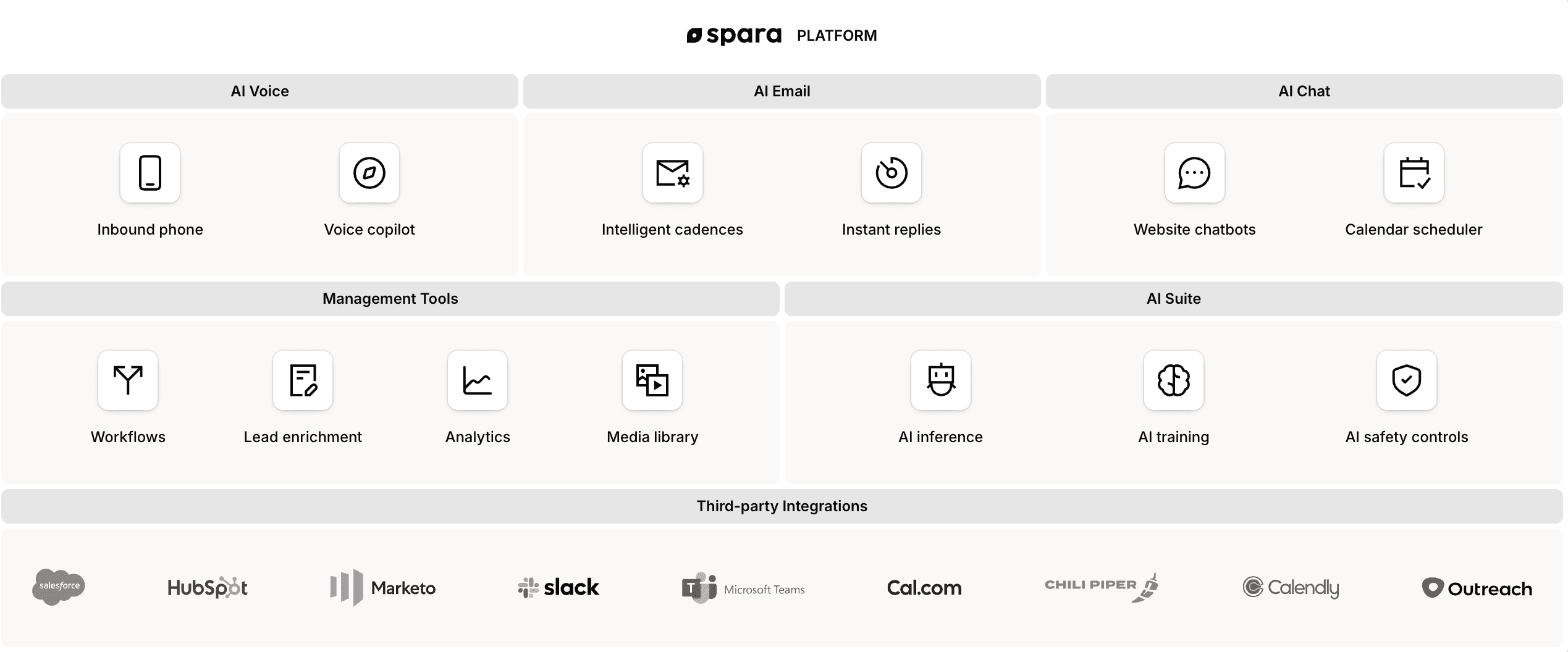
Spara AI GTM agent features
AI-native foundation
Before AI came into play, lead qualification tools simply automated what sales reps used to do manually with predefined scoring rules. They engage visitors through a conversational interface, but the backend follows a preset conversational flow and assigns points based on the visitor’s replies. For instance, if a company had over 1,000 employees, it got 10 points; if it matched certain industries, it earned more. Leads were then ranked by their total score.
When AI emerged, these legacy tools added AI as a feature rather than rebuilding their systems around it. These setups can mimic intelligence but still depend on rigid logic underneath.
That’s where AI-native platforms stand out. They’re built entirely on AI from the ground up, not patched on top of old software. Designed post-LLM, they use language models, embeddings, and semantic search to understand intent and context.
Because of this foundation, AI-native tools can personalize conversations, learn continuously, and adapt to future agentic AI advancements. So it’s best to choose a platform built after LLMs emerged, with AI embedded at its core.
Multi-channel engagement
Today’s buyers expect real-time engagement wherever they are, through chat, email, and voice. A good platform seamlessly connects across all these channels.
Look for an AI system that can drive personalized conversations across email, chat, and phone. Some advanced tools like Spara can even host live product demos and guide users through walkthroughs while answering questions like a real sales rep.
SOC 2 and GDPR compliance
An AI lead qualification tool will have direct access to your customer data. Since these tools process sensitive information, they must meet recognized security standards such as SOC 2 and comply with data privacy laws such as GDPR.
Here’s how to ensure compliance when choosing your tool:
Ask for certification: Verify that the vendor holds a current SOC 2 report and can supply its GDPR documentation.
Review data handling policies: Understand how the platform stores, accesses, and deletes customer data.
Check for transparency: Make sure you can audit or review their data protection practices anytime.
Personalized AI model
To qualify leads effectively, your GTM software should work from your own content and your own definition of a good lead.
Look at what your closed-won deals have in common, then write that into the agent’s qualification criteria. The platform applies those criteria in every conversation and reports back on which ones actually predict a meeting.
So, look for a GTM AI platform that works from your own material and your own qualification logic, rather than a generic model.
Real-world results: how companies are using AI to accelerate pipeline
Imagine your company growing faster than your sales team can handle. Leads pour in, forms fill up, and CRM alerts light the screen, but your reps struggle to keep pace.
By the time they contact a prospect, the buyer has already moved on.
This was exactly the challenge for Rho, a fast-growing financial platform. With inbound demand skyrocketing, their sales team couldn’t keep up. Thousands of potential customers slipped through the cracks simply because reps couldn’t respond fast enough.
To fix the problem, Rho turned to AI-driven lead qualification. They grounded Spara AI in their own material, including product tiers, buyer profiles and buying paths, to automatically qualify and route leads based on job title, company size, spending power, and use case.
The results speak for themselves. Rho lifted form-to-meeting conversion 3.1x, while SDR time per lead dropped by 60%.
Tommy McNulty, Chief Revenue Officer at Rho, says, “Now our reps only engage when it counts. And every lead gets a guided, high-conversion experience.”
A similar story played out at TinyMCE, a popular rich text editor. The team was attracting thousands of high-intent visitors each month, but by the time reps followed up, buyer interest had already faded.
After adopting AI-led engagement, they tripled their marketing qualified leads and now generate over $1 million in new pipeline every quarter.
These results prove that choosing the right AI lead qualification tool enables smarter, data-driven decision-making, increasing conversion rates rather than just automating workflows.
The future of AI in lead qualification: from automation to orchestration
AI has already changed how teams qualify leads, but this is just the beginning. The next wave is orchestration. Instead of isolated tools doing one job, agentic AI will coordinate your entire go-to-market workflow, connecting sales, marketing, and customer success in real time.
To get there, your lead qualification system needs to be AI-first, not a legacy tool with an AI patch. True orchestration comes from platforms built in the post-LLM era, with AI at their core from day one.
Tools like Spara are AI-native, built for the modern GTM motion post-LLM. Ready to see how Spara qualifies, routes, and converts your leads in seconds? Talk with Spara and experience the future of AI-driven lead qualification today.

Lauren ThompsonHead of Marketing, Spara
FAQs
Related posts
View all
GTM
Top 5 Drift alternatives in 2026 for better lead conversion
Drift is winding down and 1mind is the named successor, but it isn’t the only option. Five Drift alternatives compared, plus a migration checklist.
Oct 10, 2026
•
10 min read

GTM
Jon Harper on the four traps that stall complex deals before the proposal
Jon Harper's PEO reps closed 35 to 45% of the deals they proposed, but only 9% of first meetings ever got that far. The BizBenchmark founder breaks down the four traps that stall complex deals, and what to do instead.
Oct 9, 2026
•
4 min read

GTM
How Clay Built a Partner Motion That Drives 20% of Revenue
Nancy Mottice joined Clay as it moved from product-led growth into enterprise. Since then, partner-sourced revenue is up 16x and drives 20% of the business. Here are the six steps she took to get there.
Oct 9, 2026
•
7 min read
Sign up for the latest from Spara
Subscribe to get more GTM insights straight to your inbox.