
Static lead scores built years ago no longer match how your buyers evaluate software. Your sales team feels that pain every time a "hot" MQL never replies while an unscored inbound deal closes in a quarter.
AI lead scoring addresses that by giving you a way to rank demand based on real behavior and ICP fit, then connecting those signals to routing, SLAs, and handoffs that actually move pipeline.
This guide gives you a practical framework to design, deploy, and operate AI-led scoring as revenue infrastructure, and not a vanity metric.
What is AI lead scoring and why does it outperform traditional methods?
AI lead scoring predicts which leads are most likely to convert by learning from your historical conversion data and current buying signals.
Instead of assigning fixed points to actions, AI models evaluate patterns across multiple dimensions:
Behavioral engagement
Firmographic fit
Intent signals
Buying group activity
Product usage (for PLG or trial motions)
The result is a dynamic prediction of buying readiness for each lead or account.
Traditional scoring models rely on static rules such as:
"Visited pricing page = 10 points"
"Opened email = 5 points"
Those rules rarely get revisited, rarely reflect multi-threaded buying groups, and quickly lose credibility with sales. They also treat every action the same way, regardless of context or sequence.
Conversely, AI-driven models use machine learning to analyze far more context at once, including the order of activities, recency and frequency of engagement, ICP match, buying group activity, and product usage if you run a PLG or trial motion.
A recent B2B lead scoring model trained on CRM data from 2020 to 2024 illustrates this shift. Instead of assigning arbitrary point values, the model learned which combinations of behaviors, firmographic traits, and engagement patterns actually led to pipeline creation and closed-won deals.
The takeaway is that AI scoring doesn't just rank leads based on activity. It aligns scoring directly to revenue outcomes. As a result, scores become a reliable signal for sales teams, not just a marketing heuristic.
How AI lead scoring works for RevOps teams: data, signals, and outputs
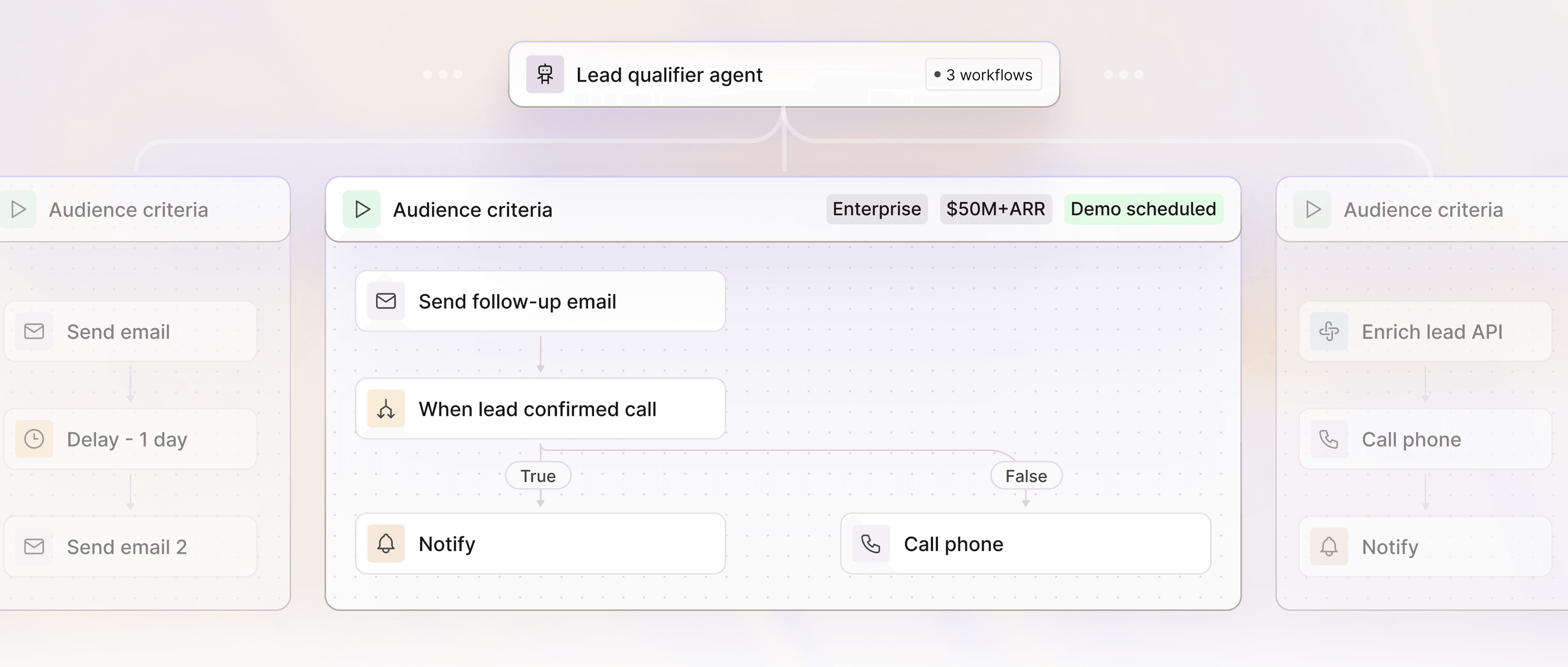
Understanding how AI lead scoring actually works helps you build a system you can trust and troubleshoot when it drifts. Every effective scoring system follows the same pattern: inputs that capture buying signals, a processing layer that converts those signals into a score, and outputs that connect directly to your GTM workflows.
Inputs: Buying signals and context
Your model is only as good as the data you feed it. For most B2B teams, that includes:
CRM and marketing automation: Contact and account records, campaign responses, email engagement, chat conversations, historical lifecycle stages, and opportunities
Website behavior: High-intent pages (pricing, integrations), content depth, visit frequency, and recency of sessions
Conversational signals: Intent data captured through real-time chat, voice, and text interactions, including questions asked, topics raised, and engagement depth, gives you a more dynamic and immediate view of buyer readiness than form fills or page views alone.
Product usage (if applicable): Trial activation milestones, feature adoption, login frequency, and user growth within an account
Firmographic and ICP attributes: Industry, employee range, revenue band, region, and tech stack
Third-party intent: Topic consumption, competitor research, and buying group activity from providers you already use
The same B2B lead scoring model research confirms that combining behavioral, firmographic, and engagement signals produces materially better predictions than relying on any single source.
Processing: Turning inputs into a score or tier
The processing layer ingests these inputs and outputs a prioritization signal: a numeric score, letter grade, or tier such as hot, warm, or nurture. Machine learning identifies which patterns historically correlate with real conversion events in your GTM motion, then updates those relationships over time as your market and product change.
Outputs: Scores that your GTM team can act on
Outputs are where AI lead scoring translates into pipeline. You write scores and tiers back to your CRM and connect those values to routing, SLAs, and outreach workflows. High scores might push a lead directly to an AE queue, while lower scores might trigger nurture programs.
Treat the scoring engine as the source of prioritization signals, and treat your CRM and engagement stack as the execution layer that turns those signals into meetings, opps, and revenue.
Step-by-step AI lead scoring implementation for revenue teams
A phased rollout lets you prove impact on a controlled segment, then scale with confidence as you see real conversion lift.
Step 1. Define conversion events and success metrics for your GTM motion
Start by aligning on what "conversion" actually means in your motion. For most B2B teams, the meaningful events are MQL to SQL progression, sales accepted lead (SAL) creation, first qualified meeting, opportunity creation, and closed-won deals. Those are the outcomes your AI lead scoring model should be trained and evaluated against.
Map your current inbound funnel and document the stages where better prioritization or faster follow-up would have the most impact. Then capture baselines, such as current MQL to SQL rate, average time from form fill to first touch, meeting creation rates, and the share of pipeline sourced from inbound programs.
To do that, here are the key questions to answer:
Which behaviors usually appear just before a qualified opportunity is created?
Which firmographic attributes show up most often in your strongest deals?
Where are reps complaining about "bad" MQLs or missed high-intent signals?
AI scoring should optimize for pipeline quality, not marketing engagement metrics.
Step 2. Connect and clean your revenue data sources
Connect every system that holds intent signals or conversion outcomes and clean them so the model can learn from consistent patterns rather than noise.
At minimum, connect:
CRM for lifecycle stages, opportunity history, conversion timestamps, and account hierarchy
Marketing automation for campaigns, email engagement, forms, and lead source
Web analytics for page views, session depth, and content interactions
Product analytics for usage-based motions, such as trials and freemium
Enrichment and intent tools for firmographic and third-party buying signals
Before you score anything, run a quick data audit. Check that key ICP fields are populated, timestamps allow you to calculate time-to-contact and time-to-opportunity, and lifecycle stages move forward logically.
Clean data is not a one-time project. Therefore, assign RevOps ownership for ongoing data governance to prevent scoring models from drifting over time.
Step 3. Activate scores in workflows and run controlled testing
With connected data and an initial model in place, prove that AI lead scoring beats your current approach through a controlled rollout rather than a full switch overnight.
First, record the score and tier in your CRM as clearly documented fields, and define the actions associated with each tier in advance:
High-priority leads: Route instantly to a dedicated sales queue with aggressive SLAs. At the same time, trigger real-time outreach workflows, such as instant meeting booking prompts, AI-driven chat engagement, or automated SDR follow-ups, to capitalize on peak intent.
Medium-priority leads: Enroll in accelerated nurturing sequences that combine marketing automation with SDR touches. Use AI workflows to personalize outreach based on behavior signals (e.g., pages viewed, use case interest) and dynamically adjust messaging as intent increases.
Low-priority leads: Route into long-term nurture workflows or disqualify based on ICP criteria. These leads should still receive periodic, low-effort engagement through automated campaigns, ensuring no potential opportunity is lost if intent changes over time.
Next, run an A/B or holdout test. Apply AI lead scoring to a defined subset of inbound leads and keep another subset on your existing logic. Measure differences in MQL to SQL rates, meetings held, opportunity creation, and velocity through the funnel.
If high-scoring leads are not converting better than the rest, investigate whether the issue is model quality, data gaps, or follow-up execution. Only expand coverage once you see clear improvement against your baselines.
Operationalizing AI lead scores for pipeline acceleration
A score in a field does nothing by itself. To accelerate the pipeline, you need clear rules for routing, prioritization, and SLAs, along with a plan to keep the model accurate as your GTM motion evolves.
Turn scores into action through routing and prioritization
Design how each score tier translates into action before you roll out AI lead scoring broadly. Your goal is to direct your most expensive resources toward the highest intent buyers while still giving mid-tier leads structured attention.
Here's an example framework:
Send top-tier leads directly to an AE or senior SDR queue with a strict response SLA.
Route mid-tier leads to SDRs with a defined cadence of email, call, and chat touchpoints.
Move low-fit or low-intent contacts into nurture programs or mark them as out of ICP.
All actions should be triggered automatically based on the score, rather than relying on manual judgment. You can use Spara workflows to set up CRM assignment rules, sequences, and playbooks that interpret the score and tier fields and respond accordingly.
As a result, you instantly engage, qualify, and route leads through real-time chat, email, text, or voice outreach, ensuring high-intent prospects are acted on the moment they show buying signals.
Spara also sits across both the signal capture and activation layers, helping you not just act on scores, but improve them over time.
First, Spara captures high-intent signals directly from inbound interactions, like website visitors engaging via chat, text, or voice, revealing who buyers are, what they care about, and how ready they are to purchase. These real-time insights can feed directly into your lead scoring model, giving you a more accurate and dynamic view of intent than static form data alone.
Then, once scores and audiences are defined, Spara powers the activation layer, including triggering workflows that engage, qualify, and convert leads automatically. Based on score and behavior, leads can be qualified in real time, booked into meetings instantly, or routed into personalized nurture sequences.
Maintain score accuracy with performance monitoring
Even a strong AI lead-scoring model will drift if you do not monitor its performance. Track three things regularly:
Score distribution: how many leads fall into each tier and how that mix changes over time
Conversion by tier: MQL to SAL, SAL to opportunity, and opportunity to closed-won for each score band
SLA adherence: whether high-priority leads receive the response speed and quality you designed
Use those views to adjust thresholds and, when necessary, retrain or recalibrate the model. The B2B lead-scoring model research evaluated accuracy across multiple years of CRM data, underscoring the need for long-term monitoring rather than a one-time post-launch check.
Assign joint ownership for this review process. RevOps manages data and model performance, Marketing validates that high scores map to high-quality demand, and Sales flags edge cases where scores do not reflect on-the-ground reality.
AI lead scoring best practices for Marketing and RevOps leaders
Teams that see real impact from AI lead scoring treat it as part of their revenue foundation, connected to clear outcomes, data standards, and operating rhythms. Key principles include:
1. Anchor models to revenue outcomes
Design your model around events that matter, including SALs created, qualified meetings held, opportunities opened, and deals won. Train and evaluate using those labels, not proxies like email clicks. The machine learning lead scoring research demonstrates that models built on real conversion events deliver more reliable predictions than static rule sets, provided the labels are accurate.
2. Invest in data quality and governance
AI amplifies the quality of the data you give it. Define standard field values for industry, employee range, and segment. Enforce required fields at lead capture. Keep enrichment and intent integrations current. Make RevOps accountable for a documented data model so that when you change processes, you update scoring inputs at the same time.
3. Connect scores to routing logic and SLAs
A score should always trigger a specific, agreed-upon action. Document those actions by tier, then build them into CRM workflows and engagement tools. Platforms like Spara can help you operationalize this layer by using scores and intent to trigger coordinated workflows, such as:
Triggering AI voice or text outreach the moment a lead crosses a high-intent threshold
Adjusting email cadence and messaging based on real-time score changes
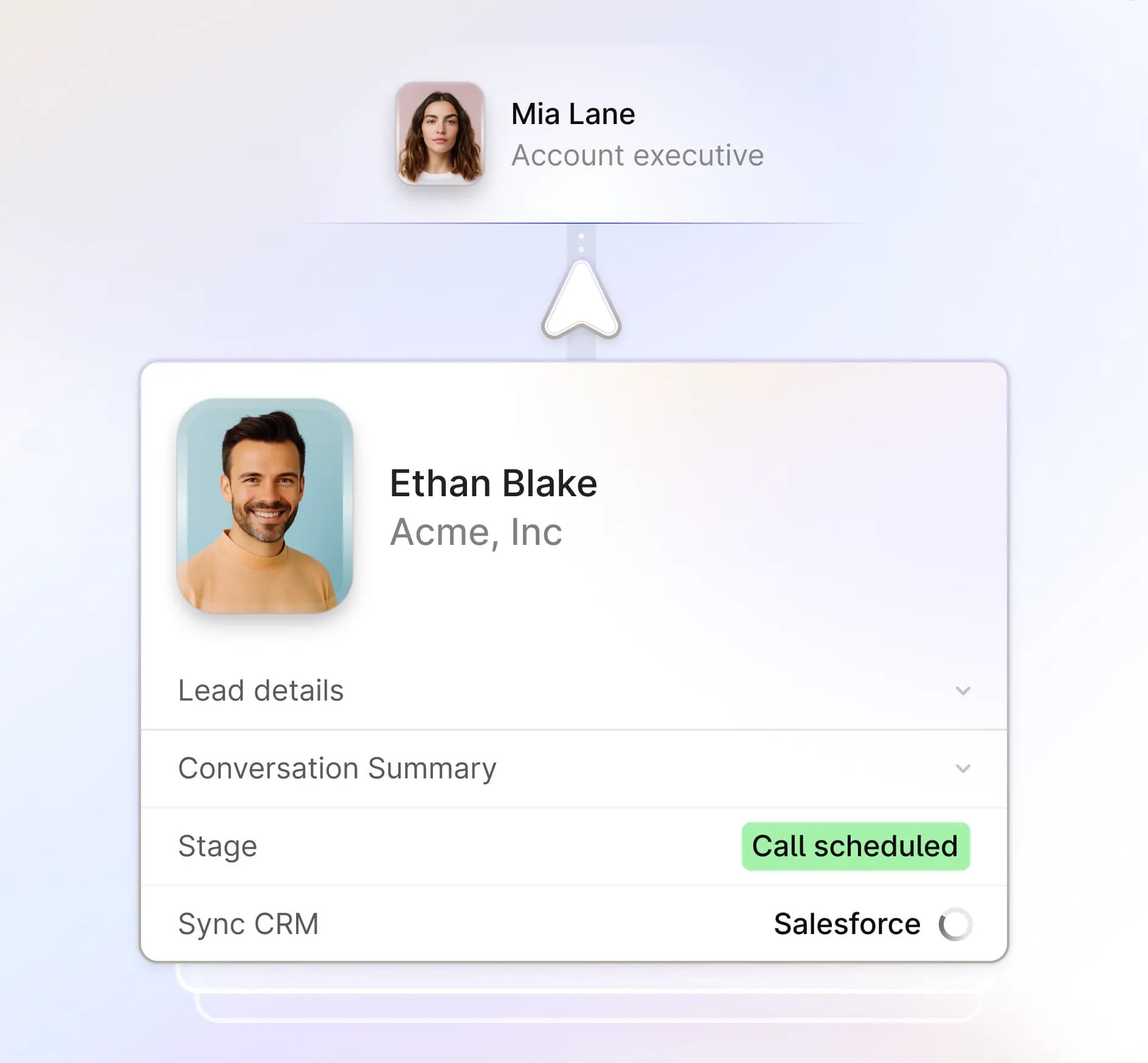
Notifying reps with full conversation context and a suggested next step
Moving leads automatically between nurture tracks as intent signals evolve
Re-engaging stalled opportunities when scoring signals renewed activity
These functions ensure every lead is acted on in the right way at the right time.
4. Review and recalibrate on a schedule
Set quarterly checkpoints to inspect score distributions, conversion by tier, and feedback from Sales. Use those reviews to adjust thresholds, update training data, or modify workflows. That discipline turns AI lead scoring into a durable asset that supports efficient growth rather than another forgotten RevOps project.
But even a well-calibrated model only delivers ROI if your team can act on its signals fast enough. Spara bridges that gap by reading scoring and intent signals in real time to instantly engage, qualify, and convert leads through automated conversations, intelligent routing, and meeting booking.
Downstream, Spara powers workflows like personalized follow-ups, dynamic nurture paths, re-engagement of stalled opportunities, and continuous CRM enrichment, ensuring every interaction moves pipeline forward.
Are your lead scores driving action or just sitting in a dashboard? See how Spara's GTM AI agents turn intent signals into fast follow-up, clean routing, and CRM-ready handoffs across chat, email, voice, and text. Book a demo.

Lauren ThompsonHead of Marketing, Spara
FAQ
Related posts
View all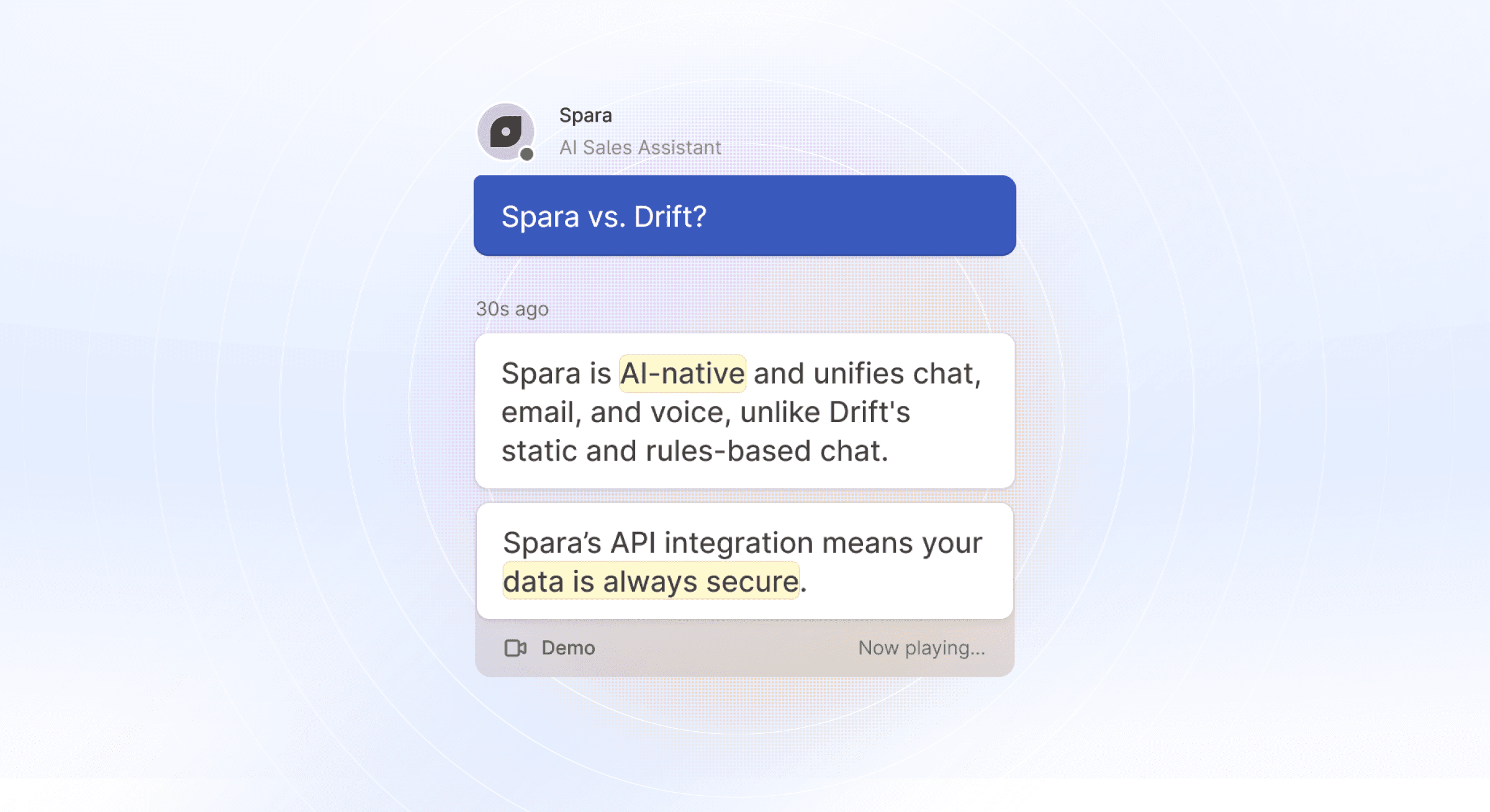
GTM
Top 5 Drift alternatives for better lead conversion
Drift alternatives drive more conversations, leads, and revenue growth. From AI chat to product demos, they personalize every stage of the customer journey.
Sep 14, 2026
•
10 min read

GTM
Databricks' Barry Dauber on why every project should start with impact, not AI
Barry Dauber runs Gen AI go-to-market at Databricks, talking companies down from AI hype every day. Here's his framework for scoping an AI project: name the metric, classify the initiative, and reserve the model for what actually needs one.
Sep 2, 2026
•
4 min read

GTM
How Clay's Head of GTM Engineering Took Event ROI From 2x to 10x
Everett Berry treats every dinner like a funnel. Here's the six-stage system — golden lists, leader-to-leader invites, engineered seating, automated follow-up — that took Clay's event ROI from 2x to 10x.
Aug 26, 2026
•
5 min read
Sign up for the latest from Spara
Subscribe to get more GTM insights straight to your inbox.