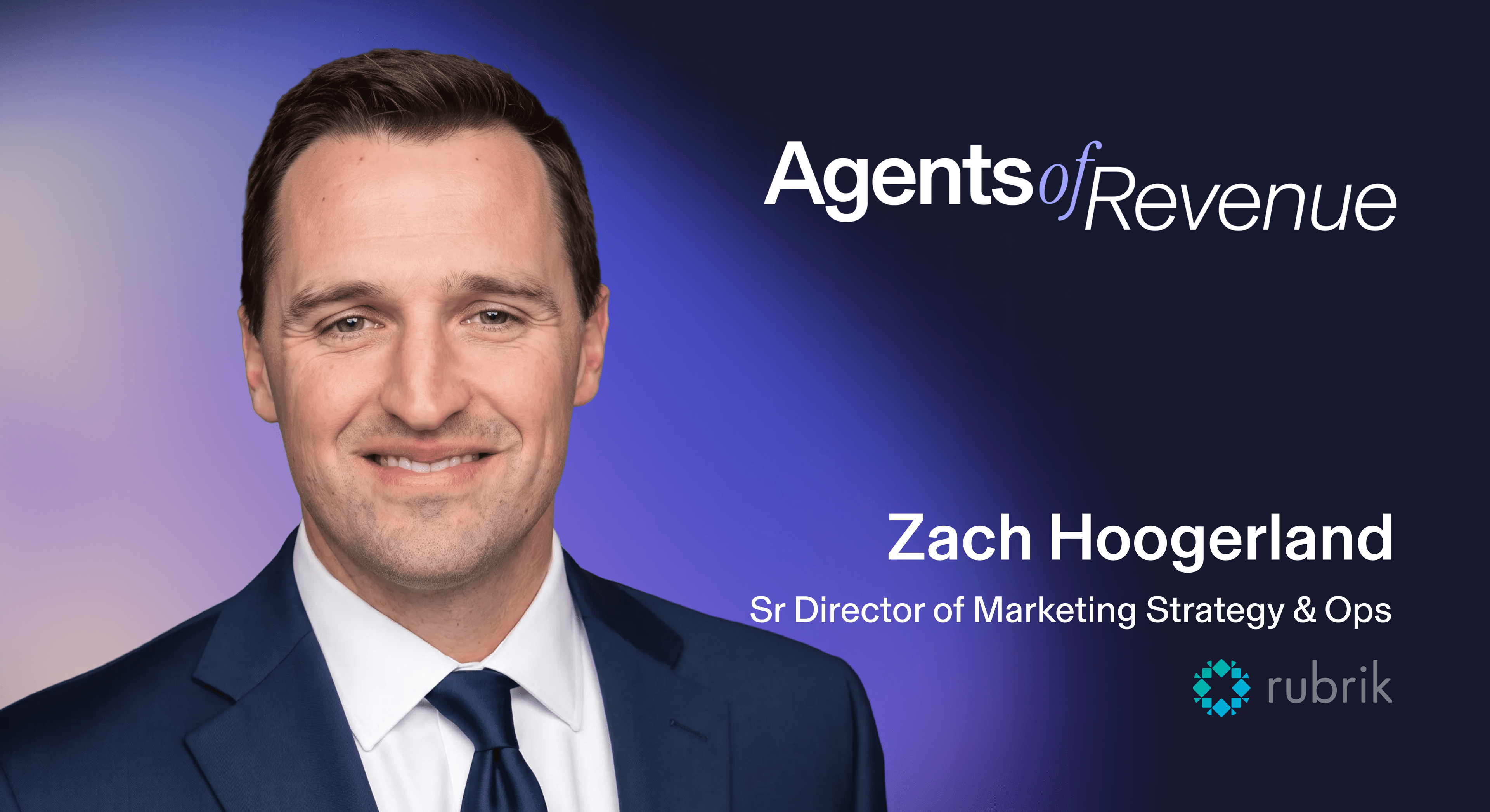

David Walker sits down with Zach Hoogerland, Sr. Director, Marketing Strategy & Operations at Rubrik, about what it means to be revenue obsessed
What you’ll learn
Every RevOps leader forecasts the sales team’s pipeline to the dollar, then guesses at what marketing will produce. Zach Hoogerland built a marketing pipeline forecast at Rubrik that his CMO, sales ops, and sales all trust, and took it from 10% to 80% confidence in a single quarter. If you run marketing, revenue, or ops, this one gets specific: the data under the forecast, and the change management that got his team to actually use it.
Marketing forecasting: How to turn field events, dinners, and conferences into predictable pipeline.
The adoption unlock: Why taking work away from the team is what got them to actually use it.
10% to 80%: How he built real forecast confidence and how he plans for the missing 20%.
The challenge
When Zach started, Rubrik had no reliable way to predict what marketing would produce, especially with their heavy emphasis on in-person events.
Marketing blind spot: Marketing was generating plenty of leads, but nobody could connect them to revenue in a way leadership could see and trust. There was no clear understanding of where to invest, where to pull back, or what to leave alone.
Untrustworthy CRM data: Marketing activity and spend both lived in Salesforce, but teams logged them inconsistently. No one could trust how current the data was, or tell whether the money going into a program was actually producing pipeline.
No predictability: The marketing number was directional at best, about 10% confidence off a rough model.
“Change management might be the single biggest rate limiter in a world where we have the tooling to move insanely fast.”

David WalkerCEO, Spara
What they did
Zach built a marketing forecast with the same rigor as a sales forecast. Every activity on the marketing calendar, each event, dinner, conference, and campaign, gets an expected conversion into leads, MQLs, and pipeline. The result is a marketing pipeline forecast leadership can actually see and trust. Here are the six moves that got him there.
Map the lead flow: Audit what your teams already log in Salesforce: the marketing activity, the leads it generates, and the spend behind it. Then trace one lead end to end: first touch, to qualified lead, to pipeline. Attach each program's cost, then calculate the conversion rate at every step. Those rates are the backbone of the forecast.
Forecast pipeline from planned activity: A sales forecast takes open deals, applies win rates, and projects what will close. Do the same with marketing. Take every event, dinner, conference, and campaign planned for the quarter, and apply the conversion rates from the previous step. Each one projects leads, then MQLs, then pipeline. Add them up and you get a single number: the pipeline marketing will produce this quarter, and where sales will need to engage.
Take work away from the field: Stop asking field marketers to forecast their own pipeline; analytics can model it better anyway. Leave them two jobs: log activity accurately, and flag the one or two things only they can see, like where sales is leaning in harder than the model expects. The counterintuitive part is that taking work off their plate is exactly what drove adoption. A system that asks less of people is the one they'll actually use.
Launch before the data is clean: The data won't be perfect, so don't wait on it. Ship the first version and work through it as a team to find the gaps. Keep the pressure off and accountability low. The goal of the first quarter is to make the data trustworthy, which includes coaching the people who aren't sure how to enter it. By the second quarter, you trust the inputs and start holding the team accountable. The test of accountability comes when you report the forecast to sales against what you committed: here's what we said, and did we deliver?
Build it with the team, not for them: Involve the whole team from the first version, from the CMO down to the people doing the hands-on work. Balance the science with the art: don't just model the data, bring in business context and market trends, the part analytics teams tend to skip. Shape the forecast together instead of handing over finished numbers. When the team builds it with you, they buy in and defend it, rather than treating it as something analytics dictated in a vacuum.
Run it on a two-week clock: Put the forecast on a fixed cadence. Every two weeks, the cross-functional team reviews it together off the shared dashboard and asks two questions: what's working, and what isn't. Sort every program into three buckets: invest more, cut, or hold steady. Then shift budget and effort toward what's converting and away from what isn't.
The outcome
10% to 80%: Forecast went from a guess to about 80% confidence in a single quarter, with two more to fully dial it in, work that would have taken over a year not long ago.
One shared number: The CMO, sales ops, and sales now run off the same forecast, with the hedge built in so they know where the missing 20% hides.
“We went from zero predictability, maybe 10%, to about 80% confidence in the number, in a single quarter.”

Zach HoogerlandSr. Director, Marketing Strategy & Operations, Rubrik
Episode highlights
1:12 - Rubrik in 30 seconds, and securing AI agents that go rogue
2:09 - The project: building a marketing pipeline forecast from scratch
4:36 - Forecasting field marketing: dinners, events, and conferences
5:44 - Where to start: taking inventory of the data you already have
7:39 - The best move in hindsight: taking work away from the team
8:50 - The real timeline, one quarter to build and two to dial in
10:53 - Giving the team permission to launch with imperfect data
13:15 - Going from 10% to 80% forecast confidence
15:42 - What’s next: purpose-built AI, not “AI everything”
20:29 - What he’s nervous and excited about long term
My two cents
Zach covered a lot of what I run into in my own conversations every week.
Marketing forecasting is an afterthought: Everyone forecasts sales down to the dollar, and almost nobody does the same for marketing. You can project your events and dinners the way you'd project a sales quarter. Hardly anyone does, and that's the opportunity.
Change management is the single biggest rate limiter: The tooling lets us move insanely fast now, but the people doing the work in the field can't always keep up. It's easy to trap your team in training mode all year, learning the next tool instead of doing the job. The real unlock isn't more tracking, it's taking work off their plate.
Stop waiting for perfect data: It still surprises me how many teams won't launch because their historical data isn't clean enough. That's backwards. Fresh data flowing in beats sitting still, and the longer you wait, the bigger the pile of problems gets.
Building is easy, keeping it alive is the hard part: It's easier than ever to build something and harder than ever to keep it worth having. People come to us wanting to deploy an agent, but six months in, what they value most is the stuff they never saw coming: the ongoing QA, the A/B testing, and rewriting the prompt every time their go-to-market shifts.
David WalkerCo-founder and CEO, Spara
Related posts
View all
GTM
Top 5 Drift alternatives for better lead conversion
Drift alternatives drive more conversations, leads, and revenue growth. From AI chat to product demos, they personalize every stage of the customer journey.
Sep 14, 2026
•
10 min read

GTM
Databricks' Barry Dauber on why every project should start with impact, not AI
Barry Dauber runs Gen AI go-to-market at Databricks, talking companies down from AI hype every day. Here's his framework for scoping an AI project: name the metric, classify the initiative, and reserve the model for what actually needs one.
Sep 2, 2026
•
4 min read
GTM
How Clay's Head of GTM Engineering Took Event ROI From 2x to 10x
Everett Berry treats every dinner like a funnel. Here's the six-stage system — golden lists, leader-to-leader invites, engineered seating, automated follow-up — that took Clay's event ROI from 2x to 10x.
Aug 26, 2026
•
5 min read
Sign up for the latest from Spara
Subscribe to get more GTM insights straight to your inbox.