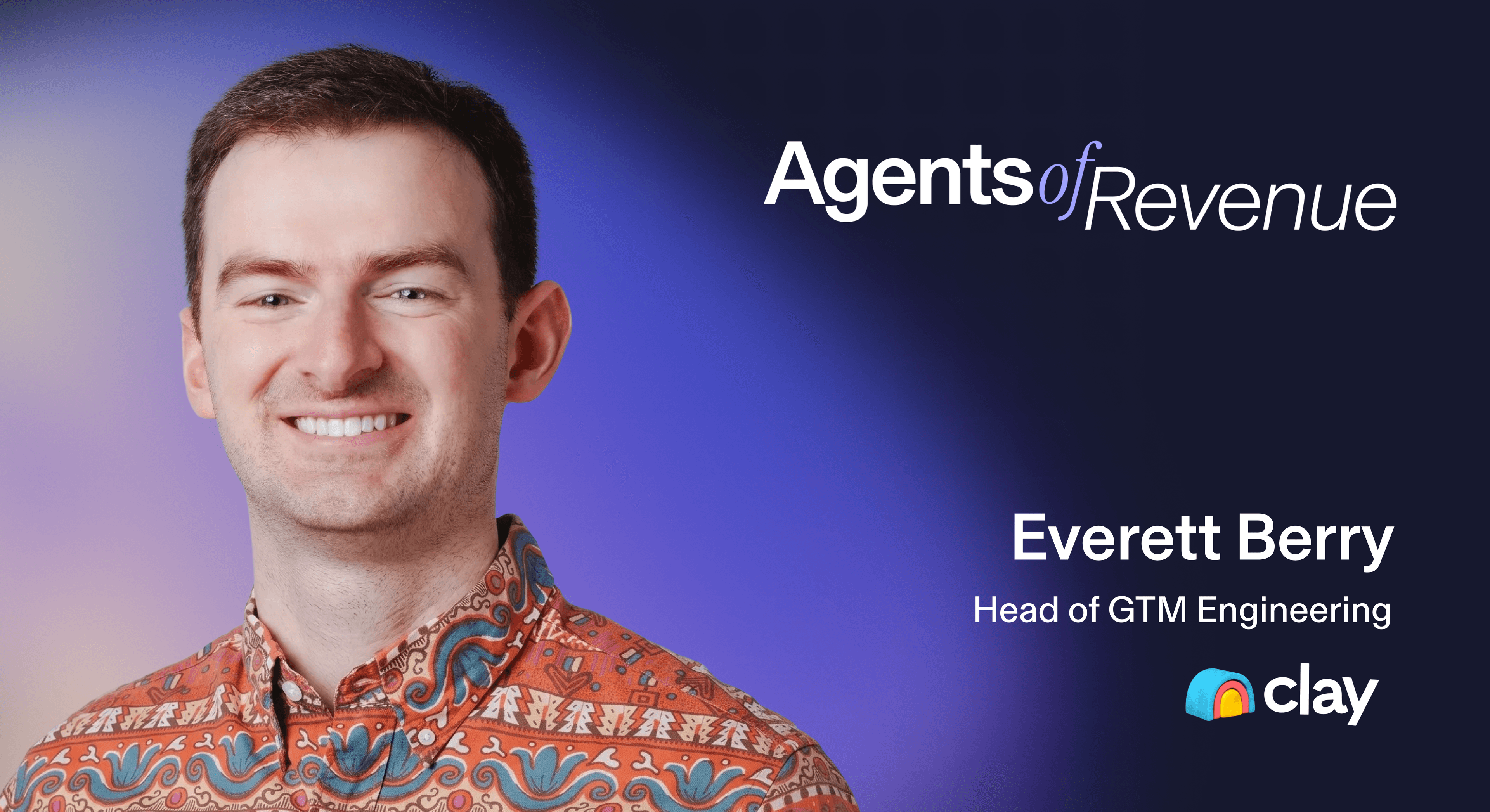

David Walker sits down with Everett Berry, Head of GTM Engineering at Clay, about what it means to be revenue obsessed
Everett Berry is a GTM engineer by role and by instinct. As Head of GTM Engineering at Clay, the company that coined the discipline, he turns manual go-to-market plays into systems you can measure and automate. So it's no surprise he treats an event like a funnel. He took event ROI from 2x to 10x by engineering every stage, from the invite to the follow-up.
The challenge
Clay's old way of filling a dinner was an internal Slack message to the sales team: ‘we're hosting in San Francisco in two months, who should we invite?’ Everett breaks down why that question is a problem, and where pipeline is lost at each stage that follows.
Reps don't see the whole pipeline: Rep-by-rep nominations surface only each rep's own deals, with their blind spots baked in. No individual rep has a bird’s-eye view of what the number requires: where coverage is short next quarter, or which accounts are the current priority.
Reps deprioritize the invite: They field 20 to 30 Slack messages a day, and the event is months out with any payoff four or five months later. Even when a rep does nominate someone, the invite still has to be executed and made compelling.
Outreach has to match seniority: A rep emailing a CRO early in the pipeline rarely lands; a leadership dinner requires leader-to-leader outreach. A large enterprise can assign three or four people to a single VIP at Dreamforce, but most companies lack that capacity.
Attendance is unreliable: Confirmed headcounts don't hold. Bad weather or last-minute drops can cut a room of 20 to 14, and lower turnout directly reduces the event's ROI.
Follow-up is inconsistent: After the event, table conversations often go unrecorded. The account owner never gets the context, so the opportunity stalls and the resulting pipeline is never logged.
Low ROI on events: Event pipeline runs through the same funnel as everything else and converts at the same rates, so much of it never closes. At a 2x spend-to-pipeline ratio, Clay was roughly breaking even on events, which made new investment on this channel hard to justify.
What they did
Everett rebuilt the event motion inside Clay, stage by stage, so pipeline stops leaking from invite to follow-up. Here are the six moves that took event ROI from 2x to 10x.
Build a golden list in a Clay Table: Replace the Slack blast with a standing list of exactly who Clay would seat at a dinner in each target city (New York, San Francisco, Chicago), maintained in a Clay Table and kept current. Keeping it fresh is the hard part of GTM engineering. With the list in place, 35 invites yield 19 or 20 acceptances that have the potential to create meaningful revenue. Invite selection becomes a centralized demand-gen decision made against this quarter's and next quarter's number rather than a rep-by-rep nomination.
Bring customers, matched to the prospects: The strongest events aren't all prospects. Clay deliberately invites customers into the room and pairs them with the prospects on the golden list, so each prospect has a relevant peer to hear from. The question isn't only who to invite, but which customers belong alongside which prospects.
Send the invites leader to leader: The host should be a senior leader, and the invite should come from the host. In Everett's example, Clay's COO, Varun, is hosting, so he emails, LinkedIn-messages, and sometimes texts the prospect CRO directly, while the rep works the champion one level down to reinforce it. The events team sends invites on the exec's behalf, or the exec's EA activates the outreach.
Run a confirmation sequence and backfill: Once people accept, send confirmation messages in the days leading up to the event. This catches cancellations early. If someone drops out 48 hours ahead instead of the day of, you have time to fill the seat from the golden list, so turnout holds and the ROI is protected.
Engineer the seating chart: Enrich every guest and seat them by shared business context. Don't put a Fortune 500 CRO next to a Series A CRO; two PE-backed healthcare CROs will have plenty to work through. Because good seating needs context, Clay built a seating-chart builder app that lets leadership set and lock the arrangement in advance, so the events team lays out the room to match instead of a leader rearranging it from memory.
Automate the follow-up off the seating chart: The seating chart identifies which Clay attendee sat with which prospects and customers. After the event, automations prompt that person (for example, Everett, who sat with three prospects and two customers) for what was discussed at the table. The notes route to the rep who owns those accounts, tagged with the source, and the automation drives the opportunity to get registered before it stalls.
The outcome
From 2x to 10x ROI: Event ROI went from roughly 2x to a 10x average spend-to-pipeline ratio. Put 50k into a dinner, expect 500k of pipeline out, with standout events landing at 15 to 20x return.
A framework that scales: The 10x return isn't limited to small dinners. Sculpt, their annual conference, puts in seven figures and projects eight figures of pipeline.
A repeatable, fundable channel:Following the playbook reliably produces the same ROI. Events shifted from a case-by-case bet to a process Clay repeats across formats and cities with confidence.
Episode highlights
01:37 - Clay's activation "golden moment" and the 6x retention it drives
02:25 - Reading customer health by month three off the consumption signal
06:54 - Events that play to emotion, including a hemp-rolling night in San Francisco
08:14 - The number: a 10x pipeline-to-spend target on events
10:11 - Where it breaks: the "who should we invite?" Slack message
12:15 - The golden list, and seating customers next to the right prospects
15:41 - Leader-to-leader invites and confirmation loops that protect the 10x
17:32 - The seating-chart web app and the post-event follow-up machine
25:43 - From 2x to 10x ROI
27:38 - What's next: account agents, rep agents, and agents that talk to each other
31:36 - The worry: non-engineers shipping vibe-coded production systems
My two cents
Clay sits in a rare position with a firsthand view of how data and AI are reshaping GTM, and the conversation was broad. I didn't expect it to move from AI agents to in-person events as seamlessly as it did. That's the sign of the times: the job now is to embrace AI in GTM without losing the human element. A few things stuck with me.
In-person events still win: In a GTM world racing to automate, in-person does something software can't. Put 20 smart people in a room, host it well, and you get associated with the value they get from each other. People leave saying they learned something at your event, and that compounds into a community you own. Just don't pitch. Let the room surface the problems and show you think about them the same way. Great products pitch themselves.
Technology can make your events better: Everett's team built a seating-chart tool to shape the discourse. At Spara, we use our own agents to run the follow-up. At every in-person event, a Spara agent trained with context reaches out to everyone we shook hands with. At more intimate dinners, the agent can send an email the following day. At larger conferences with badge scanning, Spara can text them while they're still standing at our booth. That keeps the conversation going and carries them straight from the event into the product.

David WalkerCo-founder and CEO, Spara
Related posts
View all
GTM
Your sales culture is the missing context for your team and your agents
Laura Bierbrauer has built revenue enablement at Adobe, Charles Schwab, Equinix, and Atlassian, and keeps finding the same gap: we hand people the ingredients and expect a recipe. Here is how she finds a company's sales culture, and where it has to show up, from hiring to coaching to what your agents work from.
Oct 1, 2026
•
5 min read
GTM
GTM intelligence: transforming revenue operations into measurable pipeline growth
GTM intelligence connects data, AI, and automation to turn buyer signals into coordinated action across your revenue motion. Learn the core capabilities, real-world use cases, and how to implement it in your revenue operations stack.
Oct 1, 2026
•
8 min read

GTM
Databricks' Barry Dauber on why every project should start with impact, not AI
Barry Dauber runs Gen AI go-to-market at Databricks, talking companies down from AI hype every day. Here's his framework for scoping an AI project: name the metric, classify the initiative, and reserve the model for what actually needs one.
Sep 2, 2026
•
4 min read
Sign up for the latest from Spara
Subscribe to get more GTM insights straight to your inbox.