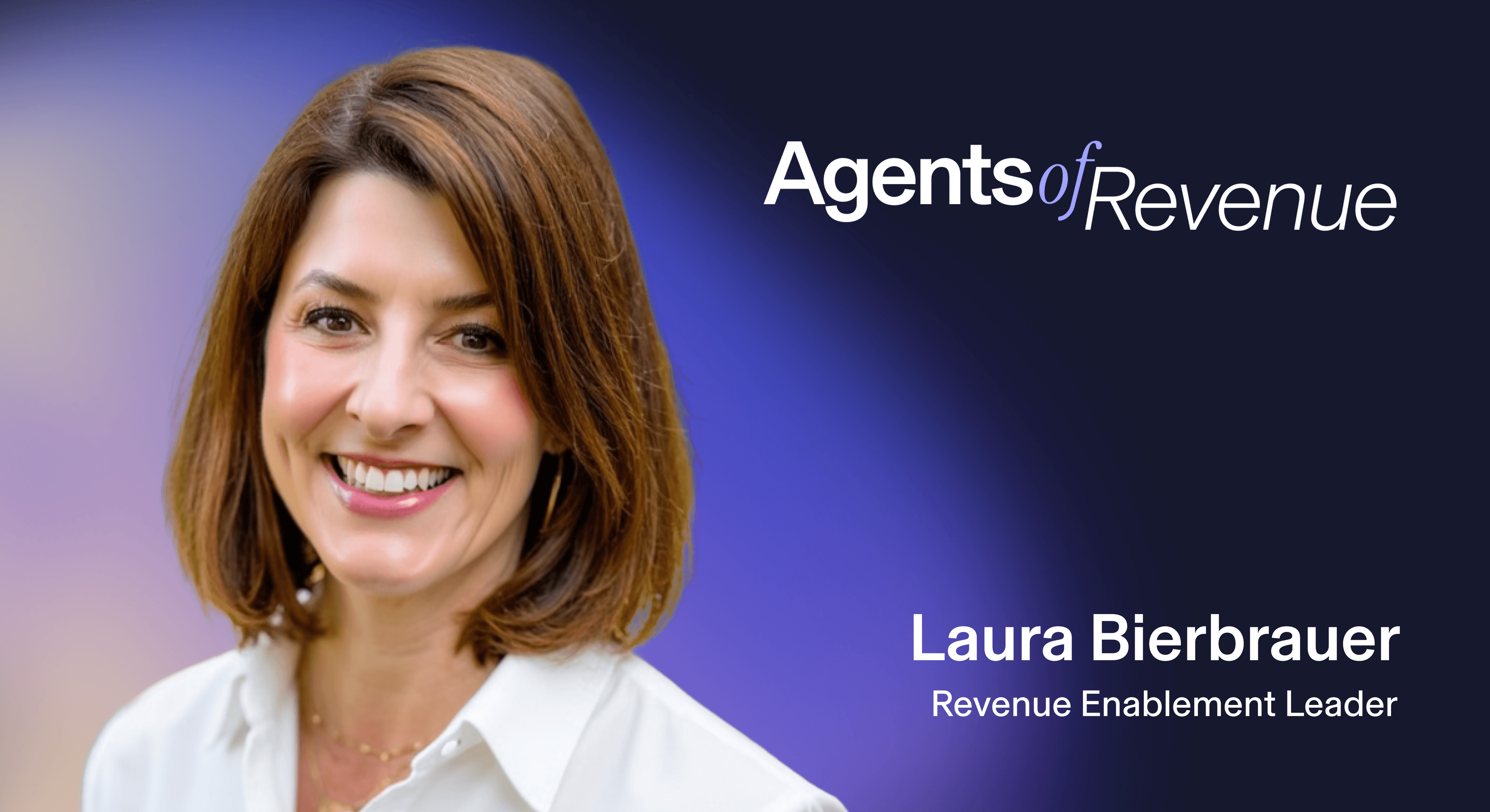

David Walker sits down with Laura Bierbrauer, revenue enablement leader formerly of Atlassian, about why your sales culture is the missing context for your team and your agents
Most GTM teams know that an agent is only as good as the context they provide it. They connect agents to their CRM, the call library, the product docs, and the pricing page. This is the best way to help AI understand the nuances of your business.
Laura Bierbrauer is a revenue enablement leader who has worked at some of the largest go-to-market organizations there are, Atlassian and Equinix among them. In this week's Agents of Revenue, we spoke about how agents and employees are both missing the context they need to do the job well.
As you can imagine, her point on the missing context piqued my interest. So what's missing?
Her answer is the sales culture. Specifically, the way teams actually engage prospects and sell. This is generally known as institutional or tribal knowledge. But, when it isn’t written down, it leaves your field teams and your agents guessing.
How to find and document your sales culture
Your sales culture is the DNA of your organization. It's not a framework.

Laura BierbrauerRevenue Enablement Leader, formerly Atlassian
Laura calls a sales culture the DNA of an organization. Notice how she didn’t call it a framework. A framework is a document or set of slides people read and ignore. DNA decides who gets hired, and how your leadership team manages the organization.
Three questions to help find your sales culture
What are our best people doing?
Look closely at what your best reps do rather than the numbers they hit. Those behaviors outline the culture and tactics that you can teach everyone else. Most companies skip this exercise because top performers hitting quota frequently cover for an inefficient GTM motion.
We hire great salespeople, we promote amazing salespeople as managers, and we assume everybody knows what great looks like. Everybody brings their own flavor.
What are we not willing to change?
Ask your leadership team what processes and rituals they would protect as the company grows. What they instinctively defend is usually what they believe makes their teams successful.
Where does change get met with friction?
Watch how your team reacts the next time you introduce something new. This can be something as benign as new positioning or as disruptive as an overhaul to pricing and packaging. The friction you witness shows you where the change challenges an existing process or norm your team values.
What to do with the answers
Give sellers the full recipe
Most enablement teams hand over assets like positioning docs, call recordings, and battlecards. These are undoubtedly useful, but without a recipe for how to use them, the results become unpredictable.
It's like going grocery shopping and saying, here are all of your gourmet ingredients. Five people will all make amazing things with the same ingredients. But is it the fastest way to get there? Is it the most repeatable way?
Enablement needs to go beyond a library of assets and expectations. It should demonstrate clear examples of what good looks like and how to be successful. A working definition of what is expected gives your managers something to measure and coach against. This also gives your agents an additional layer of context that nobody has given them before.
Reinforce with incentives
Put the context of your sales culture into the decisions that move the needle. This can look like hiring criteria, performance reviews, and President's Club eligibility. We all know that incentives drive action, especially within the GTM organization. So, go beyond putting it in your mission statement or onboarding docs, measure more than pipeline and revenue, and reward the daily habits your team watches most closely.
It's not just that you hit your number. It's how you got there, and that matters just as much.
Episode highlights
00:41 - What revenue obsession means, and why it's about behaviors rather than a good market
02:46 - The assumption every company makes when it promotes its best seller into management
07:01 - Why unconnected initiatives feel like death by a thousand cuts to a sales team
07:49 - David on the adoption gap between two companies that look identical on paper
09:27 - The grocery store problem: five sellers, the same gourmet ingredients, five different meals
11:16 - What frontline managers are actually being asked to coach to, and where coaching agents fit
12:15 - David on institutional knowledge and why undocumented means it doesn't exist
16:33 - Why not all of your call data is worth the same, and what to feed your agents instead
21:20 - David on rebuilding the sales motion from a blank slate, and websites as the trailer to the movie
24:10 - Laura's controversial take on automation and the part of selling it can't replace
26:36 - The three things a sales leader can go do on Monday
29:28 - Why the real obstacle to change is the feeling of loss
My two cents
Throughout my career I've believed that if it isn't documented, it basically doesn't exist. Every company has institutional knowledge, the stuff everyone knows yet nobody writes down. That's especially true at an early-stage company with a small group of passionate people. People learn via osmosis, watching how their manager operates and getting in the repetitions that build the muscle. Not ideal, but a fine short-term solution.
The problem is that an agent can't learn your business the way a new hire does. Onboarding through osmosis was always a band-aid rather than a strategy, and agents are now forcing the issue. Sales teams have to move off institutional knowledge and onto documented context faster than most realize. Written-down context is now a force multiplier for both your people and your agents.

David WalkerCo-founder and CEO, Spara
Related posts
View all
GTM
GTM intelligence: transforming revenue operations into measurable pipeline growth
GTM intelligence connects data, AI, and automation to turn buyer signals into coordinated action across your revenue motion. Learn the core capabilities, real-world use cases, and how to implement it in your revenue operations stack.
Oct 1, 2026
•
8 min read

GTM
Databricks' Barry Dauber on why every project should start with impact, not AI
Barry Dauber runs Gen AI go-to-market at Databricks, talking companies down from AI hype every day. Here's his framework for scoping an AI project: name the metric, classify the initiative, and reserve the model for what actually needs one.
Sep 2, 2026
•
4 min read
GTM
How Clay's Head of GTM Engineering Took Event ROI From 2x to 10x
Everett Berry treats every dinner like a funnel. Here's the six-stage system — golden lists, leader-to-leader invites, engineered seating, automated follow-up — that took Clay's event ROI from 2x to 10x.
Aug 26, 2026
•
5 min read
Sign up for the latest from Spara
Subscribe to get more GTM insights straight to your inbox.