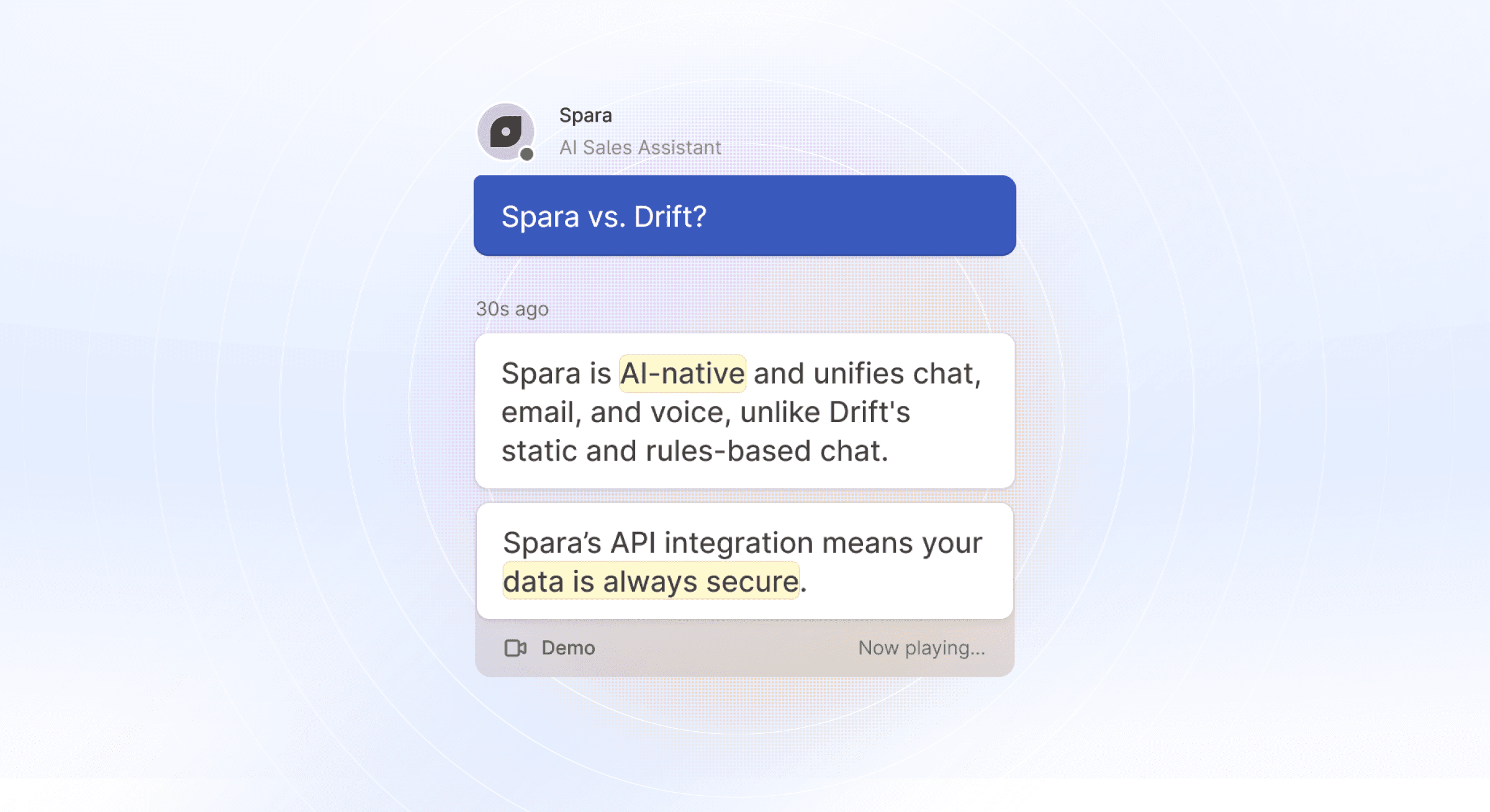

On March 6, 2026, Clari and Salesloft announced Drift's gradual sunset and named 1mind as its exclusive AI successor. Existing customers keep access for now, but there's no confirmed end date and the platform is being wound down. 1mind is built around avatar-led AI “Superhumans” that engage buyers on your website, in product, and on video calls, and for teams that want that at the center of how they sell, it's a strong fit.
But if you're replacing Drift, the real question is how much of the selling you want the platform to do.
Every revenue team has a band of demand it loses money serving: deals too small to justify a rep's time, too complex for buyers to close alone, or simply too slow to reach a human before interest cools. That band doesn't only sit at the top of the funnel. It's in renewals, dormant leads, event follow-up, and every stalled deal nobody has capacity to work. Replacing a chat widget with a newer chat widget leaves all of it exactly where it was. What closes it is a system that keeps working the demand after the first conversation ends.
Spara was built for exactly that: AI agents working every channel a buyer uses, with workflows carrying the follow-up between conversations. If Spara and Drift are the direct comparison you're making, Spara vs Drift covers it feature by feature. For Drift customers, we're offering free migration and will match your Drift contract price. You can switch without taking on new budget risk.
Key takeaways
Drift's gradual sunset was officially announced on March 6, 2026, when Clari and Salesloft named 1mind as its exclusive AI successor, leaving existing customers to evaluate alternatives quickly.
Replacing Drift with another chat-only tool repeats the problem: buyers now use an average of 10 channels across the purchasing journey, so channel coverage matters more than the widget itself.
Spara is an AI-native platform for agent-led growth, running AI agents across chat, email, voice, text, and product demos, with a shared data model and workflows carrying what happens between conversations.
Migrating off Drift follows five steps, from auditing existing playbooks to measuring speed-to-lead, with a 14-day go-live SLA on every Spara plan.
Why are Drift customers shopping now?
Salesloft acquired Drift in February 2024. Clari and Salesloft announced their agreement to merge in August 2025. On March 6, 2026, the combined company announced Drift's gradual sunset and named 1mind as its exclusive AI successor. Every Drift customer now has to find a replacement that fits how their team actually sells, and the clock is running.
Here's what teams are weighing.
A multi-vendor stack isn't simplification
Salesloft and Clari pitch the offering as unified, with conversation signals flowing from 1mind into cadences and forecasting. In practice, migrating to the named successor means onboarding a separate vendor and, to get the full loop, committing to Clari and Salesloft alongside it. That is a larger decision than a product upgrade.
Security is now part of the evaluation
In August 2025, a Drift OAuth breach compromised more than 700 organizations, including Cloudflare, Palo Alto Networks, and Zscaler. A chat widget on a platform that is being wound down, and that already suffered a major security incident, is a liability sitting on your highest-intent page.
Single-channel chat misses how buyers actually buy
Modern buyers don't stay on one channel. They start a chat, switch to email, take a call, drop off, then come back, using an average of 10 channels across the purchasing journey. If your platform only handles website chat, you're rebuilding the rest of the motion in adjacent tools.
AI bolted on top of older architecture has limits
Drift and most legacy platforms added AI features on top of rule-based chat infrastructure. AI-native platforms designed after large language models (LLMs) matured behave differently. They learn from real conversations, adapt to questions outside preset paths, and don't escalate every nuance to a human.
What are the top Drift alternatives in 2026?
Drift defined the past decade of conversational marketing. The platforms replacing it were built after LLMs matured. They engage buyers in real time, qualify against your criteria, and route to the right next step without rule-based playbooks. Here are five worth evaluating.
Platform | Primary use case | Architecture | Pricing model | Multi-channel | Best for |
Spara | Agent-led growth across the full sales cycle | Built AI-native | Usage-based, unlimited seats | Chat, email, voice, text, AI Product Demos | Revenue teams that want one connected platform, not a stack |
1mind | AI Superhumans across the buyer journey | Built AI-native | Enterprise, annual | Website, in-product, video calls | Enterprise teams wanting avatar-led demos |
Qualified | Agentic marketing with an AI SDR | AI layer added | Enterprise, annual, requires Salesforce | Website chat, voice, video, email | ABM teams already on Salesforce |
Fin (formerly Intercom) | Customer service and inbound sales agents | AI layer added | Seat-based plus usage | Chat, email, WhatsApp, SMS, voice, Slack (voice and Slack not for sales) | Teams unifying support and inbound sales |
HubSpot Chat | CRM-native chat | AI layer added | Seat-based plus credits | Website chat | Small teams on HubSpot |
1. Spara: best AI-native Drift alternative
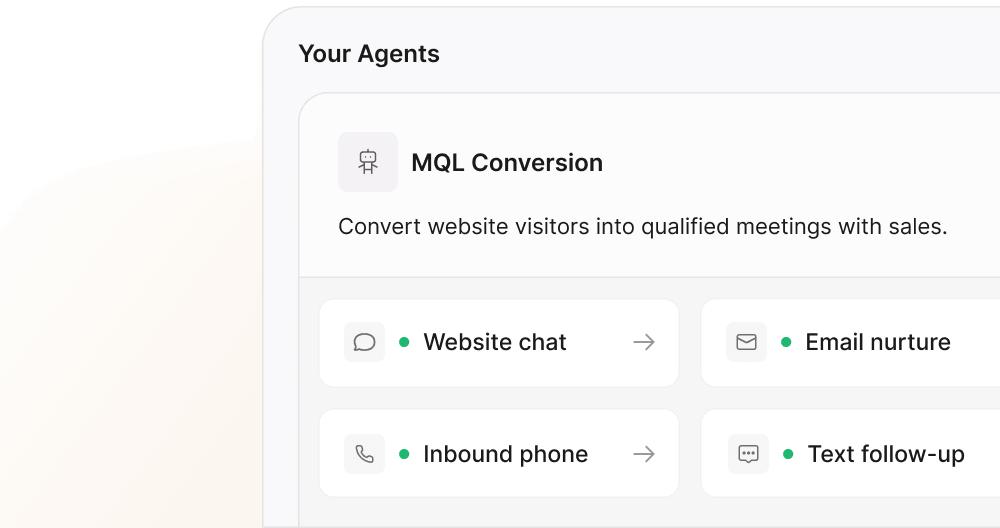
Spara is the platform for agent-led growth: AI agents that convert intent into revenue across chat, email, voice, text, and product demos. It's an AI conversion layer built after LLMs matured rather than retrofitted onto rule-based infrastructure, so agents qualify against your criteria, answer questions, and route to the right next step, whether that's a rep or more AI assistance.
Think of Spara as a network of AI agents working across the entire sales cycle. Chat comes in three formats, from a persistent navigator to a full-screen conversation to an embedded search bar, each configurable by page or funnel stage. The design is fully customizable, including whether an agent appears as an avatar, so the experience fits your brand and the moment rather than sitting in the same corner of every page.
When a buyer wants to see the product, an AI Product Demo walks them through it live, answers questions as they come, and books the call with sales once there's real intent to act on. If they'd rather talk it through by phone, a Spara Voice Agent handles that conversation. Email agents pick up from there, following up and answering questions through the same connected platform.
Why it stands out
What holds it together is the data model: one view of the lead across every channel, not just the ones a buyer starts on. A conversation that begins in chat carries into email, text, or voice with the context intact, and every action writes back to your CRM. Workflows then run what happens between conversations: when a lead goes quiet, when a renewal approaches, when an event list needs working.
Every agent runs on the same company context, so the demo agent knows what the chat agent knows. Spara is trained on your company information from the start, which means you can spin up an agent to do anything by writing out the instructions, and Ask Spara guides you through the setup inside the platform. That's why a full product walkthrough doesn't require a separate demo tool.
Pros
Fast lead conversion: Spara responds to leads within seconds, using AI to craft personalized messages. Rho saw form-to-meeting conversion increase 3.1x and booked 137 meetings in a single quarter.
Quality leads: Spara identifies real buying intent based on your company's qualification criteria. It reads conversations and behavior against your historical data, so only leads that meet your standards move forward. Reps receive each lead with the buying context attached, including what the buyer is shopping for and enrichment on their account. Mindbody converted 10.3% more MQLs into SQLs against a control group.
Real metrics: Spara reports on lead generation rates, booked meetings, and pipeline growth, the numbers a revenue team is measured on.
Better security: Spara is SOC 2 Type II compliant and complies with GDPR and CCPA regulations. All customer data is encrypted at rest and in transit using Cloudflare and Google Cloud’s multi-layered AES encryption.
Usage-based pricing: Spara pricing scales with volume and feature requirements, not with seats. Every plan includes unlimited seats, so cost follows the conversion work the agents do rather than the size of your team.
Cons
It’s not yet available as a mobile application.
Best for
Spara is best for revenue teams that want one connected platform rather than a stack of point tools. A shared data model keeps every agent working from the same view of the lead, and workflows carry what happens between conversations: renewals, dormant leads, event lists that would otherwise sit unworked.
2. 1mind: best for teams that want avatar-centric AI demos
1mind is the platform Salesloft and Clari named as Drift's AI successor. It's built around AI “Superhumans”: avatars that show up on your website, in product, and in live sales conversations to demo and qualify in real time.
That avatar-first approach is what 1mind is known for. If your inbound motion centers on live, face-to-face style AI conversations and product demos, it can fit well.
Why it stands out
The avatar interface is a different experience than text chat. Buyers can have what looks like a face-to-face conversation with an AI rep. Inside the Salesloft and Clari stack, signals flow into existing sales engagement and forecasting workflows.
Pros
Avatar-driven AI demos: Live, face-to-face style conversations on your website, in product, and on sales calls.
Integrated with the Salesloft and Clari stack: Conversation signals flow into Salesloft cadences and Clari forecasting.
Documented migration path: Named by Salesloft and Clari as the Drift replacement, so migration tooling exists.
Cons
Single-surface coverage: avatar conversations on your site, in product, and on calls, with email, text, and re-engagement handled elsewhere.
Multi-vendor commitment: Realizing the “unified” promise typically means adopting Salesloft and Clari as well.
Smaller reference base: Newer product with fewer customer case studies than longer-established alternatives.
Best for
Teams that want avatar-centric AI demos as the centerpiece of their inbound motion, especially those already on or moving to the Salesloft and Clari stack.
3. Qualified: best for ABM teams already on Salesforce
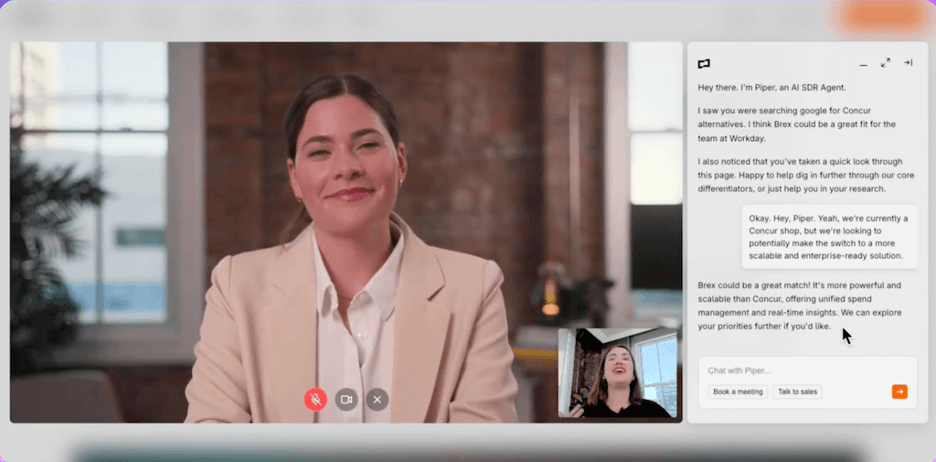
Qualified specializes in account-based marketing (ABM) and now positions itself as an agentic marketing platform built around Piper, an AI SDR agent. Piper engages visitors in real time through chat, voice, and video, follows up by email, and books meetings automatically. Over 500 companies use Piper. Qualified leads G2's AI SDR Agent Software category and was named a Leader in The Forrester Wave: Conversation Automation Solutions for B2B, Q4 2025.
Target accounts live in Salesforce, and visitor identification matches traffic against them in real time. When someone from a target account lands, Piper greets them with the account context already loaded and the rep gets an alert. Qualification criteria are yours to set: company size, industry, region, whatever defines a good fit.
Why it stands out
Qualified's draw is depth over breadth. Because it's built on Salesforce rather than integrated with it, Piper works from live CRM data during the conversation: account ownership, open opportunities, past activity. A visitor from a target account gets a conversation shaped by what the CRM already knows, and the meeting lands on the right rep's calendar.
Pros
Excellent customer support: Users praise Qualified’s customer support team. One G2 reviewer, Ryan O., shared, “The team at Qualified did everything possible to make the migration from our previous solution as easy as possible.”
Accurate lead identification: The platform instantly identifies target profiles to provide a personalized experience.
Seamless integration: Qualified connects smoothly with major CRM tools like Salesforce, keeping sales and marketing aligned.
Cons
Reporting is limited to the platform. One G2 user Janine W. mentioned that reporting is restricted to the platform and can’t be exported for deeper analysis.
The setup process isn’t always intuitive, which can slow down onboarding for new teams.
Inbound only: no outbound sequences, dialer or prospecting, so it covers visitors who engage but not the ones who leave silently.
Salesforce dependency: Qualified is built on Salesforce. If you're not on it, this isn't a platform you can realistically run.
Best for
Qualified is best for Salesforce-native businesses running an ABM strategy. That's the qualifier that matters most: the platform is built on Salesforce, so the fit question is your CRM before it's anything else. The rest comes down to whether chat alone covers your motion. Spara vs Qualified works through it.
4. Fin (formerly Intercom): best for teams unifying support and sales in one agent
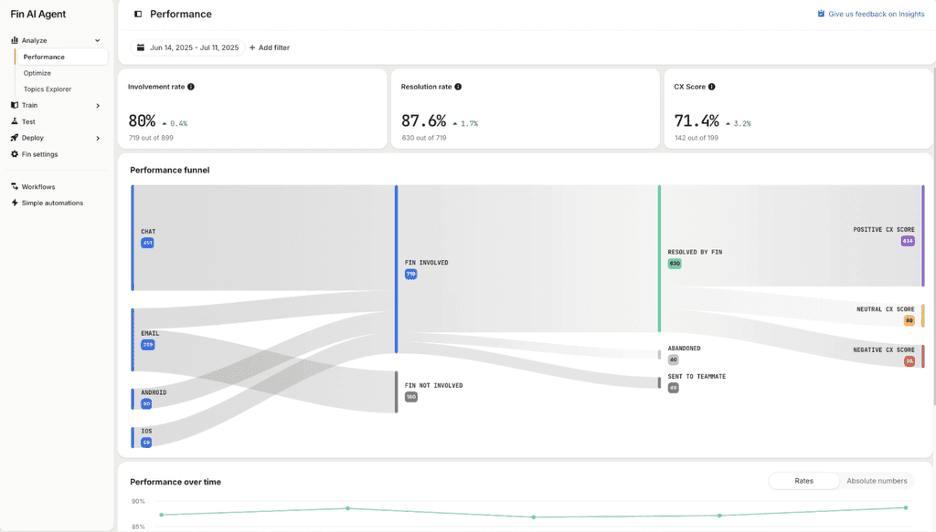
Fin, which rebranded from Intercom in May 2026 and has signed a definitive agreement to be acquired by Salesforce for approximately $3.6 billion, runs one AI agent across support and sales. It combines AI-powered chat, a ticketing system, and workflow automation, with the same agent taking on service, sales, or ecommerce roles depending on the conversation.
Support queries route to the right agent automatically, and product tours handle feature discovery for new users. That machinery is mature, and the sales role inherits it.
Why it stands out
Fin's draw is that it's one agent, not two. The same system resolves support tickets and runs inbound sales, switching roles mid-conversation when a pricing question turns into a technical one. For teams where the same visitors ask both kinds of question, that's a real advantage, and nothing else on this list works that way.
The sales role qualifies against your playbook, enriches with CRM data, and routes with full context attached. Setup is describing your criteria in natural language rather than building flows.
Pros
Natural-language setup: playbooks and qualification criteria are described in writing rather than built as flows, so changes don't require a rebuild.
Omnichannel support: Customers are served wherever they are (websites, WhatsApp, Instagram, Facebook, SMS, or chat widget).
Sales and support in one agent: the same system qualifies buyers against your playbook and resolves support questions, switching between them mid-conversation without losing context.
Powerful AI agents: Fin acts as the AI customer-facing chatbot, while Copilot, another AI agent, assists your internal support team to pull information from the knowledge base and better guide customers.
Cons
Reporting and advanced support tooling lag competitors, including nested attributes and certain call metrics that Zendesk covers.
It can be expensive for small businesses.
Coverage gaps on the sales side: voice isn't supported for sales workflows, the motion is inbound only, and it runs on the Intercom platform rather than standing alone.
Seat-based pricing with usage billing on top for the AI agent, and a pending Salesforce acquisition expected to close in Q4 of Salesforce's fiscal year 2027 that may affect pricing and roadmap.
Best for
Fin is best for teams where support and sales questions come from the same visitors and one agent handling both is worth more than either done separately. That's a genuine architecture, not a bundle. The trade-off is that the sales side inherits a support platform's assumptions: inbound only, no voice, and the Intercom platform underneath it.
5. HubSpot Chat: best for small teams and simplicity
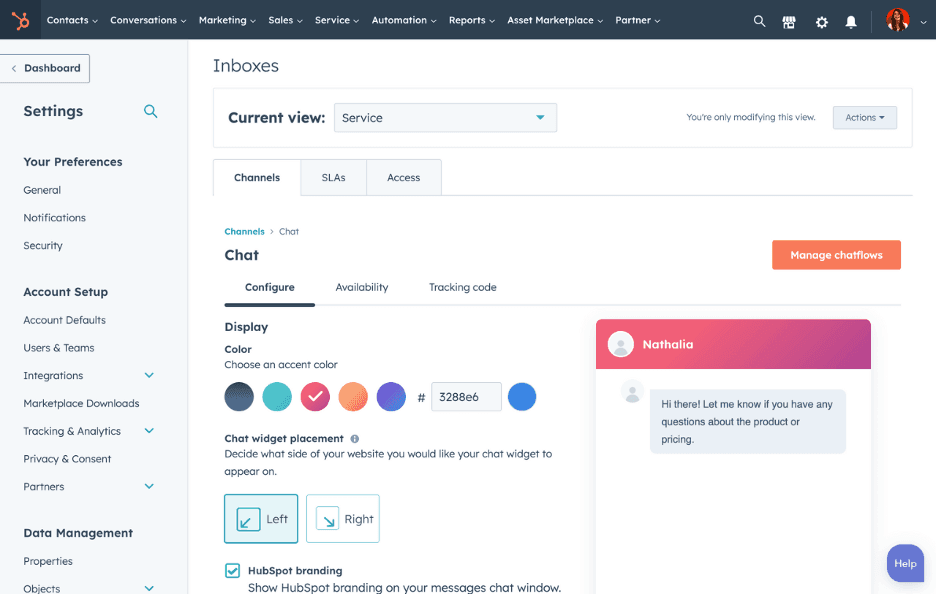
HubSpot is an ecosystem. At its core is the CRM, and around it sit specialized “hubs”: Sales, Service, Content, Marketing, and more.
The Service Hub is where customer relationships live. Within it, HubSpot Chat helps teams handle customer questions in real time, directly from the same platform that has CRM data, so it’s all connected. You can also automate these chats to handle common questions, qualify leads, and even book meetings when your team’s offline.
Why it stands out
HubSpot Chat stands out for its deep integration with the entire HubSpot CRM platform, which provides a unified view of the customer journey across sales, marketing, and service teams.
Pros
Easy to use and set up: The visual chatbot builder makes creating conversation flows simple, even for beginners.
All-in-one platform: Your CRM, website design, and customer support all live in one place.
Free plan available: You get basic live chat and bot functionality without any cost, which is a solid option for small teams starting out.
Cons
Agents sit apart: HubSpot's AI agents sit across the CRM as separate tools, a Customer Agent for support, a Prospecting Agent for outbound, a nurture agent, a deal progression agent. Each works its own slice, on HubSpot credits, inside the HubSpot ecosystem. That's a different shape from one system with a shared view of the lead working demand end to end.
HubSpot Chat isn't AI-native. It's a static chatbot with AI features added around it, so conversations follow the flows you build rather than adapting to what a buyer actually asks.
Best for
It’s perfect for small teams that value simplicity and don’t want to juggle multiple systems. You get decent automation, smooth CRM integration, and enough features to keep conversations flowing.
But if your goal is converting demand into revenue across the full sales cycle, HubSpot Chat is not built for that. Spara is designed for revenue teams that want agents and workflows doing that work end to end.
What should you look for in a modern Drift alternative?
AI-native architecture
If you adopted Drift 10 years ago, it was likely the most practical move at the time. Back then, cloud-based SaaS tools were changing how businesses talked to customers, and Drift led that revolution. Today, AI plays that same transformative role.
Choosing the right platform now means picking one built around LLMs.
Many tools claim AI capabilities, but few are designed around it. Spara was built after LLMs matured, with agents, shared context, and workflows designed together rather than bolted on.
Connected follow-up
A conversation is only the first step. What happens after it, when a lead goes quiet, when a renewal comes up, when an event list needs working, is where most pipeline is lost. Platforms built around a chat widget hand that back to you, and you rebuild it in a marketing automation tool or a workflow builder. Ask what a platform does between conversations, not just during them.
Personalized engagement
Today's customers don't wait for web forms. They start conversations directly on your website and expect fast, natural replies that feel personal and human. Modern AI chat and voice agents make that possible by understanding context, remembering past interactions, and responding in real time.
A modern Drift alternative should deliver this kind of intelligent and personalized engagement from the very first touch, engaging buyers the moment intent appears, qualifying in real time, and routing to the right next step without adding headcount.
Ease of use
Customer platforms are often used by support teams and managers with less technical expertise, so look for a tool with visual builders, drag-and-drop automation, and intuitive customization. The easier it is to use, the faster your team can respond and improve customer satisfaction.
Fit for your sales motion
Different tools specialize in different areas. Some are built for support automation, others for account-based marketing, others for one channel done well. Identify your goal and look for the tool built for it. If that goal is converting demand into revenue across the full sales cycle rather than capturing it at one point, Spara is built for that.
What does the future of conversational GTM look like?
Two things are changing at once. Go-to-market (GTM) motions are moving from rule-based chat to AI systems that understand context and adapt to questions outside a preset path. And the job itself is widening: the same agents that qualify a new lead now handle renewals, dormant pipeline, and post-event follow-up, work that used to sit with people who never had time for it. The platforms that matter in 2027 will be judged on how much of the cycle they carry, not how well they answer the first question.
If you want more of that demand converting, train the Spara AI with your business-specific data.
How do I switch from Drift without losing leads?
Before you migrate, protect your conversion rate with these steps:
Audit your existing Drift playbooks: document every routing rule, qualification path, and meeting-booking flow before you decommission anything.
Map your CRM integrations: identify every field Drift writes to your CRM and confirm your new platform can replicate or improve those writes on day one.
Set a go-live date: Drift's sunset has no confirmed hard end date, but the platform is being wound down. Treat migration as a decision for this quarter and put it on the roadmap.
Run parallel for two weeks: operate both platforms simultaneously to validate that lead volume, qualification rates, and booked meetings are stable before full cutover.
Measure speed-to-lead: your new platform should respond to inbound leads within seconds. If it does not, your conversion rate will drop before you notice.
Spara handles the migration itself, from playbook import to routing logic, with a 14-day go-live SLA on every plan. Talk to Spara about replacing Drift.

Lauren ThompsonHead of Marketing, Spara
FAQs
Related posts
View all
GTM
Jon Harper on the four traps that stall complex deals before the proposal
Jon Harper's PEO reps closed 35 to 45% of the deals they proposed, but only 9% of first meetings ever got that far. The BizBenchmark founder breaks down the four traps that stall complex deals, and what to do instead.
Oct 9, 2026
•
4 min read
GTM
How Clay Built a Partner Motion That Drives 20% of Revenue
Nancy Mottice joined Clay as it moved from product-led growth into enterprise. Since then, partner-sourced revenue is up 16x and drives 20% of the business. Here are the six steps she took to get there.
Oct 9, 2026
•
7 min read
GTM
Pendo's Kobi Stok on turning product usage into upsell pipeline
Teams automated inbound years ago, but upsell still depends on a rep hearing a customer bring it up. Kobi Stok, SVP of Product at Pendo, walks through six moves to turn product usage into pipeline.
Oct 9, 2026
•
6 min read
Sign up for the latest from Spara
Subscribe to get more GTM insights straight to your inbox.