

David Walker sits down with Mollie Bodensteiner, Head of Revenue Operations at ZoomInfo, about what it means to be revenue obsessed
Most GTM still runs on fundamentals set ten to fifteen years ago. Reps abstract every deal into a handful of CRM fields, and forecasts are built on that shorthand. The whole model rests on a constraint that no longer exists.
Now teams are bolting AI onto that broken model without asking whether it still makes sense. That's why Gartner expects 40% of agentic AI projects to be scrapped by 2027. These projects will fail because the foundation underneath was broken before the agent arrived. The better question, the one almost nobody's asking, is whether we're even running the right test.
I recently sat down with Mollie Bodensteiner. She's spent fifteen years in RevOps, ran the function at Deel, co-founded the RevTech Review, and is now VP of RevOps at ZoomInfo, which gives her as good a vantage point as anyone on how AI is reshaping the function. What I didn't expect was her pace. Sixty days into the job, she hadn't just formed a point of view on AI. She used it to build and ship a working pipeline system most teams would still be scoping.
Her First Sixty Days
Step 1: Inspect the pipeline
When Mollie takes over a RevOps org, she starts with one question: is any of this pipeline actually real? Forecasting and prediction are just math sitting on top of that question, and the math doesn't matter if the deals underneath are phantom. We've all seen the ones she's talking about, parked in late stage with nobody on the buyer's side engaged. Her point is that methodologies never catch them, because a rep filling in MEDDIC fields is checking boxes that only reflect what they already believe.
"MEDDIC and these methodologies are just asking a rep to score their own test. Now we're going to have AI score the test for you. But are we even giving the right test?"

Mollie BodensteinerVP of RevOps at ZoomInfo
Step 2: Build the two agents
She built two agents to get around rep bias and the flaws of static fields. She and a colleague built these agents inside ZoomInfo, with its own tooling, in a week.
The signal agent reads what the buyer actually did: the calls they show up to, the engagement, the real buying signals, and flags the phantom deals where nobody's bought in.
The conversation agent reads the raw conversations, the calls and the emails, and sorts every deal into keep it, coach it, or close it.
Together they replace the forecast with the actual health of the pipeline. What I love about this is that she didn't need a data science team to get there. The data was already sitting in the calls and the emails. She just had to point something at it. Five years ago, sixty days on the job would have gone to figuring out where the data even lived. Now that time goes straight to the work that matters.
Step 3: Test it where you already know the answer
This is where most teams stall. They try to validate a new idea across the entire customer base and drown before they learn anything. Mollie went the other way and ran the agents on one segment's historical deals, where she already knew what won and what lost. Validating the agents on historical data allowed her to build conviction and show up with evidence. It's how she works: get a rough version in front of people fast, because a team reacts far better to something real than to a blank slide.
Step 4: Take it to the field
Mollie was deliberate about the rollout, and she handled two audiences differently.
Execs: She led with strategy, walking them through what the data was telling her and the qualification decision it pointed to earlier in the funnel.
Reps: She was more careful, because the moment you come in flagging someone's blind spots they dig in, so she went deal by deal and asked them to help her make sense of what she was seeing.
For the execs, the payoff was visibility and a real read on the health of the pipeline. With the reps, the tension the agent created is where it got fun. When the model called a deal dead that a rep swore was closing next week, it forced a genuine conversation about that deal and the kind of inspection that drives revenue.
Step 5: Embrace the counterintuitive payoff
Mollie knew this wouldn't make everyone happy. Done well, the agents weed out the stale deals and the pipeline shrinks. Nobody wants to watch their pipeline get smaller. But the data underneath your forecast, your revenue, and your operating model has to be sound, and that matters more than a number that looks good on a board slide.
"Would I rather have 200 mediocre deals, or 25 phenomenal ones? This is a mechanism for doing the right thing, not a volume play."
Mollie launched the agents a week before we talked, so it's too early to call the final outcome. But the direction is right, and I'm bought in. I'd rather have my team focused on the deals that can actually close, building on data that reflects reality instead of hope.
Where this is goingLet’s go back to that Gartner number. They expect 40% of agent projects to fail because the foundation underneath them is broken. Mollie's version of the warning is sharper:
"Everyone wants to build, no one wants to govern. Put an agent on crap data and you've just built a faster path to a dumpster. Everyone wants a penthouse, but no one's built the elevator."
That line reframes the whole job. Data quality used to be the unglamorous chore RevOps did in the background so the dashboards would tie out. Now it decides whether your AI is an asset or a liability, because an agent pointed at bad data doesn't just underperform, it makes confident, wrong decisions at scale.
This shift also changes the role of a RevOps leader. The version of the job built on spreadsheets and reporting is ending. The one replacing it looks a lot like Mollie's first sixty days: see the problem, build the thing, prove it, put it in front of people, own the outcome. RevOps leaders are becoming builders and product managers, the people who stand agents up, govern them, and decide what gets shipped and what gets killed.
There's a theme underneath all of this. Ten, fifteen years ago, GTM was constrained by capacity at every layer, whether that was enough SDRs to follow up on the leads, enough AE hours to work the pipeline, or enough RevOps time to find the truth buried inside it. Agents are dissolving that constraint across the whole org. Everyone can move faster and spend their time on what actually matters.

David WalkerCo-founder and CEO, Spara
Related posts
View all
GTM
Databricks' Barry Dauber on why every project should start with impact, not AI
Barry Dauber runs Gen AI go-to-market at Databricks, talking companies down from AI hype every day. Here's his framework for scoping an AI project: name the metric, classify the initiative, and reserve the model for what actually needs one.
Sep 2, 2026
•
4 min read
GTM
How Clay's Head of GTM Engineering Took Event ROI From 2x to 10x
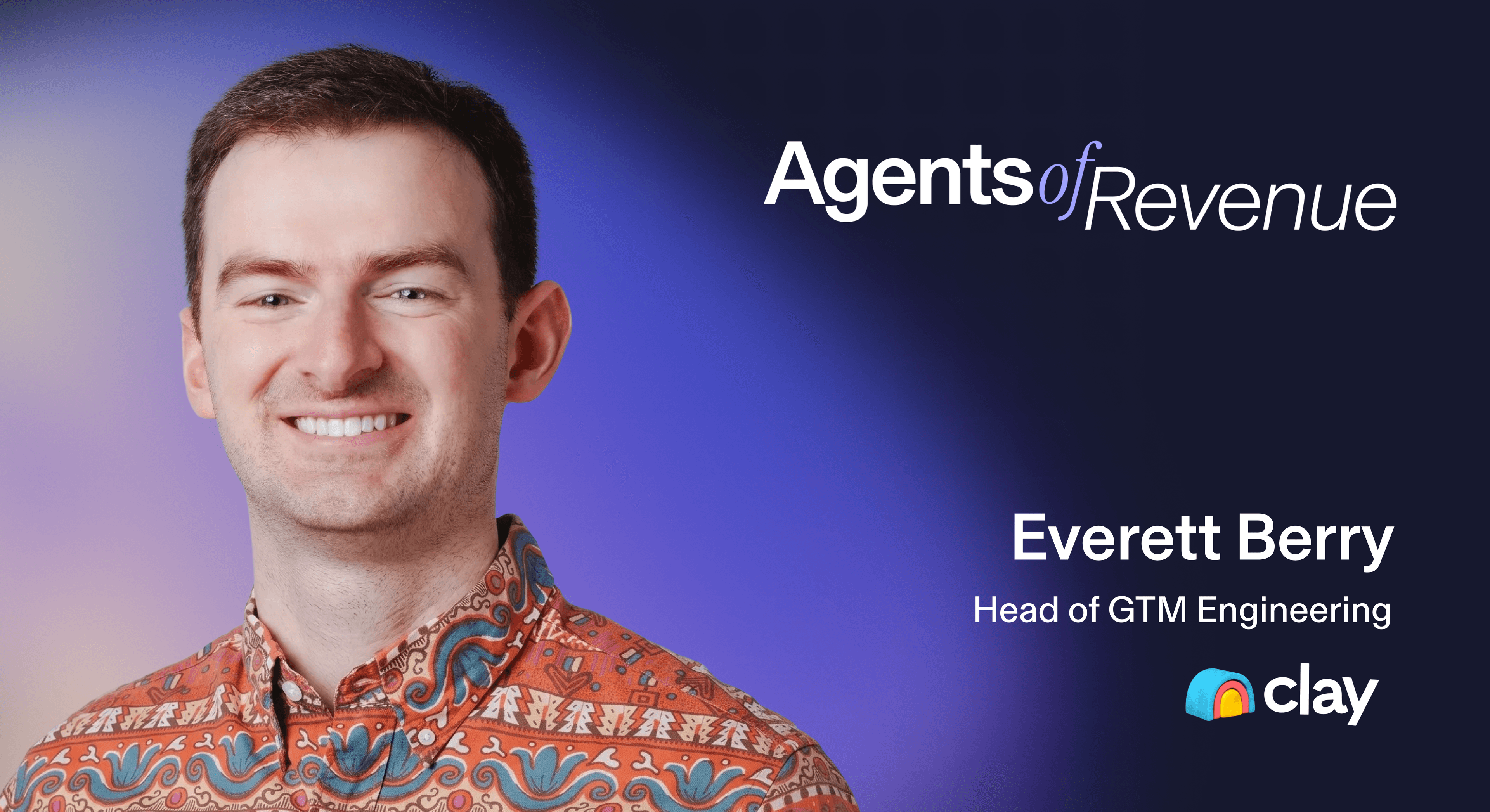
Everett Berry treats every dinner like a funnel. Here's the six-stage system — golden lists, leader-to-leader invites, engineered seating, automated follow-up — that took Clay's event ROI from 2x to 10x.
Aug 26, 2026
•
5 min read

GTM
How to Spot Real Buyer Intent in Inbound
Learn to separate real buyer intent from curiosity in inbound, and act on the signals before the moment passes.
Aug 26, 2026
•
5 min read
Sign up for the latest from Spara
Subscribe to get more GTM insights straight to your inbox.