

Key Takeaways
Conversational AI marketing means AI agents run the first conversation with each inbound buyer. They answer questions from your content, qualify buyers against your criteria, and book meetings or hand off to a rep.
The main benefit is speed with consistency. Agents reply at any hour, ask every lead the same qualification questions, and write each conversation to your CRM.
Rules-based chatbots follow fixed scripts, and marketing automation runs scheduled, trigger-based workflows. AI agents respond to what each buyer asks and keep the context when the buyer switches channels.
Before you buy, check grounding, channel coverage, CRM writeback, and governance. If you only need basic FAQs or support deflection, a simpler tool may be enough.
Inbound buyers show the most intent when they first fill out a form or ask a question, which is often when nobody on your team is free to reply. Conversational AI marketing puts an AI agent in that first conversation: it answers from your content, qualifies the buyer against your criteria, and books a meeting or hands off to a rep with the context attached.
This guide covers how conversational AI marketing works, its benefits for inbound teams, where it's used today, how it compares with chatbots and marketing automation, and what to check before you choose a platform.
What is conversational AI marketing?
Conversational AI marketing uses software that holds natural, two-way conversations with prospects across digital channels such as website chat, email, and voice.
Conversational AI adapts as a conversation unfolds. It can draw on customer data, recognize intent signals, and adjust its replies to what the buyer says.
This lets you qualify leads, answer questions, and route high-intent buyers without forcing them through rigid workflows or making them wait for a human to follow up.
How does AI conversational marketing work?
AI conversational marketing connects a large language model to your content, your qualification criteria, and your CRM, then lets it run the first conversation with each inbound buyer. The agent reads what the buyer writes, answers from your own material, and takes the next step in the same conversation. In practice, each inbound conversation follows six steps:
Engage. The agent starts or answers a conversation when a buyer shows intent, such as submitting a form, spending time on the pricing page, or replying to an email.
Interpret. Natural language processing works out what the buyer is asking in their own words, and the agent answers from your website, help docs, and sales collateral.
Qualify. The agent asks the questions your team would ask, such as use case, company profile, or timeline, and checks the answers against your criteria.
Act. A qualified buyer gets a meeting on the right rep's calendar. Other buyers get relevant resources or a handoff to a person when the question needs one.
Follow up. If the buyer leaves, the agent continues the conversation by email or text with the earlier context attached.
Record. Every question, answer, and outcome is written back to your CRM, so routing, reporting, and the next rep all see the full conversation.
Benefits of conversational AI for marketing
The main benefits of conversational AI for marketing are faster responses, consistent qualification, less friction for buyers, and better data in your CRM. AI agents support these benefits by responding to inbound buyers at any hour, answering their questions, collecting qualification details, and recording key information in your CRM.
Faster responses
An agent replies as soon as a buyer writes, including evenings, weekends, and time zones your team doesn't cover. A buyer who asks about pricing at 9 p.m. gets an answer before they leave the page, and can book a meeting in the same conversation.
Consistent qualification
Every lead gets the same questions checked against the same criteria, so qualification doesn't depend on which rep picks up the lead or how busy they are that day. Your SDRs spend time on buyers who already meet your criteria.
Reducing friction across the buyer journey
Buyers drop off when they hit delays, repeated questions, or disconnected tools. Conversational AI keeps the context and reduces handoffs, so buyers don't have to start over.
When AI agents handle early-stage engagement, buyers get faster replies, and your team steps in only when a conversation needs their expertise.
Better data in your CRM
Each conversation adds the buyer's questions, answers, and stated intent to your CRM. Marketing can see which pages and questions lead to qualified meetings, and sales can read the full conversation before the first call.
How is conversational AI used in sales and marketing today?
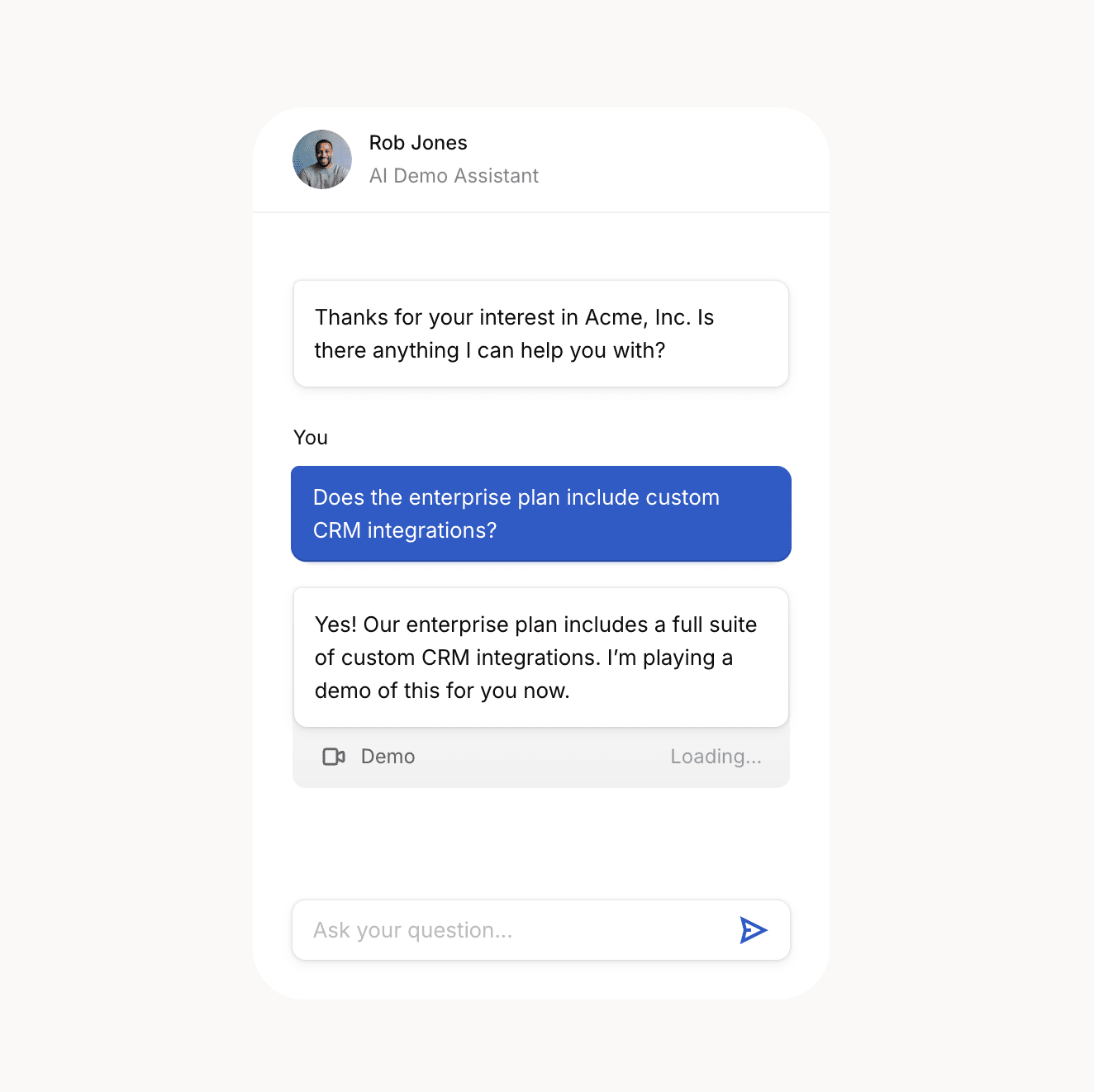
Conversational AI in marketing and sales is used at three points in the inbound funnel: qualifying and routing a lead the moment it arrives, nurturing buyers who leave without converting, and booking meetings from high-intent traffic. All three depend on the agent replying as soon as the buyer writes, before they leave the page or move on to another vendor.
Real-time qualification and routing
Conversational AI often powers lead qualification by adapting questions to each buyer's intent.
Most companies still respond to new leads too slowly. In NP Digital’s February 2026 survey of 500 marketers, only 3% said they respond within five minutes, while 31% take 24 hours or more. Another 28% said they have no defined process for responding at all.
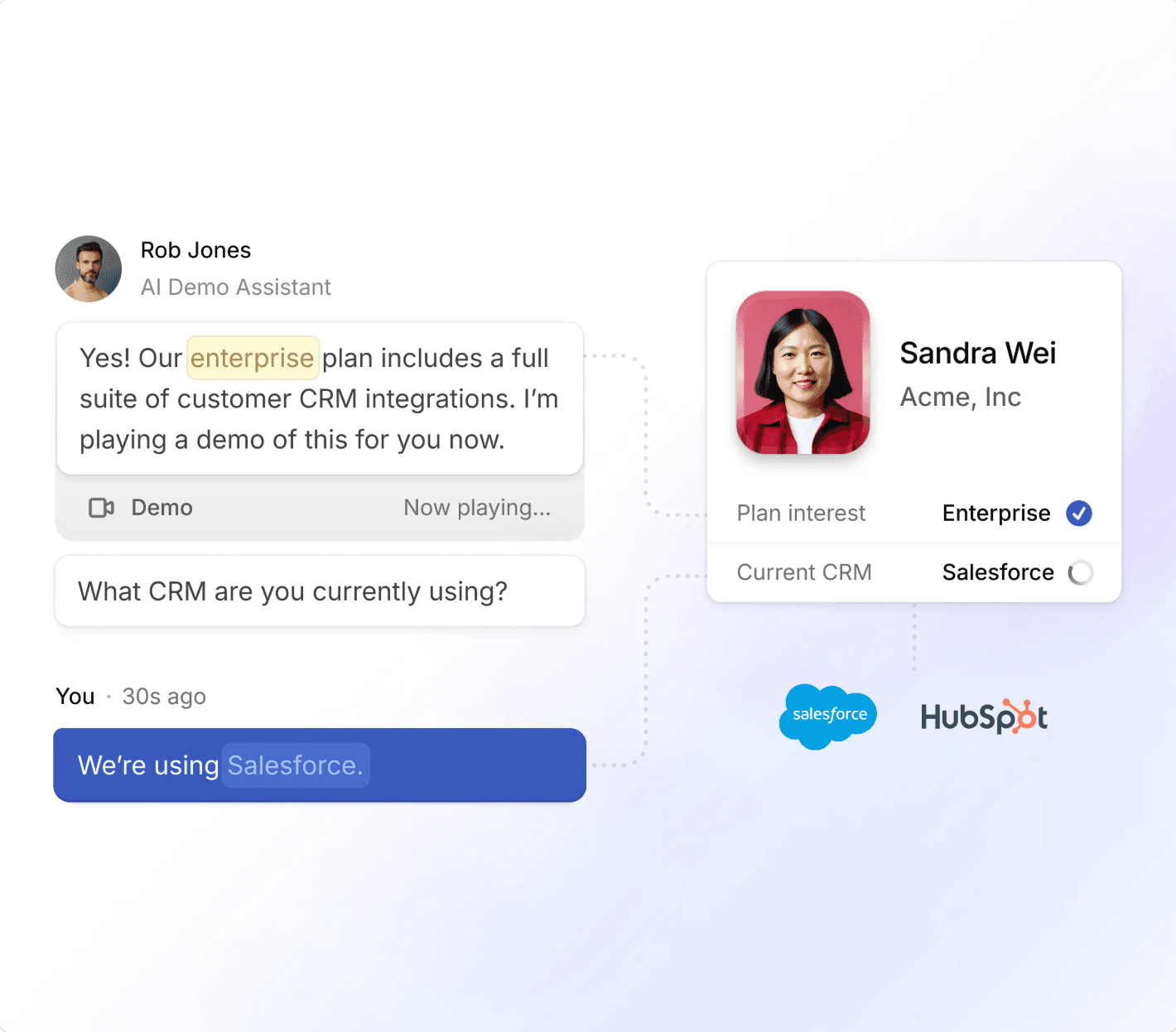
Conversational AI removes the wait for a first response. It engages visitors as they arrive, asks qualification questions, shares relevant demos or resources, and routes high-intent leads to the right sales team in real time.
AI-driven nurturing across chat, email, and voice
When a buyer doesn't convert in the first conversation, some conversational AI platforms continue it over email, voice, or text, with the earlier context attached. Say a visitor asks about pricing in chat on Monday, leaves, and replies to the follow-up email on Wednesday. The agent picks up from the pricing question, so the buyer doesn't repeat it.
AI agents can follow up after a chat by email, answer questions over voice, re-engage prospects who go quiet by text, or walk buyers through AI Product Demos, so buyers aren't passed between separate tools. Because the context carries over, buyers don't have to repeat themselves, and nobody on your team has to piece the follow-up together by hand.
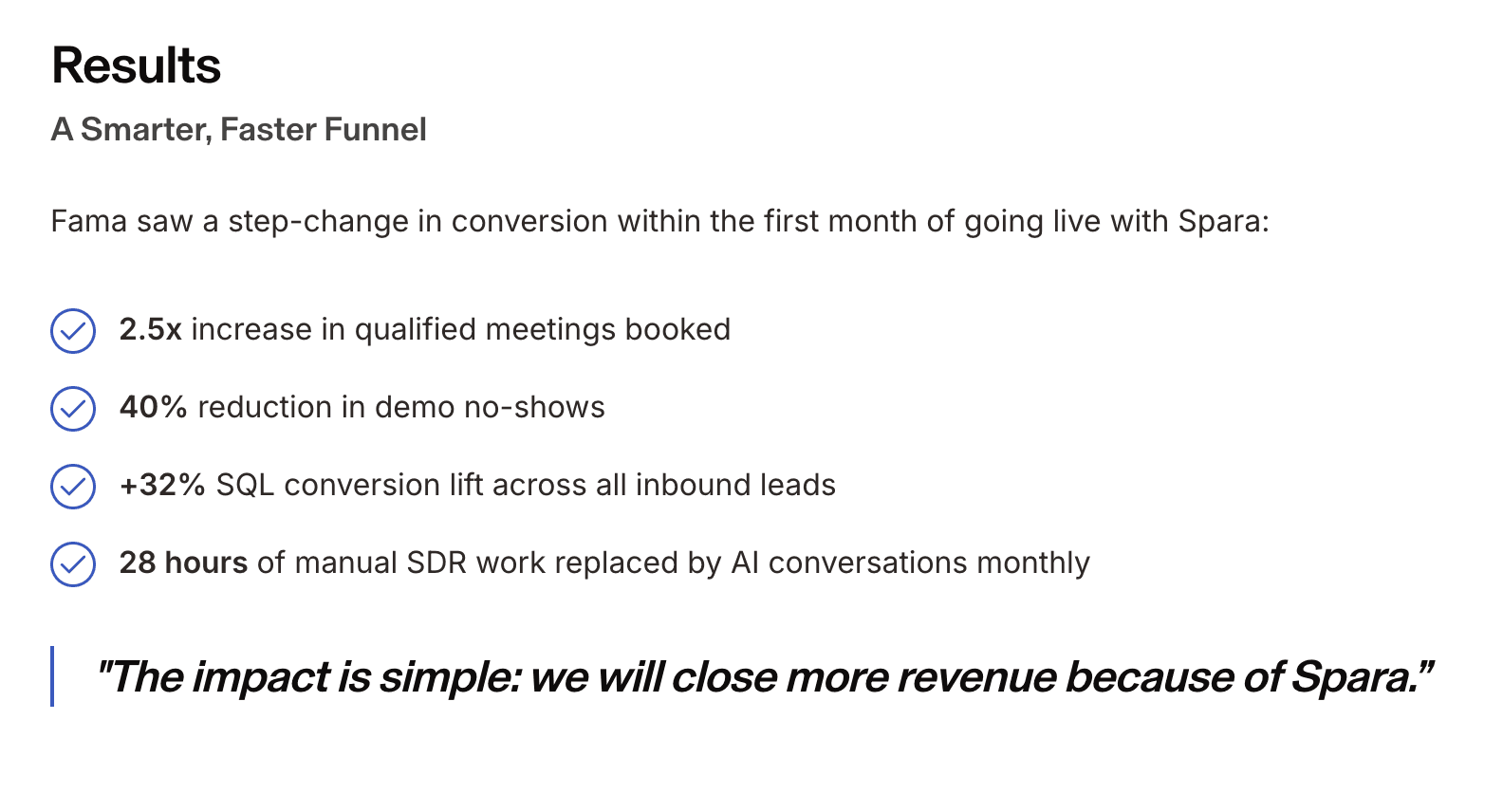
After implementing Spara, Fama saw a 2.5x increase in qualified meetings booked and a 40% drop in demo no-shows.
Turning top-of-funnel traffic into booked meetings
Conversational AI is most useful for high-intent inbound traffic and inbound lead generation. For teams using inbound SDR automation, qualifying intent and booking meetings in real time means fewer leads wait in a queue for an SDR.
After adopting Spara, Rho saw a 3.1x increase in form-to-meeting conversion and 137 qualified meetings booked in Q2.
Conversational AI marketing use case: TinyMCE
TinyMCE, the open-source rich text editor, replaced its previous chat provider with Spara to qualify inbound visitors and book meetings in real time. Within the first quarter, it tripled its MQLs compared with the previous provider, generated more than $1M in pipeline per quarter, and saw a 20% lift in MQL-to-SQL conversion without manual rep follow-up.
Before the switch, TinyMCE drew thousands of high-intent visitors each month, but its forms only captured interest. SDR follow-up was slow, so buyer intent often faded before a rep connected, and SDR time went to unqualified leads.
Spara went live across key TinyMCE pages within days, trained on TinyMCE's product docs, pricing, and ideal customer profile. The setup had three parts:
Proactive chat starts a conversation when a visitor shows high intent, such as time on the pricing page or viewing specific documentation.
The AI agent asks buyer-specific questions to qualify each lead on firmographics, technical fit, and use case.
Once a lead qualifies, the agent books a meeting directly on the right BDR’s calendar.
Conversational AI marketing vs. chatbots and marketing automation
Conversational AI marketing replies to each buyer specifically, in real time and across channels. Rules-based chatbots follow fixed scripts and marketing automation runs scheduled, trigger-based workflows. Both older tools break down when a buyer asks something off-script or moves to another channel. Without a fast first response, inbound demand leaks away, a problem which a zero-leak inbound motion is meant to solve.
Capability | Rules-based chatbot | Marketing automation | Conversational AI marketing |
How it responds | Uses predefined menus, keywords, and scripted paths | Runs workflows based on triggers, segments, and scheduled steps | Interprets intent and context to generate relevant responses |
What happens off-script | Falls back to a default response or human handoff | Waits for a matching trigger or routes the contact for follow-up | Can clarify the request, use available context, or escalate |
Channels covered | Primarily website chat | Commonly email, forms, and campaign channels | Varies by platform and can span multiple conversational channels |
When follow-up happens | During the active chat or after a handoff | At a scheduled time or when a trigger fires | In real time and through subsequent automated follow-up |
What reaches the CRM | Captured fields and chat records, depending on integration | Campaign activity, form data, scores, and workflow updates | Conversation context, qualification details, and actions, depending on integration |
Ongoing upkeep | Script and decision-tree maintenance | Workflow, segmentation, scoring, and campaign maintenance | Content, guardrail, integration, and performance review |
Best fit | Basic FAQs and simple self-service | Scheduled nurture and batch campaigns | Adaptive qualification and contextual engagement across buyer journeys |
How to evaluate conversational AI platforms (what actually matters)
Differences between conversational marketing AI platforms show up in live buyer conversations, so test each one with your own content and real questions.
If your primary goal is support ticket deflection, weigh help-desk integration and support workflows above sales qualification and channel coverage.
Grounding and accuracy
If an AI agent gives a wrong answer or drifts off-brand, buyers stop trusting it. Confirm that the agent answers from your own content, such as your website, help docs, and sales collateral. Ask what it does when that content doesn't cover a question: whether it says so, hands off to a person, or guesses.
Also ask whether the platform was built around large language models or if AI was added to an existing chatbot or automation tool, and test both kinds with questions that go beyond your scripts.
Channel coverage with one shared lead record
Buyers move between chat, email, and voice depending on urgency and preference. If a platform treats each channel as a separate system, the conversation restarts every time the buyer switches.
Check that every channel writes to one shared lead record, so the agent picks up the conversation where it left off.
CRM writeback for every action
Check that the platform writes intent signals, conversation history, and outcomes back to your CRM for every action it takes. Without that, conversation data stays outside the system your team works in, and routing, follow-up, and reporting miss it.
A shared record also helps marketing and sales teams align on the same metrics and outcomes, without manual handoffs.
Governance, privacy, and human oversight
Ask each vendor for its current SOC 2 report, check how the platform supports GDPR obligations, and review its controls for how customer data is used, stored, and retained. A SOC 2 report is an independent CPA attestation against the AICPA Trust Services Criteria, so vendors shouldn't describe it as a certification. The voluntary NIST AI Risk Management Framework, released in January 2023, gives you a structure to govern, map, measure, and manage AI risk.
Use the agent for repetitive, early-stage engagement, and escalate complex or high-value conversations to your sales and support teams. Ask how it handles edge cases it shouldn't answer. Before launch, test agent changes against common scenarios. After launch, check that your team can read transcripts, flag errors and hallucinations, and correct the agent's answers.
When to choose AI-native agents over chatbots?
Choose AI-native agents for conversational AI marketing when your team has steady inbound demand, uses a CRM, and needs to prevent slow or scripted follow-up from losing qualified leads. A rules-based chatbot or support tool works for basic FAQs and support deflection.
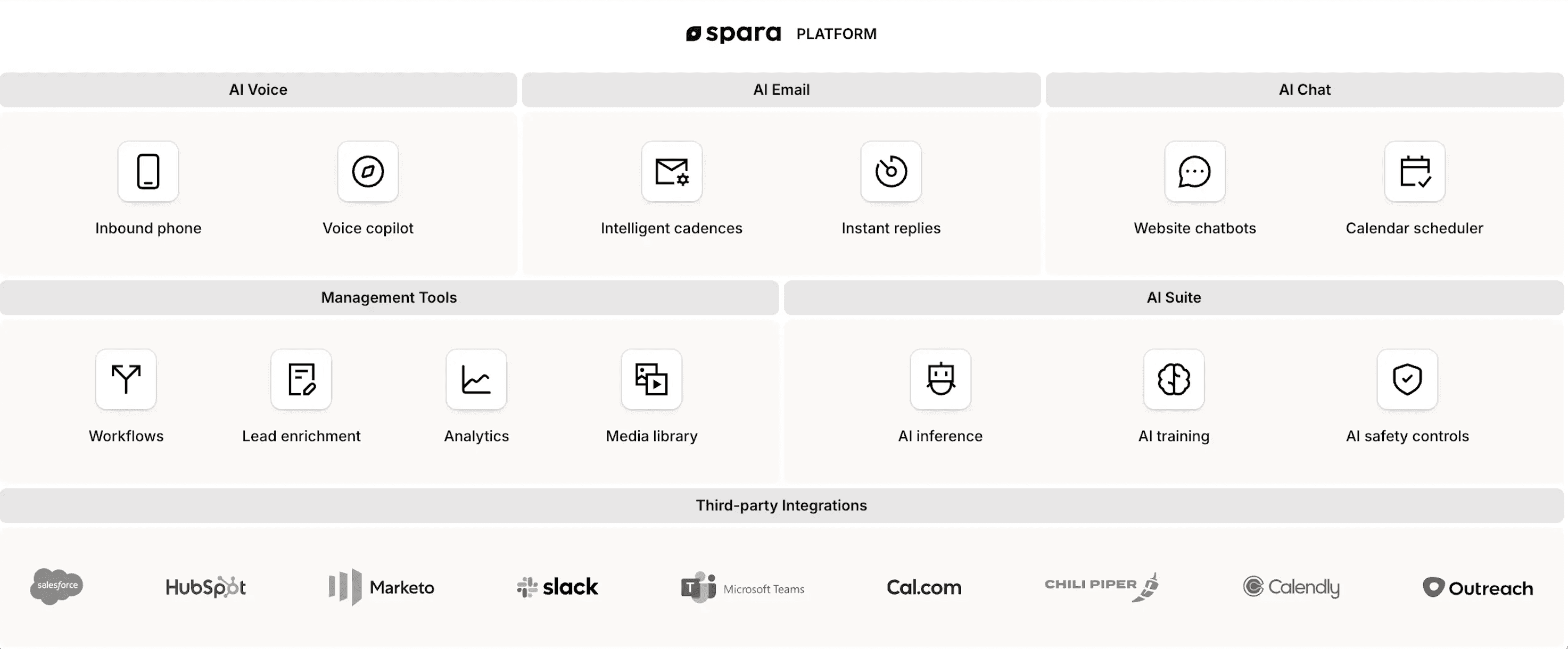
Spara's agents engage buyers, qualify them against your criteria, book meetings, and record every action back in your CRM. They're grounded in your own content and work across chat, email, voice, text, and AI Product Demos.

Lauren ThompsonHead of Marketing, Spara
FAQs
Related posts
View all
GTM
Chili Piper Pricing (2026): Plans, Seats, and Total Cost
Explore Chili Piper pricing, included seats, AI credits, and annual costs. See what affects your total spend and what to confirm before choosing a plan.
Nov 2, 2026
•
7 min read

GTM
Qualified Pricing (2026): Plans, Limits, and Budgeting
Understand Qualified pricing, plan features, and usage limits. Learn what to ask for in a quote and how to compare the full cost with your sales needs.
Nov 2, 2026
•
7 min read
GTM
Qualified Integrations: API, MCP, and Stack Fit
Explore Qualified integrations, API options, and MCP capabilities. See supported tools, access requirements, and how to assess fit for your GTM stack.
Nov 2, 2026
•
5 min read
Sign up for the latest from Spara
Subscribe to get more GTM insights straight to your inbox.