

AI sales agents are becoming a standard part of the modern revenue stack, covering inbound, qualification, and follow-up at scale. The need for that kind of coverage only gets sharper as buyers increasingly expect instant, personalized responses — and SDR coverage simply can’t scale with inbound volume.
An AI sales agent handles that load by autonomously engaging inbound buyers, qualifying intent in real time, and moving the right conversations forward across chat, email, or voice — without adding headcount or slowing reps down.
In practice, agents take on repetitive tasks, follow-ups, and data capture as soon as interest appears, while human sales reps step in when judgment and relationship-building matter most. This combination changes how teams scale pipeline, protect conversion rates, and operate day to day.
To see why they matter, it helps to understand how AI sales agents actually work and where they create the most leverage across the sales process.
From automation to autonomy: the evolution of sales technology
Sales technology has moved in clear phases, each one pushing teams closer to faster execution and higher conversion rates. Here’s how:
Customer relationship management (CRM) systems centralized customer data and sales activity, but relied entirely on manual input and follow-up. Sales reps constantly chased updates, and the system was never fully up to date.
Automation tools introduced workflows for tasks like follow-ups, lead routing, and CRM updates. These tools improved efficiency but still depended on rigid rules and constant maintenance.
Traditional rule-based chatbots handled inbound inquiries using scripted decision trees. They could answer predefined FAQs and capture basic information, but they broke down when prospects asked unexpected questions or stepped outside preset flows.
Conversational AI marked a major shift. Instead of relying solely on scripts, AI-powered systems began using natural language understanding to engage buyers more dynamically, adapt responses in real time, and support more complex qualification and scheduling workflows.
Autonomous AI sales agents represent the next step. An AI sales agent actively handles end-to-end aspects of the sales process rather than simply responding to inbound interactions.
What separates agents from assistants or chatbots is autonomy. AI sales agents can:
Learn from CRM data, past sales conversations, and customer profiles.
Adapt messaging and follow-ups in real time based on buyer intent.
Take action across workflows, not just within a conversation. They qualify leads, enrich data, update CRM records, trigger workflows, and book meetings without requiring manual handoffs.
Optimize outcomes like response time, conversion rates, and qualified lead volume without constant human oversight.
For example, teams use platforms like Spara to deploy AI sales agents that handle inbound engagement, qualification, and meeting booking in real time.
The agent can engage leads instantly, capture and enrich key context in the CRM, and route qualified buyers into the right meeting flow — so reps aren’t stuck doing first-response triage or manual follow-ups.
Instead, they come into conversations with full context and can focus on the deals that are ready to move forward.
Why “AI-native” matters
The difference between retrofitted AI tools and AI-native platforms like Spara becomes obvious as soon as they face real buyer behavior. Retrofitted AI tools were built on pre-LLM architectures, so they inherit the same core constraints as the legacy systems underneath:
Rigid workflows and decision trees
Heavy manual configuration and ongoing rule maintenance
Breakdowns when buyers go off-script or ask unexpected questions
Context loss when conversations move across channels
Automation without intent or nuance
AI-native sales agents built post-LLM operate differently at every layer. They process natural language in real time, reason over multiple data sources, adjust their actions based on context, and maintain continuity as buyers switch between communication channels. That capability allows true autonomy across the sales process instead of surface-level automation.
Spara was built from the ground up just for this purpose. Its AI-powered sales agents support dynamic, multimodal conversations while preserving context as buyers move between channels. That allows the agent to:
Qualify inbound leads based on intent and customer profile
Handle real-time follow-ups and outreach without delays
Update CRM systems like HubSpot or Salesforce automatically
Book meetings and route opportunities without brittle workflows or no-code rule sets
This AI-native approach creates speed and flexibility at scale. Sales teams gain an AI-driven layer that adapts to buyer behavior in real time, streamlines outreach, and supports high-quality engagement, without sacrificing accuracy, compliance, or control.
How AI sales agents work in practice
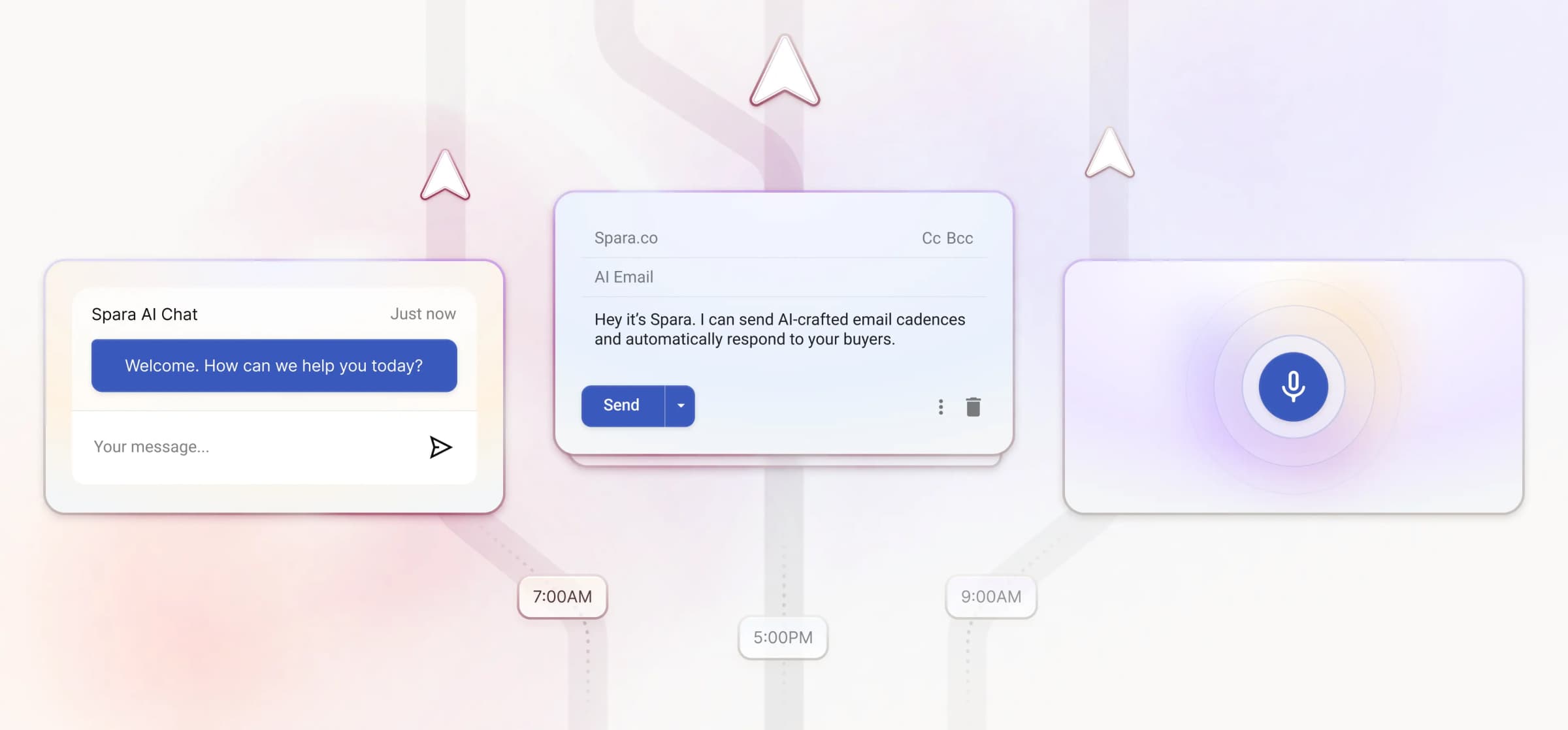
At a high level, AI sales agents operate through four core layers:
Data inputs: The agent pulls from CRM data, marketing automation platforms, product documentation, pricing pages, FAQs, and external data sources like LinkedIn. This gives it context on the buyer, account history, and customer profile.
Training and learning: Generative AI and LLMs are used to train the agent on real sales conversations, qualification criteria, and past outcomes. It uses those patterns to identify which signals typically indicate high intent versus low-quality leads.
Decision logic: Instead of rigid workflows, the agent evaluates intent, fit, and timing in real time. It adjusts follow-ups, outreach, and messaging based on how the conversation evolves.
Action layer: The agent takes action immediately, updating CRM records, enriching lead data, routing leads, or scheduling meetings, all without waiting on a human handoff.
That system allows AI sales agents to plug directly into your existing stack, including:
CRM integrations like Salesforce or HubSpot keep sales data accurate and updated automatically.
Marketing automation tools trigger outreach, personalized email follow-ups, and workflow updates.
Scheduling systems book meetings the moment a buyer qualifies, cutting response time to seconds.
In practice, these show up in clear use cases sales teams care about:
Instant qualification from inbound traffic: The agent engages visitors immediately, qualifies intent in real time, enriches CRM data, and routes high-intent buyers to a meeting—without forcing them through a static form experience.
Real-time routing and meeting booking: The agent routes qualified buyers to the right SDR or salesperson and books meetings on the spot, protecting speed-to-lead and conversion.
Personalized email follow-up at scale: Using CRM data and conversation context, the agent sends tailored follow-ups and nudges buyers toward the next step, without manual sequencing.
The multi-channel agent in action
A multi-channel AI sales agent doesn’t wait for buyers to stay in one lane. It follows them wherever the conversation goes.
Here’s what a typical day looks like in practice:
A buyer lands on your site and starts a chat with a pricing question. The agent answers using your latest pricing from your pricing page.
The same buyer leaves an email address. The agent sends a personalized email follow-up asking qualification questions and urging them to book a demo.
Later that day, the buyer calls to clarify an integration detail. The agent recognizes the caller, summarizes prior interactions, and continues the conversation without missing context.
Once the buyer meets the qualification criteria, the agent books a meeting, updates the CRM, and notifies the sales team in Slack with conversation summaries and key signals.
Spara’s AI sales agents operate across chat, email, and voice as a single system, not disconnected tools. This multi-modal approach helps sales teams streamline workflows, reduce repetitive tasks, and maintain a consistent sales conversation from first contact to booked meetings.
The ROI of deploying an AI sales agent
The ROI of an AI sales agent shows up quickly because it impacts the metrics revenue teams already track, and struggle to improve.
Key performance gains typically fall into three areas:
Speed-to-lead: AI sales agents respond in real time and after hours across communication channels. Faster response times lead directly to higher conversion rates, especially for high-intent inbound traffic. Teams stop losing deals simply because a competitor replied first.
MQL to SQL conversion quality: Instead of surface-level qualification, AI-driven agents use contextual signals from CRM data, sales conversations, and customer profiles. That improves lead quality, reduces noise for SDRs, and increases the percentage of qualified leads that convert into real opportunities.
Pipeline velocity and faster closes: Real-time routing, instant meeting booking, and automated handoffs remove friction between marketing, SDRs, and sales reps. Deals move through the sales process faster because buyers never stall in queues.
That’s the model platforms like Spara are built for: AI handles the high-volume work that doesn’t require human judgment — first response, qualification, follow-ups, and routing — so reps spend their time on qualified conversations and active deals. The result is more pipeline coverage without adding headcount.
When and where to deploy an AI sales agent
An AI sales agent delivers the most impact when speed, scale, and consistency directly affect revenue. Certain environments make the ROI unmistakable.
You’ll get the most out of an AI sales agent when you have:
High inbound volume with a leaky funnel: When traffic outpaces human coverage, AI sales agents qualify, enrich, and route leads in real time, protecting conversion rates without adding headcount.
SDR bandwidth constraints: AI-powered sales agents absorb repetitive tasks like outreach, follow-ups, and data entry, allowing SDRs to focus on high-quality conversations and closing deals.
Missed after-hours engagement: AI-driven agents engage prospects instantly across chat, email, and inbound phone calls. They answer questions, qualify intent, and route or book meetings in real time.
Response lag between MQL and SQL: Real-time decision logic eliminates queues. AI sales agents move qualified leads straight into meetings, accelerating pipeline speed and reducing drop-off.
Modern conversational AI also acts as a secure extension of your GTM stack. Built correctly, it integrates cleanly with CRM data, marketing automation, APIs, and sales tools, while maintaining SOC 2 and GDPR standards and protecting data ownership.
Spara allows teams to deploy AI sales agents across each of these touchpoints with measurable lift, without forcing changes to existing workflows or tech stacks.
Avoid these common AI sales agent pitfalls
An AI sales agent can drive meaningful gains in speed, conversion rates, and pipeline efficiency, but only when teams deploy it thoughtfully. Before rolling out automation at scale, understand and avoid these pitfalls that can undermine results if left unchecked:
Don’t over-automate: AI should enhance human sellers, not replace trust-building and judgment.
Prioritize security and compliance: Choose providers with clear SOC 2/GDPR compliance and transparent data handling.
Avoid “set it and forget it” thinking: Continuous fine-tuning, testing, and optimization keep AI sales agents aligned with your sales process and buyer expectations.
How to evaluate the right AI sales agent platform
Choosing the right AI sales agent platform requires looking past feature lists and focusing on how the system actually drives pipeline outcomes. The strongest platforms share a clear set of must-haves.
Use this checklist to help you evaluate the right platform for your needs.
AI-native foundation: Look for platforms built post-LLM. An AI-native system adapts in real time, learns from sales data, and avoids rigid workflows that break during real sales conversations.
Multi-channel support: Buyers move between chat, email, and voice. The AI sales agent should maintain context across channels so conversations feel continuous, not fragmented.
CRM and calendar integration: Native integrations with Salesforce, HubSpot, and scheduling tools allow the agent to qualify leads, update CRM data, and book meetings without manual intervention.
Security and compliance: SOC 2 and GDPR compliance matter. The platform should offer transparent data handling and clear ownership of customer data across all data sources.
Proven results: Prioritize vendors that tie AI-driven performance to measurable metrics like qualified leads, conversion rates, and reduced SDR workload.
Ease of deployment: Fast onboarding and minimal configuration signal a mature product. Teams should see impact in days or weeks, not months.
Platforms like Spara demonstrate what this looks like in practice. Customers such as Fama saw results within their first 30 days, including 2.5x more qualified meetings, a 40% drop in demo no-shows, and a 32% SQL conversion lift across all inbound leads. This is proof that the right AI sales agent multiplies output without adding complexity.
The future of AI sales agents
AI sales agents are evolving from point solutions into full GTM copilots that operate across the entire funnel. Instead of handling isolated tasks, AI-driven agents will coordinate workflows that span lead generation, qualification, routing, follow-ups, and post-meeting handoffs.
As these platforms mature, AI sales agents will:
Act across multiple funnel stages without losing context.
Orchestrate outreach, CRM updates, and scheduling as a single system.
Optimize decisions in real time based on sales data and buyer behavior.
What won’t change is what drives competitive advantage. Trust, speed, and personalization will continue to separate teams that convert from teams that fall behind. AI sales agents that earn buyer trust, respond instantly, and adapt to each customer profile will define how modern sales teams scale, without sacrificing human connection.
Spara’s approach supports these developments by using AI-powered workflows to connect conversations, actions, and outcomes across chat, email, and voice.
AI sales agents and the human edge
The most effective AI sales agents amplify human performance instead of replacing it. By handling repetitive tasks, real-time qualification, and follow-ups, AI-driven agents free sales reps to focus on judgment, relationships, and closing complex deals.
That combination delivers speed, trust, and personalization at scale, without losing the human edge.
Discover how Spara’s AI sales agents help your team engage faster, qualify smarter, and convert more pipeline.

Lauren ThompsonHead of Marketing, Spara
FAQs
Related posts
View all
GTM
Drift sunset 2026: timeline, impact, and next steps
Salesloft retires Drift on January 31, 2027. See what stops working, when unexported data is deleted, and how to plan your move.
Oct 16, 2026
•
8 min read
GTM
Drift review 2026: what it did, where it fell short, and what to use instead
Drift is being retired on January 31, 2027. What it did well, what reviewers said, and what to look for in its replacement.
Oct 16, 2026
•
10 min read
GTM
Drift pricing in 2026: plans, costs, and what to budget now
Drift's last public price was $2,500 a month for Premium, billed annually. See what each plan included, what the sunset changes, and what to budget now.
Oct 16, 2026
•
6 min read
Sign up for the latest from Spara
Subscribe to get more GTM insights straight to your inbox.