

Artificial intelligence (AI) now powers a growing share of automation tasks across industries. Teams use AI marketing tools to streamline content marketing, campaign execution, reporting, data sync, and more. These tools learn from real buyer behavior, adapt as conditions change, and help teams make data-driven decisions in real time.
Leaders like CMOs, marketing ops, and RevOps teams are paying attention to these tools. Pipeline pressure is rising, speed-to-value matters more than ever, and buyer journeys are scattered across channels and devices. To address these challenges, AI marketing tools connect multiple touchpoints, enrich data, personalize engagement, or execute outreach.
In this guide, we explain the benefits AI marketing tools deliver and how to choose them carefully to avoid tool sprawl and build an efficient, connected system.
What limitations do traditional marketing tools still have?
When automation first entered the GTM stack, it felt like a breakthrough for marketing teams. They could execute email campaigns at scale, route leads automatically, and follow up without relying on human memory alone.
But as buying journeys became more fluid, the cracks in traditional automation started to show. What once felt efficient now feels rigid and fragmented, especially as teams attempt to manage high-quality experiences across channels. A few limitations include:
They automate tasks without intuition
Most traditional marketing tools are great at executing individual actions such as sending an email, triggering a chatbot response, or logging an activity.
The moment a buyer behaves in an unexpected way, however, the system stops and waits for human intervention. That pause introduces friction, slows momentum, and creates gaps where high-intent leads often go cold.
They demand ongoing maintenance
The customer experience only changes when teams refine the rules set within traditional automation tools. That requires constant buyer behavior monitoring, ongoing market research, and improving logic and messaging as the dynamics change.
They operate in silos across channels
Traditional conversational tools often treat chat, email, and voice as separate systems. Because they don’t share context effectively, conversations often lose momentum as buyers move between channels. In every new channel, buyers have to explain themselves again, while sales teams search across channels to understand the full customer relationship.
How AI agents fit into the broader AI marketing landscape
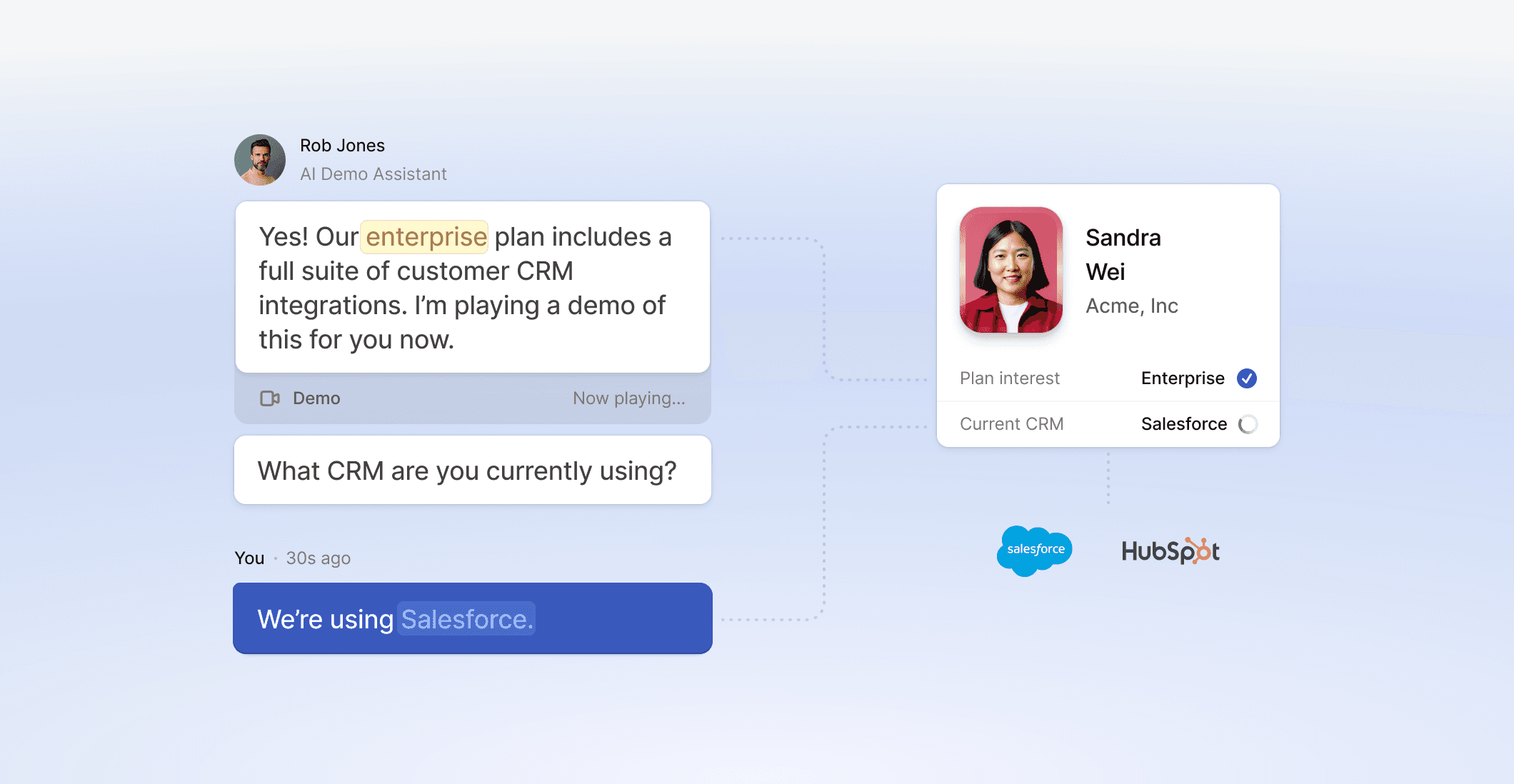
AI marketing tools have expanded across the GTM stack, with most focusing on specific functions like drafting content, optimizing campaigns, scoring leads, or automating email outreach.
Each tool strengthens a defined area: a content platform accelerates production, a qualification tool improves scoring, and an email tool adapts timing or messaging. But the overall workflow still depends on coordination between systems and people.
As buyer journeys move fluidly between chat, email, and voice, that coordination layer becomes harder to manage, which can create delays or misalignment as context evolves.
AI agents manage this by maintaining context across channels and executing next steps without requiring manual intervention.
Instead of optimizing one task, they coordinate multiple tasks at once. An agent can:
Engage a high-intent visitor
Qualify in real time
Follow up over email
Update CRM data
Route to the right rep
Continue the conversation without losing context
For teams evaluating AI marketing tools, the distinction comes down to how much of the workflow you want your tools to handle. Some platforms improve individual functions, while others are designed to carry inbound demand forward across channels with less manual oversight.
What should you look for when choosing an AI marketing tool?
Because AI marketing tools now range from content generators to agentic systems that qualify, route, and nurture inbound demand across channels, the first step in evaluation is defining the workflow you want the tool to improve. Choosing an AI marketing tool requires more than comparing feature lists. If your priority is inbound qualification, cross-channel engagement, faster follow-up, or reducing operational drag across chat, email, and voice, evaluate tools based on how well they carry conversations forward, not just how many features they list. This section outlines what actually matters during evaluation, from cross-channel context and usability for GTM teams to trust, accuracy, and time-to-value.
Look for tools that support multiple channels
As you compare tools, pay attention to whether they share context across touchpoints using unified customer data. When channels operate in isolation, interactions stay hidden within each one. A lead appearing on a new channel may be treated as new even though they’re already engaged in another channel.
Tools that carry context across channels prevent this reset. Buyers get a consistent, high-quality experience as conversations continue and GTM teams get a complete view of customer interactions.
Favor the tools that GTM teams can shape without engineering
Platforms that rely on engineering for routine changes slow learning and limit adoption. Tools built for GTM power users let teams adjust workflows, qualification logic, and engagement patterns on their own, so they can adapt as they learn without waiting on technical help.
Prioritize trust, accuracy, and clear guardrails
As AI takes on more responsibility, it also takes on more risk. This applies whether the system generates content, makes decisions, or interacts directly with buyers.
Strong AI tools don’t hide how they work. They clearly explain how decisions are made, where humans stay in control, and how data is handled. Guardrails, transparency, and compliance are not optional. They’re what make AI-powered marketing usable at scale.
Evaluate time-to-value, not just long-term potential
Pay attention to how quickly teams see impact after implementation and whether vendors can point to measurable outcomes. Fast feedback loops make it easier to course-correct and expand usage.
What are the benefits of AI marketing tools?

AI marketing tools drive results by improving inbound qualification and conversion, accelerating follow-up and nurturing, and supporting sales conversations. Here’s how those benefits translate into real impact.
Increased inbound qualifications and conversions
While some AI marketing tools focus on generating demand through content and campaigns, others are designed to capture, qualify, and convert that demand once it appears. AI agents enable teams to engage prospects the moment intent appears and guide them to the next best action while interest is still high.
Real-time AI interactions clarify buyers’ needs, tailor responses based on customer behavior and context, and remove friction that causes qualified prospects to drop off. For example, after implementing Spara AI, fintech platform Ora increased inbound conversions by 4x.
Accelerated follow-up and nurturing
AI marketing tools speed up follow-up and nurturing by removing the manual bottlenecks that slow momentum when a lead enters the funnel. They continuously evaluate how prospects engage, what content they consume, and where they are in the buying journey, then adjust messaging and timing to match.
Effective lead nurturing increases the number of sales-ready leads while lowering acquisition costs because prospects receive relevant information when interest is building rather than after it fades. AI closes that gap by personalizing outreach automatically and triggering follow-ups as soon as intent signals appear.
Sales conversation support
AI tools can analyze sales calls and meetings to identify intent signals, objections, competitor mentions, and next steps, then feed that information back into marketing and sales systems to improve messaging.
Some AI-powered tools also assist sales conversations in real time. During live calls, AI assistants can answer technical questions when reps need help, using product knowledge they’re already trained on.
Optimized GTM operations
AI marketing tools reduce operational drag by automating reporting, analysis, and real-time data sync. Leaders see performance and risk earlier without assembling data manually.
By modeling demand and pipeline flow, AI helps allocate budget, coverage, and effort, so resources go where they matter most.
This shifts GTM planning from reactive adjustments to proactive resource allocation. McKinsey research shows that organizations that apply AI to GTM operations improve marketing ROI and free up time to focus more on customers and prospects than administrative tasks.
Create faster, more helpful buyer journeys with AI agents
Content tools create assets, automation tools automate workflows, and analytics tools explain what happened after the fact. With no single system moving them forward in real time, buyers still experience delays, one-way conversations, repeated questions, and broken handoffs.
Agentic GTM systems address this gap by giving AI ownership of progression. AI agents respond as intent appears, adapt to buyer context, and act autonomously across channels. They also qualify interest through live interaction, route conversations without delay, and continue engagement without losing context.
Because agents operate continuously and coordinate actions themselves, they remove the waiting periods and manual transitions that typically slow inbound motion. The benefit is a faster and more helpful journey for buyers and a cleaner operating model for GTM teams.
Buyers get immediate answers and clear next steps instead of waiting in queues. Teams spend less time coordinating handoffs and more time in meaningful conversations. As demand scales, the system scales with it without adding operational burden.
See how Spara’s AI agents qualify, route, and convert inbound buyers instantly by adapting to intent and orchestrating workflows across channels.

Lauren ThompsonHead of Marketing, Spara
FAQs
Related posts
View all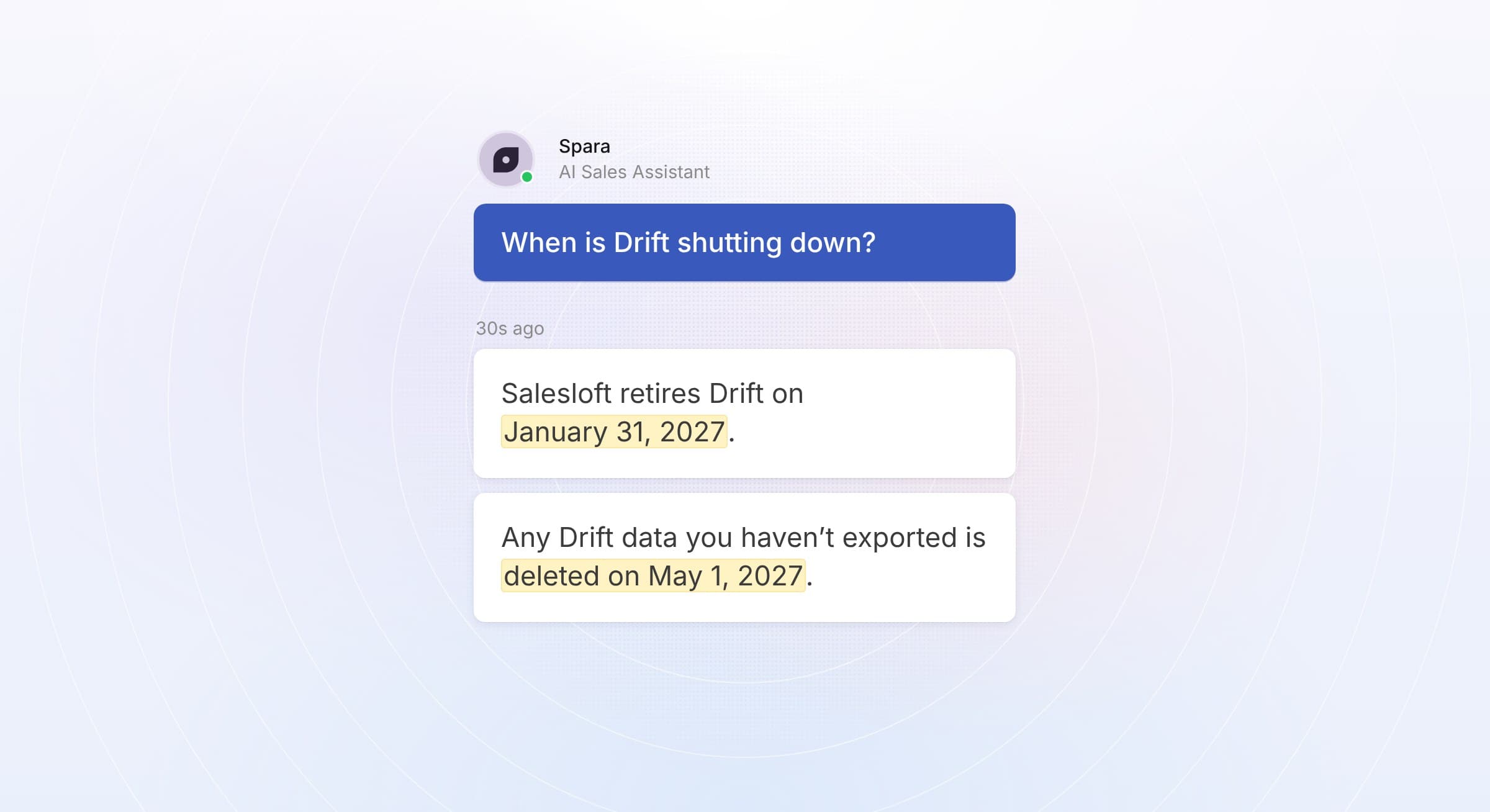
GTM
Drift sunset 2026: timeline, impact, and next steps
Salesloft retires Drift on January 31, 2027. See what stops working, when unexported data is deleted, and how to plan your move.
Oct 16, 2026
•
8 min read
GTM
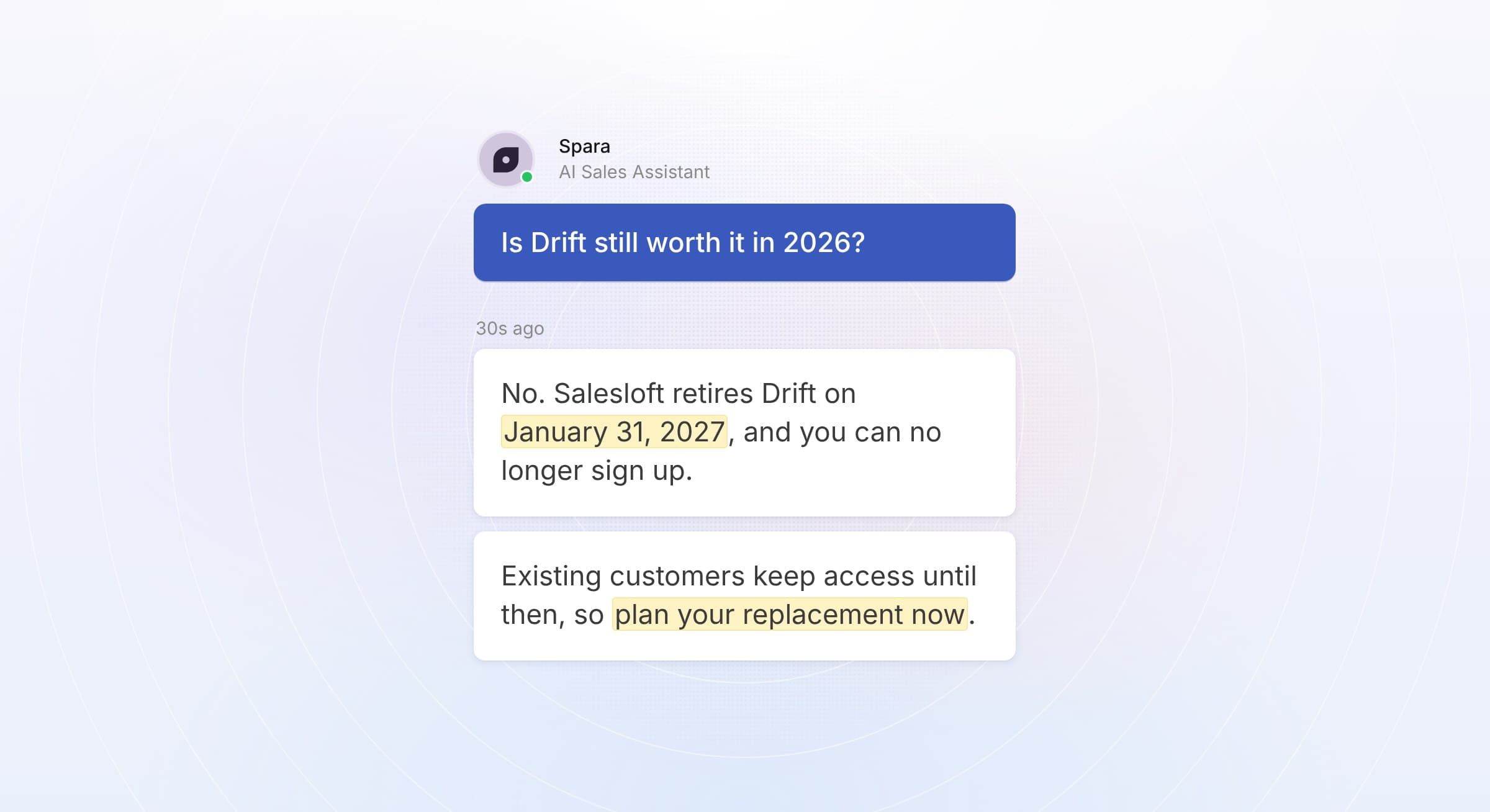
Drift review 2026: what it did, where it fell short, and what to use instead
Drift is being retired on January 31, 2027. What it did well, what reviewers said, and what to look for in its replacement.
Oct 16, 2026
•
10 min read
GTM
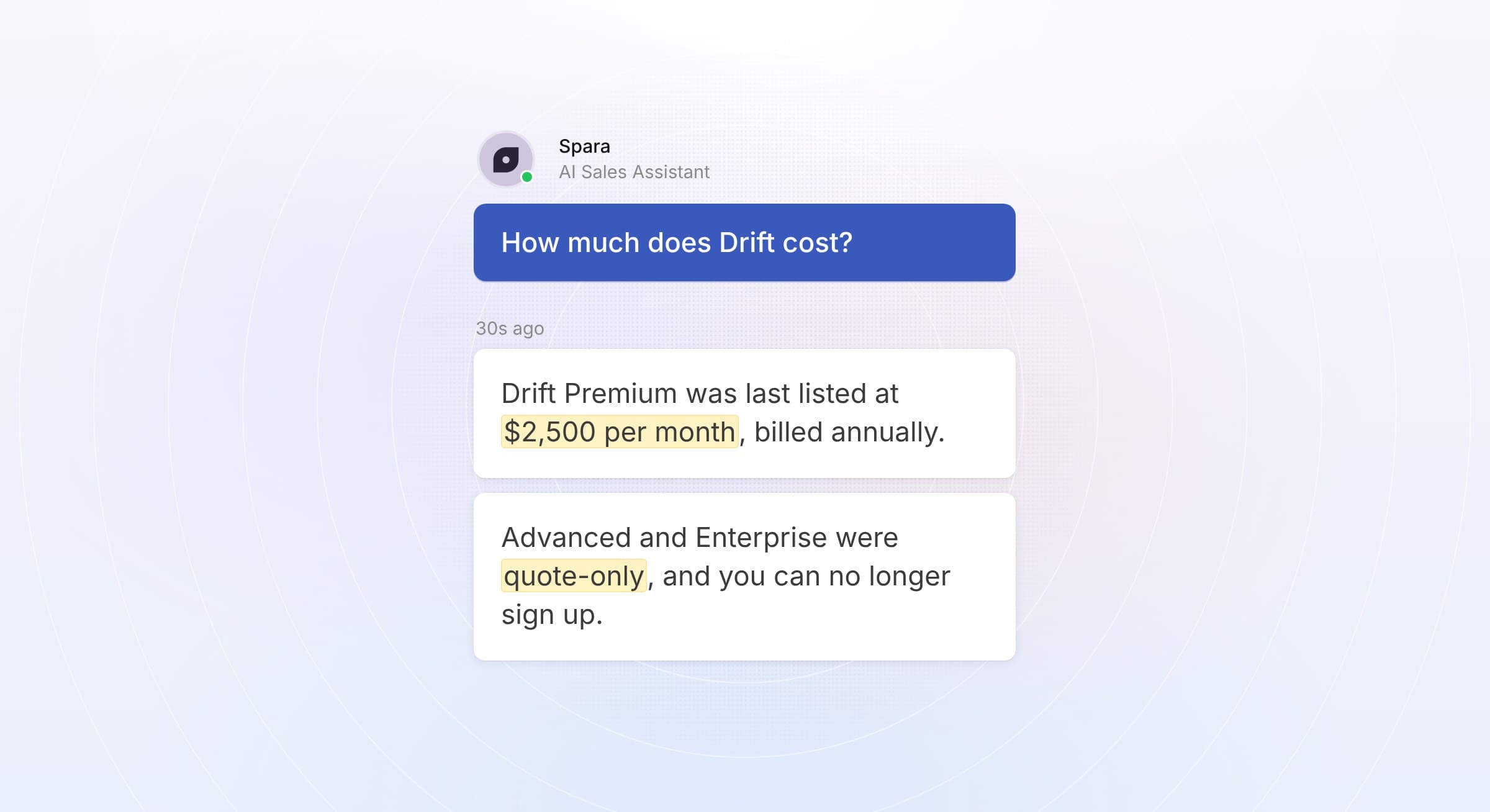
Drift pricing in 2026: plans, costs, and what to budget now
Drift's last public price was $2,500 a month for Premium, billed annually. See what each plan included, what the sunset changes, and what to budget now.
Oct 16, 2026
•
6 min read
Sign up for the latest from Spara
Subscribe to get more GTM insights straight to your inbox.