

Your inbound motion lives or dies by how fast you respond. When a prospect raises their hand on your site, in your product, or via a campaign, they expect a real conversation in minutes or seconds.
The problem is simple but brutal because your buyers now operate on real-time expectations, while most sales orgs are still built around office hours and manual SDR follow-up. That gap is where pipeline leaks, meetings fall through, and high-intent buyers quietly go back to Google.
Conversational AI in sales changes that dynamic. Instead of waiting for a rep to become available, AI agents quickly greet qualified buyers, ask relevant questions, and offer tailored answers. This helps efficiently guide them to the next step, whether it's booking sales time, starting a product trial, or connecting with the right team.
Below, you’ll learn how to approach conversational AI in sales, create a solid business case focused on speed-to-lead and conversion, and identify key features when assessing modern, AI-native platforms like Spara.
The shift from traditional chatbots to true conversational AI
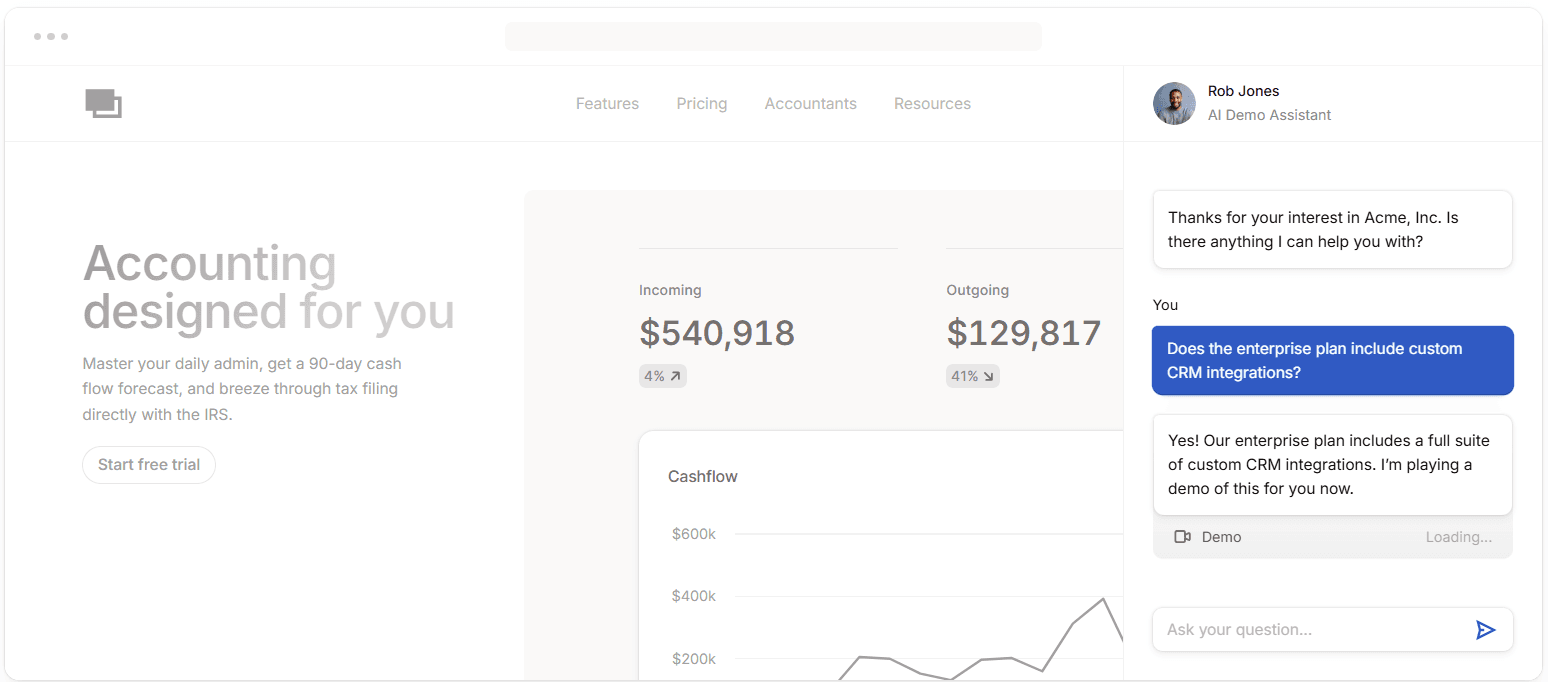
Traditional chat widgets were rule-based decision trees. You configured buttons and scripts: “If they click pricing, show option A, B, or C.” They could capture basic info and hand off a chat transcript, but they couldn’t actually run a nuanced sales conversation or adapt when a buyer colored outside the lines.
Modern conversational AI is fundamentally different. It’s powered by large language models (LLMs) and orchestration logic that lets agents understand intent, reference your content, and respond in natural language. Instead of forcing buyers down a rigid branch, AI can:
Ask follow-up questions based on how someone answers, not just what they click
Pull in context from your CRM, MAP, or data warehouse to personalize the conversation
Summarize what it learned and automatically push that back into your systems
The difference is simple: legacy systems capture lead info, while AI-native platforms convert qualified interest in the moment.
When a highly motivated prospect visits your pricing page, a basic rule-based system may collect their email, but a sophisticated conversational AI can grasp their specific needs, assess suitability, address concerns, and even schedule a meeting with the appropriate representative, all in one seamless interaction.
Why “AI-powered” doesn’t always mean intelligent
“AI-powered” has become a default label across the GTM stack. But in many cases, it simply means AI features were layered onto infrastructure built long before LLMs existed. These platforms still rely on rigid decision trees and scripted workflows. The AI sits on top, generating responses, but underneath, the logic hasn’t changed.
When a prospect asks something unexpected, switches topics, or moves channels, the experience breaks, and the following happens:
Context disappears
Conversations reset
What’s marketed as intelligent feels disjointed and inauthentic
True intelligence requires architectural change.
For instance, Spara was built post-LLM, not retrofitted. Its AI-native foundation means adaptive conversations aren’t an add-on—they’re core to how the platform operates. Agents learn from your sales process, maintain context across chat, email, and voice, and qualify dynamically instead of following static scripts. The result is AI that understands, adapts, and converts in real time.
The business case for conversational AI in sales
Most teams have enough inbound coming in. The problem is how much of that intent makes it to a real meeting.
Inbound funnels leak at three critical points: slow follow-up, inconsistent qualification, and wasted SDR cycles. A prospect fills out a form. It sits in a queue. An SDR responds hours or days later. By then, the buyer is already in conversation with a competitor.
That delay compounds. First, slower follow-up lowers qualification rates, then manual back-and-forth increases no-shows, and finally, SDRs spend time chasing low-intent leads instead of engaging real buyers.
Conversely, conversational AI addresses these breakdowns directly. Instead of waiting for human availability, AI agents engage instantly, qualify in real time, and route high-intent buyers immediately. The impact is measurable:
Increase in qualified meetings booked
Reduction in demo no-shows through immediate scheduling and confirmation
Hours of SDR time reclaimed from repetitive qualification
Higher SQL conversion across inbound leads
This is why speed-to-lead is now a revenue metric. Additionally, speed-to-value, which is how quickly a buyer reaches an important next step, is equally critical. When response time drops from hours to seconds, conversion rates follow. And when conversion improves, pipeline becomes more predictable.
Quantifying ROI beyond efficiency
It’s easy to tell a story about “X% more meetings” or “Y hours saved per week,” but the real value of conversational AI in sales needs to show up in pipeline and revenue.
To build a credible business case, you should look at metrics across three layers:
Top-of-funnel impact: Change in the percentage of inbound leads that become qualified meetings, and the speed from first touch to that meeting.
Pipeline quality: Win rates and average deal size for AI-qualified leads versus your historical baseline.
Team productivity: How many SDR hours are now focused on strategic outreach instead of chasing unqualified inbound or doing manual data entry.
Spara’s customers typically start by running A/B-style motions or specific segments (e.g., website pricing page, specific campaigns) through AI agents, then comparing conversion and pipeline outcomes against their existing process.
That focus on outcome-based proof, rather than hypothetical efficiency gains, gives you a grounded ROI story you can defend with finance and the rest of the leadership team.
How conversational AI enhances the modern sales motion
In traditional models, SDRs spend a large amount of their time monitoring form fills, manually qualifying inbound leads, routing those leads, and following up on low-intent inquiries. This work is operational rather than focused on strategic selling.
Conversational AI shifts that dynamic through inbound SDR automation. Instead of SDRs acting as reactive routers, they become strategists who design and oversee your qualification logic while AI handles the first interaction. Here’s what that looks like in practice:
Website chat to instant qualification: An AI agent greets visitors on high-intent pages, asks tailored discovery questions, and either books a meeting, guides them to relevant resources, or redirects them to self-serve options.
Email agents for warm follow-ups: After a demo request or content download, AI follows up via email with contextual messaging, answers questions, and nudges prospects toward scheduling if they’re ready.
Voice AI for real-time call triage: On inbound calls, AI can gather key details, verify basic qualifications, and route to the right person or queue with clear, structured notes.
When these channels share a single conversational brain and CRM backbone, you get true 24/7 coverage. Buyers experience a consistent, helpful guide from first touch onward, and your team gains a reliable engine that keeps inbound moving while they focus on later-stage deals and strategic outreach.
Supporting (not replacing) sales reps
The fear that AI replaces sales teams misunderstands the problem. It’s not about replacing people, but rather, it’s about automating the busywork so humans can focus on the conversations and decisions that actually move deals forward.
Repetitive qualification, calendar coordination, and initial information gathering are necessary but not high-leverage tasks. When AI absorbs that workload, SDRs and AEs can focus on high-value conversations, including navigating objections, building consensus, and advancing complex deals.
Human nuance remains critical because enterprise buying decisions involve multiple stakeholders, risk evaluation, and relationship-building. AI accelerates the path to that conversation, but it doesn’t replace it.
In practice, teams see:
More time spent on qualified buyers
Less burnout from manual follow-up
Higher-quality conversations entering the pipeline
Instead of removing the human element, conversational AI ensures that when humans engage, they’re doing the work only humans can do.
The role of data and compliance in AI-powered sales
Beyond sounding smart, an AI agent has to be secure, auditable, and aligned with your compliance posture. For most enterprise and mid-market teams, that means your conversational AI platform must:
Meet standards like SOC 2 to demonstrate sound security practices
Support GDPR-compliant data handling, including data residency and deletion rights where required
Offer clear controls over what data the AI can access, store, or send to third-party models
Provide logging and monitoring so you can review and audit interactions
Spara was designed as an AI-native platform with these requirements at the core, not as an afterthought. Agents operate as a controlled extension of your GTM stack, with configurable access to CRM fields, content sources, and external systems. That lets you unlock AI-driven engagement without creating hidden data exhaust or unpredictable behavior that your security team can’t see or govern.
Building a seamless buyer experience with AI
Every interaction with your AI agents is a brand moment. If the tone feels off, the answers are generic, or the experience seems disjointed across channels, you’ll lose trust before a human ever gets involved.
Strong conversational AI in sales is powered by contextual learning. Instead of responding with generic model output, your AI should be grounded in your:
Website and product documentation
Case studies, customer stories, and vertical-specific collateral
Pricing, packaging, and qualification criteria
Brand voice guidelines and tone preferences
That grounding lets AI agents mirror how your best reps talk about your product. A prospect chatting on your site, getting follow-up via email, or interacting through voice should feel like they’re dealing with the same helpful, knowledgeable guide every time.
Teams using Spara typically begin with a clear persona or priority use case, configuring the agent to reflect their qualification criteria and brand voice. As it learns from real conversations, the AI becomes a consistent extension of your GTM team, guiding buyers through the funnel instead of slowing them down with forms and handoffs.
How to evaluate conversational AI solutions for your sales org
Once you’ve decided conversational AI should be part of your sales motion, the hard part begins: choosing the right platform. The market is crowded, and many tools sound similar on the surface.
Here’s how revenue teams should evaluate solutions.
AI-native architecture: Was the platform built post-LLM with agents at the core, or is it a legacy chatbot with AI “features” added on? AI-native systems typically adapt better, improve faster, and integrate more deeply.
End-to-end workflow execution: Can the platform run full workflows from first touch to booked meeting and CRM update without manual handoffs? Beyond qualifying leads, the AI should route them, schedule meetings, update records, and automatically trigger follow-up actions.
Multi-modal engagement: Look for a single platform that can handle chat, email, and voice, with a unified brain and shared context across channels.
CRM & scheduling integration: The AI should reliably read and write structured data to your CRM and calendar system, not just drop unstructured notes that reps ignore.
Security and compliance: Confirm SOC 2, GDPR readiness where relevant, and clear documentation of data flows and model usage.
Proven pipeline metrics: Ask for concrete examples of improved conversion, faster speed-to-lead, and better show rates.
When you evaluate Spara or any other platform, run a small but real experiment: enable AI on a meaningful slice of inbound traffic and compare outcomes to your current flow. That’s the fastest way to see whether an “AI-native” promise actually shows up in your Salesforce reports as a more qualified pipeline, not just more conversations.
The future of conversational AI in sales
Today, most teams start with conversational AI at the top of the funnel, including website chat and inbound phone number to answer calls or email follow-up. But the trajectory is clear as AI agents are moving further down the funnel and taking on more orchestration work across the entire revenue engine.
In the near term, you can expect AI agents to:
Proactively re-engage dormant opportunities and trial users with context-aware outreach
Coordinate multi-threaded communication across different stakeholders in an account
Support AEs during live deals with research, recap, and next-step suggestions
Platforms like Spara are evolving from point solutions for inbound conversion into agentic systems of action that sit alongside your CRM. Instead of being a system of record you report on after the fact, your GTM stack becomes an environment where AI can both interpret what’s happening and take appropriate, governed actions to move deals forward.
The sales organizations that succeed in the future will be those that combine human creativity, strategy, storytelling, and negotiation with AI's precision in execution, routing, and follow-through.
Benefit from conversations that actually convert
You don’t need another channel that collects leads and pushes them into an already crowded queue. You need a way to turn high-intent interest into a qualified pipeline quickly, reliably, and at scale, without burning out your team.
Conversational AI for sales gives you that layer. It engages instantly, qualifies dynamically, enriches lead data in real time, and routes high-intent buyers to the right rep without friction. Every interaction strengthens your CRM instead of creating manual cleanup. Every touchpoint moves the deal forward instead of restarting the process.
If you’re ready to see how AI can qualify, convert, and keep deals moving from first touch through follow-up, chat with Spara today.

Lauren ThompsonHead of Marketing, Spara
FAQ
Related posts
View all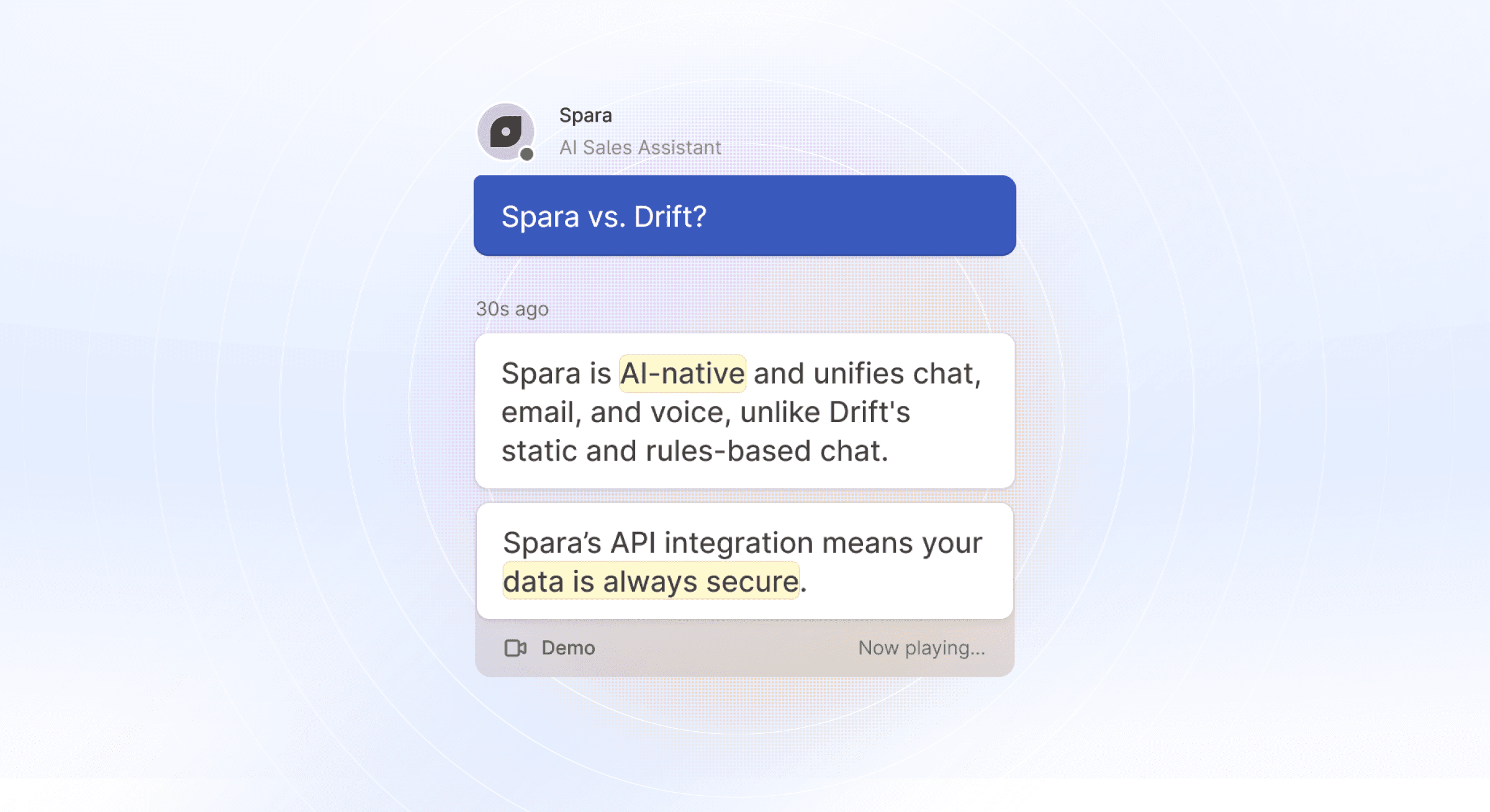
GTM
Top 5 Drift alternatives in 2026 for better lead conversion
Drift is winding down and 1mind is the named successor, but it isn’t the only option. Five Drift alternatives compared, plus a migration checklist.
Oct 10, 2026
•
10 min read
GTM
Jon Harper on the four traps that stall complex deals before the proposal
Jon Harper's PEO reps closed 35 to 45% of the deals they proposed, but only 9% of first meetings ever got that far. The BizBenchmark founder breaks down the four traps that stall complex deals, and what to do instead.
Oct 9, 2026
•
4 min read
GTM
How Clay Built a Partner Motion That Drives 20% of Revenue
Nancy Mottice joined Clay as it moved from product-led growth into enterprise. Since then, partner-sourced revenue is up 16x and drives 20% of the business. Here are the six steps she took to get there.
Oct 9, 2026
•
7 min read
Sign up for the latest from Spara
Subscribe to get more GTM insights straight to your inbox.