
If you handle inbound for a B2B team, you know the pain of "great" leads that never turn into pipeline. Forms get filled, MQL reports look healthy, but Sales still struggles to create real opportunities. The problem usually is not demand volume, but a lead qualification process that cannot keep up with how buyers actually research, engage, and buy.
This guide gives you a practical framework to turn inbound interest into qualified pipeline. You’ll see how to define "qualified," choose a framework that matches your motion, operationalize it in your stack, and keep it aligned with sales over time.
B2B lead qualification: What it protects and why it breaks
Done well, B2B lead qualification is revenue infrastructure. High-intent buyers are recognized quickly, routed to the right rep, and handed off with enough context that the first meeting moves straight into discovery. Marketing budgets, sales reps’ capacity, and revenue forecasts stay protected from unfiltered inbound volume.
When qualification breaks, the impact compounds. Marketing passes MQLs that sales views as “just another form fill.” Reps cherry-pick familiar accounts and ignore the rest. Discovery calls stall because there’s no clear problem, no budget horizon, or no real stakeholder.
As a result, the sales pipeline fills with deals that look credible in your CRM but won’t close.
This failure often hides behind surface metrics: rising MQL counts while lead-to-opportunity conversion rates stay flat, or a full SDR calendar that rarely advances to stage two. Fixing it means treating qualification as a shared Sales and Marketing system with clear rules, well-placed automation, and regular tuning based on what actually turns into revenue.
What counts as a "qualified lead" in modern B2B sales
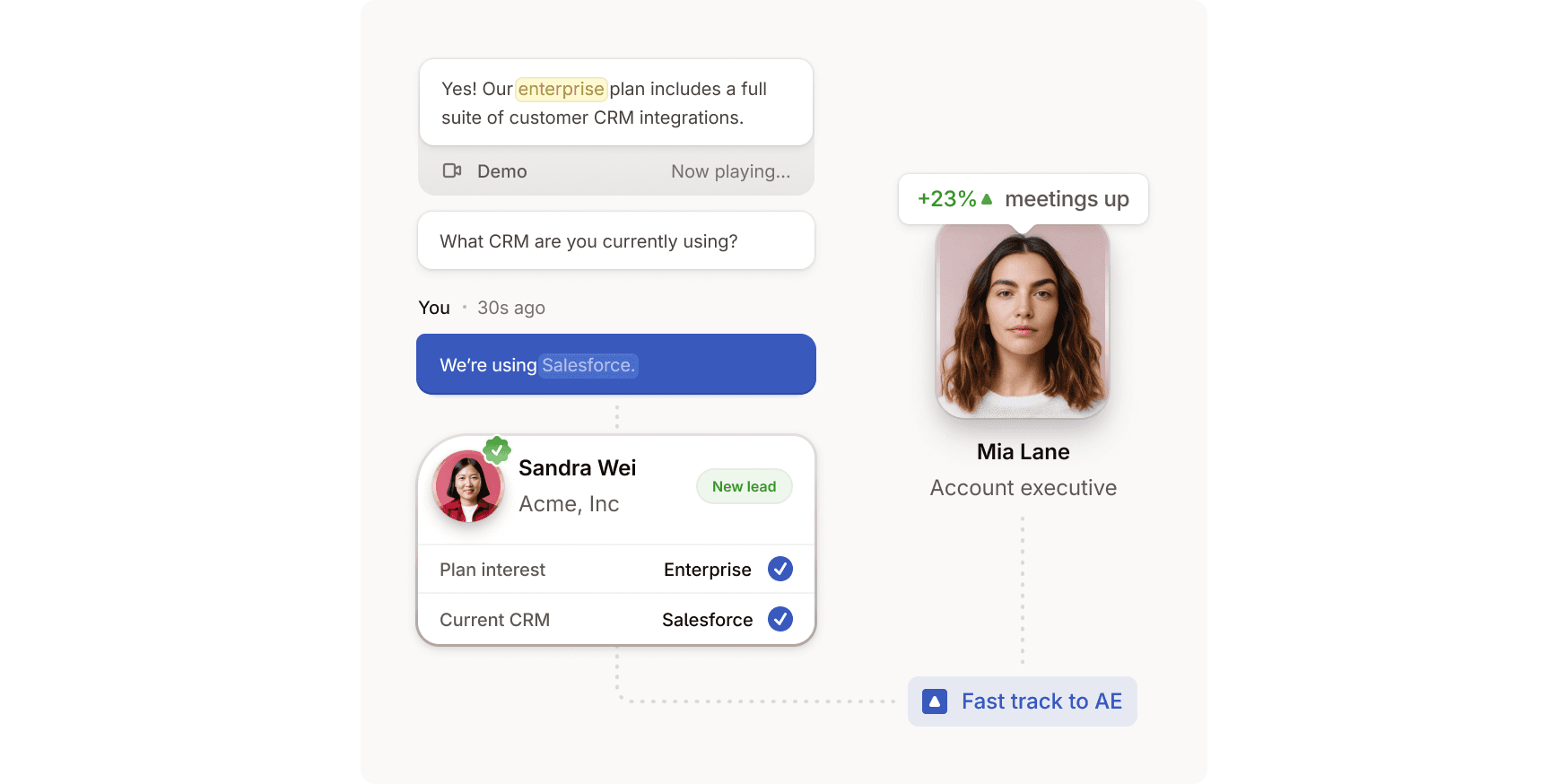
In modern B2B sales, a qualified lead is an account and contact that fits your ideal customer profile and shows clear signals of actively exploring a solution like yours in a realistic timeframe.
Traditional BANT (Budget, Authority, Need, and Timeline)-style thinking still matters, but buyers rarely hand you "budget, authority, need, timeline" in a single form. Buyers complete most of their journey independently, moving across your website, product, events, and outbound touches before they ever talk to sales.
Your qualification logic has to read that behavior rather than wait for a perfect discovery call. These two dimensions do most of the work:
Fit: Firmographic and role alignment with your ICP, such as company size, industry, tech stack, region, and seniority.
Intent and readiness: Signals like pricing page views, repeated return visits, demo or trial requests, evaluation questions, and activity from multiple stakeholders at the same account.
If you only qualify on fit, you flood sales with contacts who aren’t in a buying cycle. If you only qualify on engagement, you chase every webinar attendee regardless of deal size or use case.
Modern B2B lead qualification separates these two dimensions, scores them independently, and uses the combination to decide who gets routed, who gets nurtured, and who gets filtered out. This prioritization is what keeps your sales funnel healthy and your marketing efforts focused on accounts most likely to convert.
Which B2B lead qualification framework fits your sales motion
The right B2B lead qualification framework depends on how you sell. A high-velocity PLG motion that closes in days needs a very different approach from a multi-threaded enterprise sale that runs across quarters.
The goal is qualification criteria that reflect how your best deals actually close, not a methodology copied off a shelf.
Lightweight frameworks for high-volume, short-cycle motions
If you run high-volume motions such as SMB SaaS, self-serve trials, or transactional products, your qualification should be light, fast, and mostly automated. You are trying to separate high-intent buyers from casual browsers in minutes, not days.
Small number of decisive criteria. Focus on a handful of variables that strongly predict conversion, such as company size band, primary use case, role, and a clear intent trigger like “requested demo” or “started trial.” This keeps your lead scoring models actionable.
Simple scoring and routing. Classify leads into a small number of buckets such as "sales-ready," "nurture," or "disqualify," instead of complex point systems that nobody trusts.
Automation-first operations. Sales-qualified lead candidates trigger instant actions such as outbound email sequences or calendar scheduling, while inbound visitors are qualified in real time through AI chat before they ever reach a rep's queue.
Real-time enrichment. Data tools and conversational experiences fill in missing firmographic and use case details during the initial interaction so you can qualify off the first touch.
This approach works best when buyers can self-educate quickly, pricing is transparent, and Sales focuses on clarification and closing deals. It breaks down when you need multi-stakeholder alignment, custom scoping, or heavy security and procurement review.
Rigorous frameworks for enterprise and multi-threaded deals
If you fill your pipeline with six-figure, multi-stakeholder opportunities, you need a more structured approach. The cost of chasing the wrong opportunity is high, and information typically lives across a team of decision-makers and their systems, not a single form fill.
Enterprise frameworks expand qualification across three layers:
Buying committee mapping. Identify economic buyers, technical approvers, champions, and users, then track engagement at the account rather than just the lead level. The CHAMP framework (Challenges, Authority, Money, Prioritization) is one structured way to capture this.
Deal mechanics. Qualify around decision criteria, approval process, legal and procurement steps, and any mandatory integrations or security reviews that could stall a deal.
Business impact. Capture the specific pain points, metrics, and initiatives your solution will influence so the opportunity is anchored in outcomes, not features.
Frameworks like MEDDIC (Metrics, Economic Buyer, Decision Criteria, Decision Process, Identify Pain, Champion) or its expanded version MEDDPICC (which adds Paper Process and Competition) are useful because they force you to collect this information consistently.
Pick the elements that correlate with wins in your data-driven analysis, build them into your qualification stages, and train reps to record them the same way every time.
The most effective teams treat their framework as configurable, adjusting which criteria are mandatory, which can be discovered later, and which no longer matter as motion or product changes.
How to build lead qualification that sales teams accept
Even a well-designed framework fails if Sales doesn't believe in it. Building qualification that Sales trusts comes down to three operational steps: defining who's in and who's out, layering in intent signals, and closing the loop between marketing and sales.
1. Define ICP criteria and hard disqualifiers
Start by writing down, in plain language, who you sell to and who you do not. Your ideal customer profile should cover firmographic attributes such as size, industry, region, and tech stack, as well as the roles that usually drive evaluation and own budget. Reviewing personas with your sales team here helps surface disqualifiers that aren’t obvious from data alone.
Then define explicit disqualifiers: Company sizes too small for your pricing, industries you cannot support for regulatory reasons, unsupported regions, or use cases your product does not solve. Document the business reason behind each disqualifier so you can revisit it with data later.
Operationalize these rules in your CRM and automation tools so that clearly unqualified leads are filtered or routed to nurture before they hit a rep’s queue. When Sales sees that marketing is willing to say “no” to bad fits, trust in the entire lead qualification process goes up quickly.
2. Layer scoring with intent and engagement signals
Firmographic fit answers "could this be a good customer," while engagement and intent answer "are they moving now." Your scoring model should treat those as separate axes so you can prioritize high-fit, high-intent leads without losing sight of emerging opportunities.
Useful behavioral signals include recency and depth of website activity, pricing page or demo actions, event attendance, and responses to outbound sequences. For enterprise motions, account-level signals (multiple stakeholders engaging from the same domain) matter more than any single individual's activity.
Use progressive qualification to capture just enough data to route and respond quickly, then let SDRs, AEs, or AI-powered agents collect deeper information through email follow-up and conversation as interest grows.
3. Operationalize routing and feedback loops
Once you know who's qualified, you need clear rules about where they go, how fast, and with what context. Map your routing logic directly to how your sales team is organized: territory, segment, vertical, product line, or a mix. Define backups for out-of-office situations and rules for existing accounts to avoid internal conflicts.
Every qualified lead that lands in your CRM should arrive with a concise summary of why it was routed, including fit score, recent activities, and key qualification answers. Reps shouldn't have to read a full activity log to understand why a meeting is on their calendar.
Build a simple but enforced feedback path. Require reps to log an outcome and reason for every qualified lead, such as "not a fit," "no active project," or "timing issue." Those reason codes are what let you tune scoring and routing over time. Without them, you're optimizing in the dark.
For teams that want to automate this, Spara's workflow builder lets you build sequences that run against any contact in your CRM, including leads collected through chat, and configure routing rules across chat, email, voice, and text without custom development.
Ready to operationalize your qualification criteria without adding headcount?
Spara's AI agents encode your ICP rules, disqualifiers, and routing logic across chat, email, voice, and text so every inbound lead is handled consistently from the first touch. Book a demo.
How to measure and improve B2B lead qualification
B2B lead qualification needs to evolve as your motion, product, and market change. To keep it honest, you need a small set of metrics and a habit of looking for common failure patterns before they become cultural problems.
Best practices checklist
Use this checklist to audit your current qualification process and identify where the biggest gaps are likely to exist.
Align on a shared definition of "qualified" between marketing, sales, and RevOps before leads enter sales queues.
Separate ICP fit from buying intent so you can prioritize by both, rather than treating title and company size as proxies for readiness.
Define hard disqualifiers early to keep obviously unwinnable leads out of sales capacity.
Use progressive qualification rather than demanding every data point upfront.
Close the feedback loop between Sales and Marketing with structured reasons for acceptance and rejection.
Revisit criteria at least quarterly as product, ICP, or motion changes.
Tie qualification effectiveness to downstream pipeline metrics, not just lead generation volume.
Core metrics to monitor
Review these metrics by segment, channel, and campaign so you can see where your B2B lead qualification logic is performing well and where it needs refinement.
Lead-to-meeting rate: The share of qualified leads that result in a scheduled conversation. This exposes gaps between your definition of "sales-ready" and what reps view as worth their time.
Lead-to-opportunity rate: The percentage of qualified leads that progress to an opportunity stage. If this is low, your criteria may be too loose or your handoff process may be weak.
Sales velocity from first touch to opportunity: The average time from lead creation to opportunity creation. A healthy qualification process shortens this by recognizing and acting on real intent quickly.
Disqualification rate and reason codes: The share of leads marked unqualified, categorized by why. Patterns here show where demand generation and qualification criteria are misaligned.
Sales acceptance rate (SAL rate): The portion of marketing-qualified leads that sales accepts and works. Persistent low SAL rates signal that qualification rules are out of step with sales operations reality.
Common failure modes
A quarterly review with Sales and RevOps, focused on real deals created and lost, will usually surface which of the following issues is starting to show up.
Overweighting demographic fit. Treating company size and job title as main signals while ignoring meaningful behavior produces "perfect" leads that are nowhere near a buying cycle.
No clear disqualification rules. Without hard no-go criteria, everything drifts into "maybe," and sales ends up doing manual qualification on every inbound contact.
Criteria sales doesn’t trust. If reps consistently re-qualify or ignore assigned leads, your model has lost credibility and needs a reset with sales at the table.
Set-and-forget models. Scoring and rules that never change start to reflect an old version of your market and ICP.
Optimizing for volume instead of pipeline. Incentives that reward MQL counts push teams toward loose definitions, which drag down conversion and forecast accuracy.
Technology that supports modern B2B lead qualification
Effective B2B lead qualification depends on aligning your criteria with your sales motion, keeping ICP fit and intent as separate signals, and tying every decision back to pipeline outcomes.
The right technology stack makes that possible at scale and helps streamline your sales process from first touch to closed deal.
CRM and lifecycle systems such as Salesforce or HubSpot provide the system of record for stages, ownership, and conversion, with clear stage definitions that mirror your qualification criteria so you can report accurately on performance.
Marketing automation platforms like Marketo, Pardot, or HubSpot Marketing Hub score leads and trigger routing workflows, keeping qualification logic connected to your broader demand generation motion.
Data enrichment tools like Clearbit, Clay, and ZoomInfo add firmographic context to inbound demand, filling in company size, industry, and tech stack details that improve scoring accuracy. Intent providers like Bombora go a step further, surfacing accounts that are actively researching problems you solve, useful for prioritizing outbound alongside inbound qualification.
Conversational AI and GTM automation platforms handle real-time inbound conversations and perform much of the early qualification work. Spara sits in this category. Its AI Chat, AI Email, AI Voice, and AI Text cover every inbound entry point, with qualification logic that's configurable to your ICP, disqualifiers, and routing rules.
When these tools work together through Spara's GTM AI agent platform, you move the right people into pipeline at the right time, and create a lead qualification process you can actually measure and improve.
B2B lead qualification shouldn't rely on static scoring alone. See how modern revenue teams operationalize qualification across chat, email, voice, and text to move high-intent buyers into pipeline faster. Book a demo.

Lauren ThompsonHead of Marketing, Spara
FAQ
Related posts
View all
GTM
Top 5 Drift alternatives for better lead conversion
Drift alternatives drive more conversations, leads, and revenue growth. From AI chat to product demos, they personalize every stage of the customer journey.
Sep 14, 2026
•
10 min read

GTM
Databricks' Barry Dauber on why every project should start with impact, not AI
Barry Dauber runs Gen AI go-to-market at Databricks, talking companies down from AI hype every day. Here's his framework for scoping an AI project: name the metric, classify the initiative, and reserve the model for what actually needs one.
Sep 2, 2026
•
4 min read

GTM
How Clay's Head of GTM Engineering Took Event ROI From 2x to 10x
Everett Berry treats every dinner like a funnel. Here's the six-stage system — golden lists, leader-to-leader invites, engineered seating, automated follow-up — that took Clay's event ROI from 2x to 10x.
Aug 26, 2026
•
5 min read
Sign up for the latest from Spara
Subscribe to get more GTM insights straight to your inbox.