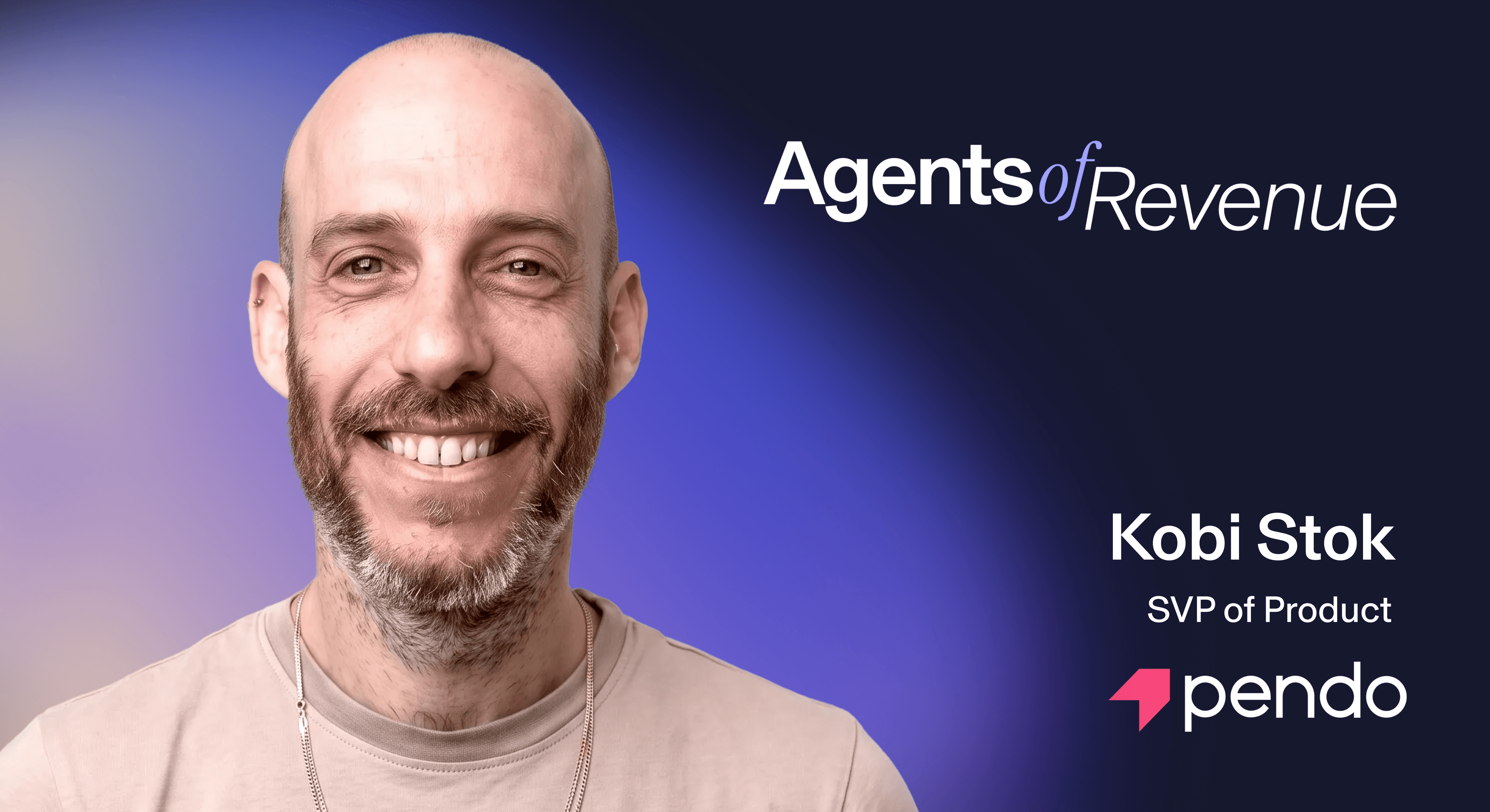

David Walker sits down with Kobi Stok, SVP of Product at Pendo, about turning product usage into upsell pipeline
Kobi Stok founded Forwrd.ai, a no-code platform for building models that predict churn, upsell potential, and lead quality. Pendo acquired it last July and he's now their SVP of product. Before that he co-founded Abbi.io and sold it to WalkMe, where he led the product team.
We started with his diagnosis of where GTM teams put their time and money. By his account, the top of the funnel is handled. Inbound leads get routed, scored, and sequenced without anyone touching them. That is where the attention and the investment go.
Kobi thinks that prioritization is getting harder to justify, and that it should shift toward expansion. Competition keeps accelerating, and new logos cost more to win every quarter. The best growth most teams have left is inside the customers they already won.
The catch is that expansion is the one motion nobody automated. Upsell surfaces when a rep happens to be on a call and the customer brings it up. Nothing routes it, nothing scores it, nothing triggers it. And the bigger you get, the more that costs you:
It's mostly spray and pray. The bigger the size, the bigger the opportunity, the bigger the miss.

Kobi StokSVP of Product, Pendo
He walked me through how he'd build that motion. He's talking about product companies, but the sequence works anywhere you can see what your customers do.
Six moves to turn product usage into pipeline
Kobi's point is that the model isn't the hard part. The hard part is getting the signal right, then getting it in front of a rep who will act on it. Here are the six moves, roughly in the order he'd run them.
Reverse-engineer your past upsells: This only works if customers get value from using the product, so you need solid product analytics in place. Connect that usage data to your CRM, then look at every account that upgraded or bought more and find what they had in common. From there, AI can flag current accounts that match the pattern, and reps get those opportunities the same way they get inbound leads. The difference is that these leads come from what your customers have already done. Kobi's caveat: the more history and process you have, the more this pays off. It isn't a day-one move.
Stop hunting the single signal, and blend two by segment: A year ago Kobi was still betting on one unified signal. Sink everything into a warehouse, build on top of it, done. Unstructured data broke that plan. A call carries sentiment, history, and context all at once, and you can slice it an unlimited number of ways. Analyzing it properly turns out to be close to impossible. So he runs two inputs instead: sentiment from tools like Gong, and product usage. Blending them is a segmentation decision, not a modeling one. On small long-tail accounts, an agent takes both signals and decides. On heavy enterprise revenue, the rep blends them in their head. Usage is deterministic, and the rep knows the customer better than the model does. That gap is the part AI doesn't take. Kobi calls it connecting the apples and the oranges to make the best juice.
Until a year ago, I was a big believer in the single signal. A big believer.
Deliver it where the rep already works: Kobi says this is where most of these projects die. You build the model, and the output lands in yet another dashboard. The rep has to remember it exists, open it, and filter it. Nobody does. So don't build a new place for reps to go. Put the results inside a workflow they already use. For example, a rep working in Salesforce gets a pop-up saying the agent found eight accounts eligible for an upsell. They click through to the list without leaving Salesforce. The AI explains why each account made the list (the modules in use, the segment, the region) and then drafts the email. The explanation matters as much as the list. AEs change territories constantly, and Product ships faster than anyone can keep up with, so reps often don't know the account or the feature they would be selling. Do that work for them and you can skip the enablement session.
Don't wait for your company to build it: Kobi's advice to individual AEs is to start this week. Find out which product analytics tool your company uses. Most now offer an MCP connector that AI tools can plug into. Connect it to Claude or ChatGPT, ask your questions, and build your own version. The company version is the same idea, built once for everyone. Set up the agent centrally so reps aren't each building their own. Put it where they already work, which for Kobi is Slack. And give it skills based on the company's strategy, not one rep's.
Run two motions, and automate the long tail: Not every account needs a human. Kobi runs two motions off the same data. The first delivers insights to the rep. The second feeds an engagement agent that acts on its own, aimed at small ARR and tech-touch accounts. The automated one runs on plumbing you already have. Segment the usage signals into sequences in HubSpot or Marketo, then feed the results back so the AE still knows what happened.
Start counting agents as users: Kobi doesn't think the UI disappears. People still read books and hang pictures in their living rooms. Boards and executives will still want dashboards. What changes is the workflow. Instead of clicking through many buttons, you prompt. Behind the scenes, an agent connected through MCP acts like another user, working through tools instead of clicks. So product usage has to cover what agents do, not just what people click. Kobi says this is already live, just small and experimental. The GTM consequence shows up at renewal. If you can show what the agents actually did, you have your ROI answer.
Episode highlights
00:38 - Revenue obsession: hear a pain, build for it, and get the note back
03:15 - "Delivery is super easy, a few prompts away." The hard part is value.
05:00 - Why existing customers are the best bet in a noisy market
06:22 - The manual upsell problem, and reverse-engineering past wins
07:52 - "Yet another dashboard": why insights die outside the workflow
09:43 - Two motions, one of them fully automated
12:19 - "Until a year ago, I was a big believer in the single signal."
16:42 - Where to start: the analytics MCP, the company agent, the sequences
20:53 - MCP uses tools instead of clicks
23:44 - Salesforce, trust, and what vendors still get paid for
26:07 - "You don't need a big spaceship to win."
My two cents
Two things from this one stuck with me.
The two questions I ask every salesperson: When I'm buying B2B software I ask two things. What's the number one value your existing customers get out of this? And, what's your six-month roadmap? On the first one I care about the answer, but I care more about how fast and how confidently it comes. On the roadmap question I don't put much stock in the answer at all. I'm checking whether anyone in the GTM org has an understanding of the product roadmap. When I start hearing about the one customer who really likes the one thing, that concerns me. How customers use your product and how you sell it should be inextricably linked. They usually aren't.
We're sick of new panes of glass: AI surfacing insights a human would miss is table stakes now. What I like about Kobi's approach is the second piece: using AI to decide when to drop that information into a workflow that already exists. Asking someone to log in somewhere new is too big a burden, and AI is making it bigger. As we work faster, each task takes less time, so switching between tools eats up a bigger share of the day. Eventually the ask is simply: tell me what to do and when to do it. The same thing is happening one level up. I expected data-heavy products to move to MCP first. If I need to query customer usage data, I don't care whether I log into Pendo or ask Claude. What surprises me is how many UI-heavy products are going the same way. Companies can now render their own interfaces inside Claude, which gives them a new canvas to build on. We've always called screens "panes of glass." Claude wants to be the window frame, the place where all our software lives and loads. This has moved much faster than I expected.

David WalkerCo-founder and CEO, Spara
Related posts
View all
GTM
Jon Harper on the four traps that stall complex deals before the proposal
Jon Harper's PEO reps closed 35 to 45% of the deals they proposed, but only 9% of first meetings ever got that far. The BizBenchmark founder breaks down the four traps that stall complex deals, and what to do instead.
Oct 9, 2026
•
4 min read
GTM
How Clay Built a Partner Motion That Drives 20% of Revenue
Nancy Mottice joined Clay as it moved from product-led growth into enterprise. Since then, partner-sourced revenue is up 16x and drives 20% of the business. Here are the six steps she took to get there.
Oct 9, 2026
•
7 min read
GTM
How Attention tripled positive reply rates in three weeks
Anis Bennaceur, co-founder and CEO of Attention, built an ABM machine for selling into large buying committees. Three weeks after he started sending, positive response rates had tripled. Here is the build: infrastructure, reasoning, and logistics.
Oct 9, 2026
•
5 min read
Sign up for the latest from Spara
Subscribe to get more GTM insights straight to your inbox.