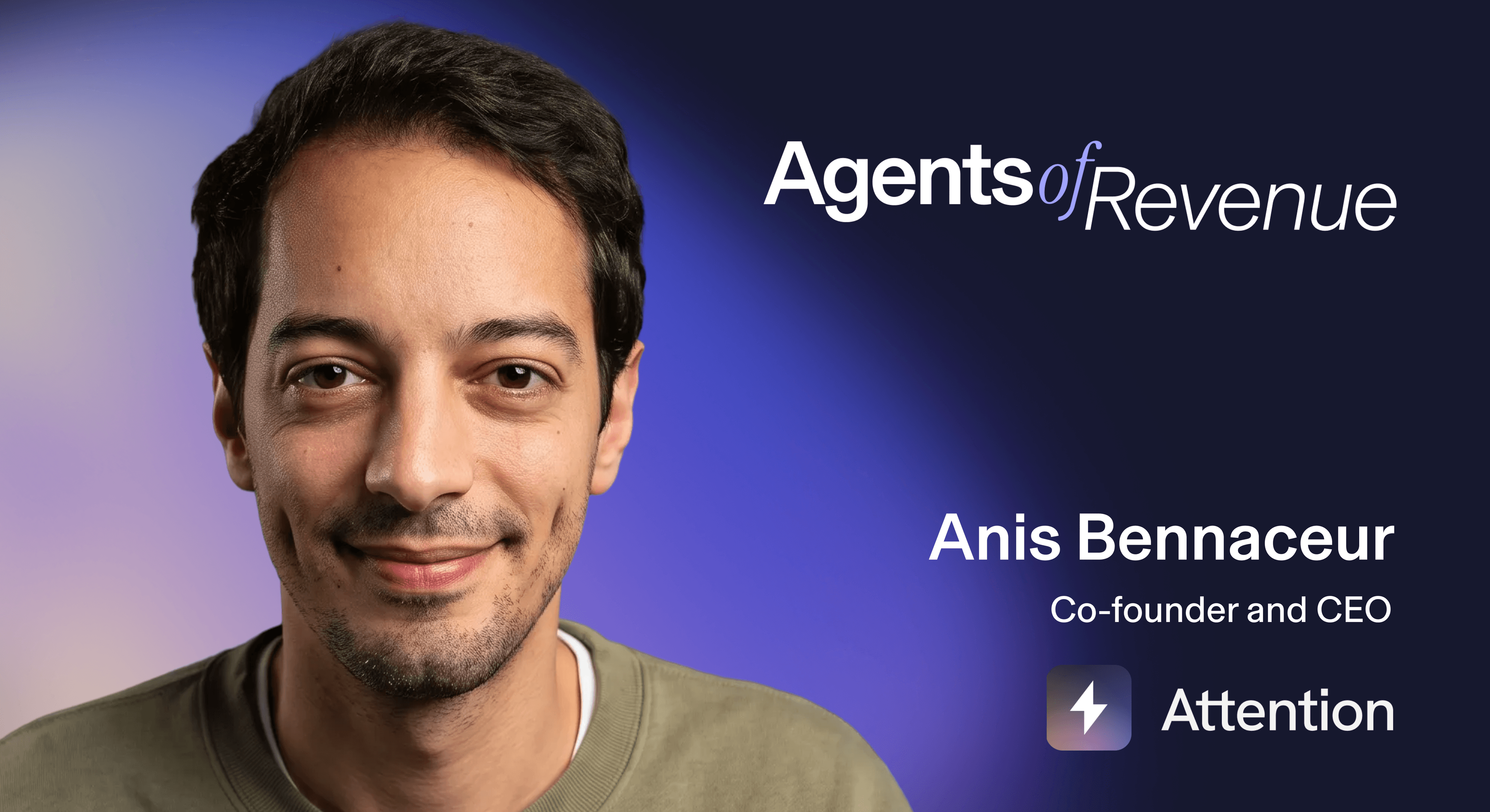

David Walker sits down with Anis Bennaceur, co-founder and CEO of Attention, about the ABM machine that tripled positive response rates in three weeks
Attention, like a lot of you, sells into large organizations. That makes outbound complicated, because the buying committees are big and everyone has to be bought in before anything moves. Booking the meeting is only half of it. The other half is the rest of the committee. They were never on a call with you, and you still need them to vouch for you when the deal comes up internally.
To further complicate it, these stakeholders are not all listening for the same thing. Revenue growth is where they all align. Past that, each one has two or three priorities of their own, and those change as the business evolves.
Nothing off the shelf truly solves the complexity of enterprise outbound. In Anis Bennaceur's words, you can build these things yourself now as long as you know exactly what you are building. So he built one for Attention's own outbound. A couple of months on what he calls their ABM machine, a build he describes as a bit of a beast, and he started sending on August 10.
By August 31, his positive response rates, the ones that turn into meetings booked, had tripled.
How to build the machine that booked 3x meetings in three weeks
He frames the whole build in three layers: infrastructure, reasoning, and logistics. Here is how it comes together.
Infrastructure
Tie inbound and outbound together: This is the insight underneath everything else. The information coming out of your call recordings should be driving the outbound you create. Why someone signed up or looked at you, why they agreed to meet, what the compelling event was, what pain points came up, what friction they have with their current vendor. It is already sitting in your recordings, and almost nobody leverages it in their outbound.
Turn the recordings into 20 to 40 plays: Mine your recordings and identify the plays that will drive pipeline, then repeat them over and over. The value prop will likely remain unchanged while the persona and timing of outreach will vary.
Build the persona matrix: Lay the plays against the people you actually sell to. For Attention, that is CROs, VPs of sales, VPs of RevOps, and VPs of enablement. Start from the one point of alignment, revenue growth, then break it down into the two or three things each persona cares most about right now, knowing that list moves as their business moves.
Map each committee by awareness and intent: For every target account in the play, understand the whole buying committee: who sits on it, each person's level of awareness, and each person's level of intent. This will help inform who to meet with first, and how to make sure the rest of the committee supports your solution.
Get insider-level account insights and stack the signals: Know what is happening across your prospect's business as if you worked there. Did they just launch a new product? Were there budget cuts? Store that piece of news as a signal in your data warehouse. Then stack it with the other signals you are collecting to refine your messaging and sequencing.
Reasoning
Make the reasoning deterministic: Anis started by trusting the LLMs to draft the play and the messaging, then flipped it. Now he writes the plays, ranks them, and lets the reasoning engine pick the best available play for that person at that moment. You create your own decision tree rather than asking an AI to figure out the next best action. In his words, human judgment in this specific case is almost always better.
Logistics
Thoughtfully orchestrate your outreach: Understand who you reach out to, with what messaging, and through which channel. Attention has run this almost entirely through email so far. Anis knows email response rates are lower than on other channels and takes it on anyway. LinkedIn is another channel to explore, but be sure to look for common connections and match titles.
Episode highlights
00:33 - What revenue obsession means: your customer's revenue, not their experience
02:43 - Employee obsession, and the 30-day reset on what counts as normal
04:50 - Why every incremental hire raises the covariance of the business
07:34 - Hire for one 10 out of 10 spike, not for a lack of weaknesses
08:42 - The spoiler: 3x meetings booked in three weeks
11:48 - Tying inbound to outbound, and mining call recordings for plays
13:36 - Insider-level account understanding and stacking signals in the warehouse
15:13 - The three layers: infrastructure, reasoning, and logistics
16:29 - Flipping from stochastic to deterministic, and why human judgment still wins
18:00 - Five-year visions turning into six-month sprints
21:48 - The guardrail era: QA, versioning, and agents you can shut down
My two cents
3x in three weeks is not a normal number: You usually hear something like three percent in three weeks. A 3x increase is generally unheard of for a mature GTM org like Attention. I hear a lot of people in go-to-market talk about wanting a better understanding of buying committees and intent signals. This is stuff everybody knows and everybody is trying to do. Anis actioned it fast enough to move a key metric quickly, and that is the holy grail we are all trying to get to.
A lot of sales still lives in the brain: This is the contrarian take I am seeing more and more of. The models are good enough now that the default move is to throw a good model at the problem and wait for it to work. Sales does not work that way. The art and science of it still lives in the brain to a pretty shocking degree. Anis took a more deterministic approach where human oversight was foundational. This is similar to how our customers experience Spara. A person sets the plays and workflows, then the agent runs them at a speed and volume no team could match. Human oversight is what lets AI do what it is exceptional at without handing it the decisions it should not be making.
Drive outcomes rather than vanity metrics: Most companies think great technology and support add up to a great customer experience, but that is now the bare minimum. Anis and I agree that we must set the bar higher and deliver measurable outcomes. For us, that means helping customers grow and increase revenue.

David WalkerCo-founder and CEO, Spara
Related posts
View all
GTM
Jon Harper on the four traps that stall complex deals before the proposal
Jon Harper's PEO reps closed 35 to 45% of the deals they proposed, but only 9% of first meetings ever got that far. The BizBenchmark founder breaks down the four traps that stall complex deals, and what to do instead.
Oct 9, 2026
•
4 min read
GTM
How Clay Built a Partner Motion That Drives 20% of Revenue
Nancy Mottice joined Clay as it moved from product-led growth into enterprise. Since then, partner-sourced revenue is up 16x and drives 20% of the business. Here are the six steps she took to get there.
Oct 9, 2026
•
7 min read
GTM
Pendo's Kobi Stok on turning product usage into upsell pipeline
Teams automated inbound years ago, but upsell still depends on a rep hearing a customer bring it up. Kobi Stok, SVP of Product at Pendo, walks through six moves to turn product usage into pipeline.
Oct 9, 2026
•
6 min read
Sign up for the latest from Spara
Subscribe to get more GTM insights straight to your inbox.