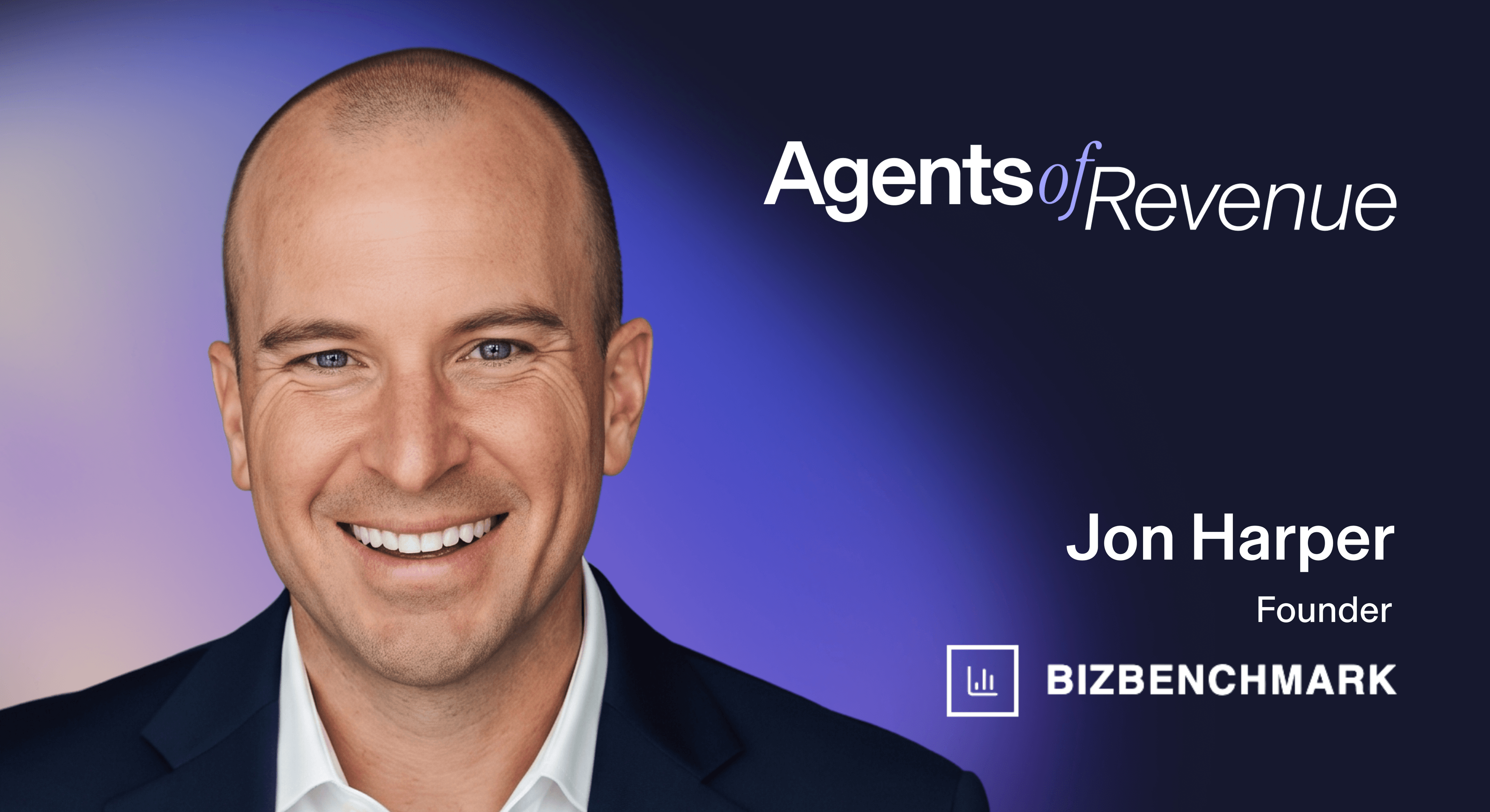

David Walker sits down with Jon Harper, founder of BizBenchmark, about the four traps that stall complex deals before the proposal
Jon Harper spent more than 15 years selling PEO (professional employer organization) and leading PEO sales teams at companies like ADP and Paychex. It's one of the harder sales in B2B. In Jon's words, it's "a very complex solution to sell" and "a very complex solution to buy," it isn't cheap, and the buyer has to hand over enough information to get through underwriting before they ever see a proposal.
Over those 15 years, Jon kept seeing the same thing. His reps could close: once a deal was proposed, they won 35 to 45% of the time. The trouble was getting there. Without a trigger event like a healthcare renewal or a workers' comp spike, only 9% of first meetings produced enough information from the buyer to build a proposal.
A few weeks before we recorded, he left a big corporate job to start BizBenchmark and fix that gap. What he learned applies to any complex sale, not just PEO.
Four traps that stall complex deals, and what to do instead
Jon's observation is that complex deals don't die at the close. Instead, they die before they reach a proposal. Here are the four causes and how to avoid them.
Holding back value until they buy
I'm not gonna give you value unless you buy my thing.

Jon HarperFounder, BizBenchmark
This is the old model, and it shouldn't be a surprise when buyers don't give you their time. Instead, give them something they care about whether they partner with you or not. Jon's company benchmarks the business against its competitors on turnover, revenue per employee, healthcare, workers' comp, taxes, and pay, and hands the owner a 90-to-180 day business plan.
Showing up to solve problems they already know about
If it's a problem that they know about, they've already solved it before I walk in the door.
Instead, your job is to help the buyer discover a problem. Jon likens this to bloodwork that turns up high blood pressure. When you compare the owner's numbers to industry benchmarks, the owner sees problems they didn't know they had, and that creates urgency.
Going quiet between meetings
The seller says, "I have what I need, I'll get back to you," and the buyer sits idle for four business days. To avoid this trap, keep giving the buyer value between stages in a way that doesn't feel automated. Ultimately, you want the buyer to feel like you're solving their problem together. That's why Jon is building toward voice and video in the middle of the sales process.
Leading with the solution
This is our solution. The answer is yes or no.
A one-size-fits-all offer leaves the buyer two options: take it or walk away. Instead, lead the prospect to a solution for a problem you've defined together, rather than leading with your solution before the problem is clear. By forming the problem and solution alongside your prospect, your proposal will reflect their company's goals and challenges.
Episode highlights
00:30 - Revenue obsession, and the trap of being busy but not productive
01:31 - Why PEO is so hard to sell, and the 9% problem
03:52 - No ROI for the buyer: the thesis behind BizBenchmark
04:40 - Benchmarking a 30-employee company against its competitors
06:04 - The bloodwork analogy
07:23 - Buyers deciding earlier, and competing for change management
09:51 - Under the hood: business plans, rep console, and AI proposal practice
11:26 - Creating value between meetings, and leading to a solution
14:48 - From sales leader to founder: why he bet on himself
20:51 - Three weeks in: support doesn't pay the bills
25:26 - Why execution is the new edge
My two cents
Jon's traps come from PEO, but they show up in every complex sale I've been part of.
Buyers move on their own clock: I look at consumer buying behavior as a really good indicator of B2B buying behavior, because it's the same people. When I realize I'm out of diapers, I throw an Amazon order in and expect to act on it right then, on my own time. Buyers are also deciding earlier in the process than we think. So you either catch them at the moment something changes, or you give them a reason to look before anything changes.
You're competing for change management: Companies are being attacked with opportunities to use AI for efficiency in every department. For the first time, we're competing for attention with how they run finance, internal operations, and HR, and there's only so much change management a company can handle. If you're selling PEO, you're competing for mind share against companies you'd never think of as your competitive set. That makes it even more important to identify the actual problem, and more importantly, the impact of solving it versus not solving it.
Buyers want to engage on their own time: I built a big sales org at my last company, and we were always trying to sell on the capacity and schedule of our sellers. Sometimes that works great: everyone's aligned, and you talk through the problem together for thirty minutes. But there are so many moments where buyers want to interact in the sales process on their own time, and historically those were lost moments. For the first time, we can capture them. Agents and humans complement each other really well through a sales process, and the either-or was never the right question.

David WalkerCo-founder and CEO, Spara
Related posts
View all
GTM
How Clay Built a Partner Motion That Drives 20% of Revenue
Nancy Mottice joined Clay as it moved from product-led growth into enterprise. Since then, partner-sourced revenue is up 16x and drives 20% of the business. Here are the six steps she took to get there.
Oct 9, 2026
•
7 min read
GTM
Pendo's Kobi Stok on turning product usage into upsell pipeline
Teams automated inbound years ago, but upsell still depends on a rep hearing a customer bring it up. Kobi Stok, SVP of Product at Pendo, walks through six moves to turn product usage into pipeline.
Oct 9, 2026
•
6 min read
GTM
How Attention tripled positive reply rates in three weeks
Anis Bennaceur, co-founder and CEO of Attention, built an ABM machine for selling into large buying committees. Three weeks after he started sending, positive response rates had tripled. Here is the build: infrastructure, reasoning, and logistics.
Oct 9, 2026
•
5 min read
Sign up for the latest from Spara
Subscribe to get more GTM insights straight to your inbox.