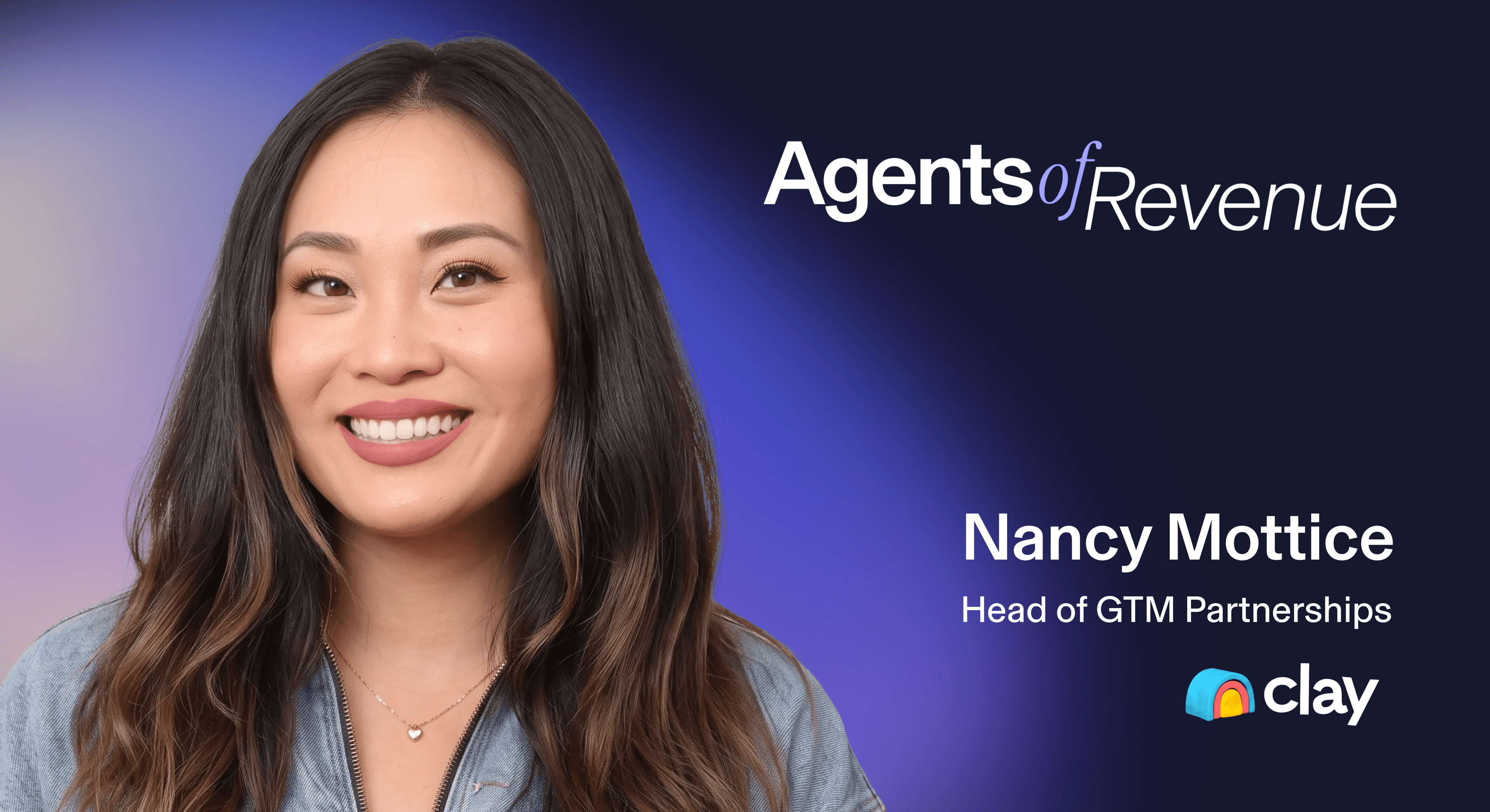

David Walker sits down with Nancy Mottice, Head of GTM Partnerships at Clay, about building a partner motion that drives 20% of revenue
Nancy Mottice joined Clay almost two years ago, right as the company started moving from product-led growth into enterprise sales. Since her first quarter, partner-sourced revenue is up 16x and now drives 20% of the business. Deals that come through partners close at double the rate, and private equity, the channel they almost skipped, has become their biggest pipeline producer.
First, a look back. When Nancy joined, Clay was a red-hot startup with an early partner program and a GTM team that had never sold to enterprise customers. Here are some of the challenges she faced.
A product-led company learning enterprise sales: Clay started as a product-led company. About two years ago the company was selling enterprise for the first time, and Nancy's opening mandate was to figure out what co-selling with an agency even meant, including how to structure the incentives around it.
A partner base built for a different customer: The existing "Claygency" ecosystem was made up of five-person growth hacker shops that were critical to the product-led business. Moving upmarket meant agencies of 100 to 800 people in marketing, sales, and ops. Most of them were ingrained in the Salesforce, HubSpot, Demandbase, and 6sense ecosystems. Clay had to earn mind share and credibility there from scratch.
No framework and no team: When I asked what framework she started with, Nancy said, "No framework." It was "me all by my lonesome self," selling enterprise contracts directly while trying to co-sell with agencies. Her first two hires came last summer.
A product with many paths to success: Clay is, in her words, a fairly unopinionated tool. It isn't like Gong where you implement steps one, two, three and it looks the same every time. That's "a beauty and a curse," and it's why a services layer had to be part of the go-to-market rather than a nice-to-have.
Six steps to build a partner org like Clay
Nancy was quick to share that she didn't have a framework. What is clear to me is that she had a playbook, even if in her head. Here are the six steps in the order she ran them.
Start with the problem rather than the channel: Her first question for anyone considering a partner motion is "why is that question coming up even?" Referrals and net new leads? Use case adoption? Retention? For Clay the answer came out of the product. Because there are many paths to success in the tool, agencies are the credible thought partner clients already trust on how to navigate their stack. Clay's product uniquely enabled partners to drive top of the funnel and expansion at the same time. Most customers start with one use case, data enrichment, and balloon from there, and partners are a big part of why.
Listen to the data: When Nancy joined Clay, the Claygency ecosystem was developed and growing. This was an early data point that showed that customers who work with an agency are much more likely to expand. It was also the data point that gave Clay conviction that partners would be critical to both growth and stickiness. Nancy describes the whole early stage as watching for clues: "ding ding ding, is this the right direction?"
Less is more: Nancy started with more than 30 agencies. They were all excited to partner and said the right things. But as a team of one, she had to make some bets. She cut about 90% of the list and kept the partners most aligned to Clay's ICP and go-to-market strategy: RevOps agencies and top Salesforce and HubSpot partners. With a shorter list, she could go deep. She got to know everyone on those teams, learned who runs sales versus delivery, and trained their staff on how Clay connects to the rest of the stack. She was careful not to close any doors. The cuts were mutual, framed as "let's talk again in six months," and some of those agencies came back a year later ready to invest.
Get in the trenches on your co-sell deals: Co-selling presents challenges at any company, and at the very least it changes the standard sales process. As a partnership leader, you have to be in the deal alongside your sales colleagues and your partners. Nancy learned quickly that enterprises never buy Clay in isolation. It is usually Clay plus two or three other things being evaluated, which makes the sales cycle inherently more consultative. Once she understood the nuances of a co-sell deal, she started running pre-calls with her partners and the sales team to decide who plays which role and what each side is uniquely credible on.
Project manage your partners: Nancy's first move with a new PE partner was to put a Gantt chart in front of them. Their CRO summit was three months out. She set a goal of three portfolio companies live on Clay before the event, so there would be clear success stories to share in front of the rest of the portfolio. The trade was explicit. A fund-exclusive rate card, or the workshops and enablement their less AI-native teams needed, in exchange for a real base of portfolio companies using the product. That also answers the question worth asking about any fund: are they here to build market maps, or are they putting you into live evaluations at portfolio companies? Dates surface the answer fast.
Let your partners teach your sellers: Your partners are subject matter experts, and they often understand your prospects more deeply than you do. Clay's agency partners had been in sales, marketing, and ops for 15 years, which made them more credible on the stack as a whole than Clay's own team. You know you have a strong partner when your sellers start saying they're going to steal that partner's talk track. Clay was standing up its own enablement around the time Nancy leaned into co-selling, so the early materials were borrowed from partners to train the team on the landscape.
The outcome
Almost two years in, this is what the motion produces.
16x partner-sourced revenue: Partner-sourced revenue has grown 16x since Nancy's first quarter at Clay and now drives 20% of revenue for the business.
Double the win rate: Deals that are partner sourced close at twice the rate of deals that are not.
Private equity as the biggest channel: PE started as one or two fund value creation teams and a real question about whether it would be a waste of time. It is now one of their best performing partner channels, powered by board-level mandates to undergo digital transformation.
Increased retention: The SI ecosystem plays a large role in retention and expansion, which is why Nancy frames partners as a way to diversify how Clay goes to market rather than just a top line number.
Team growth: At first, Nancy ran partnerships alone. She added her first two team members last summer, and the team is at 12 today.
Episode highlights
00:31 - Revenue obsession as maniacal experimentation, and hunting for greenfield
02:27 - Nothing is static anymore, so action has to produce the information
03:13 - What one-to-many distribution looks like at Clay: SIs, GSIs, VC and PE
03:37 - 16x partner-sourced revenue, and 20% of the business
05:51 - From product-led to enterprise, and the Claygency ecosystem she started with
08:19 - What surprised her: co-selling is consultative work plus project management
11:00 - Selling when you're one piece of the puzzle, and why the problem-to-solution gap is the real sales motion
12:05 - Before you start a partner motion, answer why you want one
14:29 - The first enterprise co-sell, double win rates, and stealing a partner's talk track
16:17 - Private equity: the channel they almost skipped, now the biggest pipeline producer
18:38 - The Gantt chart that pressure tests how committed a partner really is
22:13 - Going too wide: 30 agencies down to five, and going deep on those five
25:52 - Why she's optimistic about the next era of building
My two cents
There's no framework at the start: Most people hear "partner motion" and picture a framework and a lot of theoretical work. Anyone who has built a team or a company from scratch knows you have to roll up your sleeves and drive outcomes. Nancy co-sold those early enterprise contracts alongside her partners, and that's how she figured out what actually works.
Learn from your partners: Co-selling with people who have been doing it for 15 years is a fun challenge. I've gone through the same process and hit the same moment: these people might be better at this than I am right now, and I need to soak up and learn a whole lot. Clay's sellers ended up borrowing their partners' talk tracks and battlecards. Put your ego aside and enjoy the fastest version of becoming a subject matter expert.
Set a high bar: This holds for any channel, not just partners. Start where there's already organic pull, because that's the signal the channel will work. Then set a bar high enough that whatever clears it is worth a real bet. Most teams stay busy with fast experiments and never concentrate their resources. Set the bar, let the data pick the winner, and put your weight behind it.

David WalkerCo-founder and CEO, Spara
Related posts
View all
GTM
Jon Harper on the four traps that stall complex deals before the proposal
Jon Harper's PEO reps closed 35 to 45% of the deals they proposed, but only 9% of first meetings ever got that far. The BizBenchmark founder breaks down the four traps that stall complex deals, and what to do instead.
Oct 9, 2026
•
4 min read
GTM
Pendo's Kobi Stok on turning product usage into upsell pipeline
Teams automated inbound years ago, but upsell still depends on a rep hearing a customer bring it up. Kobi Stok, SVP of Product at Pendo, walks through six moves to turn product usage into pipeline.
Oct 9, 2026
•
6 min read
GTM
How Attention tripled positive reply rates in three weeks
Anis Bennaceur, co-founder and CEO of Attention, built an ABM machine for selling into large buying committees. Three weeks after he started sending, positive response rates had tripled. Here is the build: infrastructure, reasoning, and logistics.
Oct 9, 2026
•
5 min read
Sign up for the latest from Spara
Subscribe to get more GTM insights straight to your inbox.