
Many teams adopting AI in their go-to-market motion make the same mistake: they deploy the technology without embedding their own expertise into it.
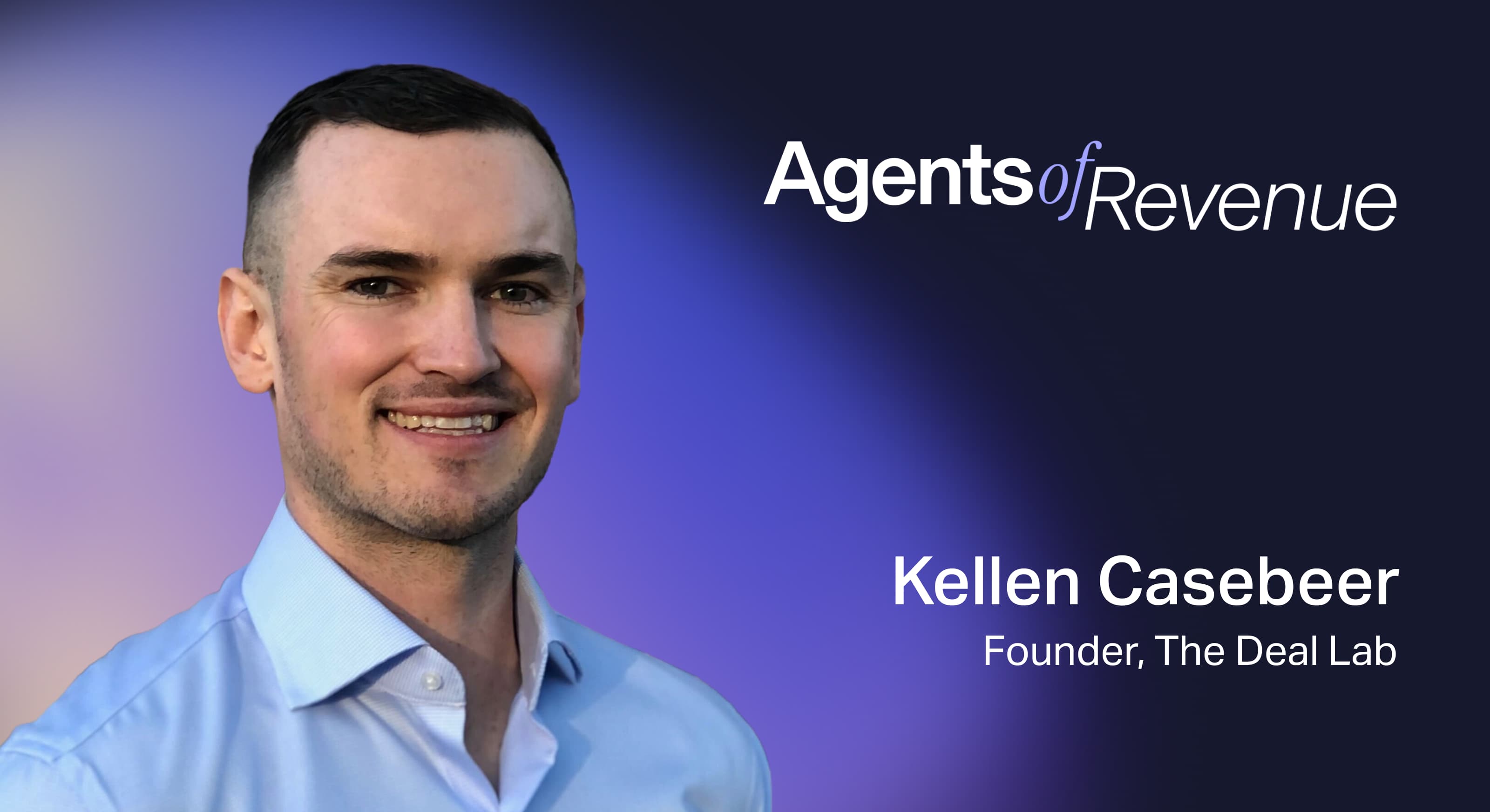
Kellen Casebeer, Founder of The Deal Lab and a revenue strategy operator, sees this constantly.
"The miss is over-engineering for AI and letting it have the opinion, versus our company having the opinion," Kellen says. "Because that perspective is what differentiates us. When you know the tool sets, everyone has the same access."
The teams that win aren't the ones with better tools. They're the ones that know how to feed their unique market knowledge into those tools so every rep, message, and interaction carries the nuance that earns buyer attention.
This is Kellen's playbook for doing exactly that.
How to extract the expertise AI actually needs
Kellen doesn't start with the CRM, the data tool, or the enrichment layer. He starts with a conversation, and works through a process that turns human expertise into something AI systems can actually use.
Step 1: Interview whoever knows the market best
The first step is to sit down with the person who has the deepest understanding of the company's buyers, whether that's the founder, the VP of Sales, or the first rep who cracked the motion, and coach them to talk openly without worrying about what's possible in the tech.
The framing Kellen uses to get people past their assumptions is simple. "Imagine your spouse's best friend's spouse and you are at a Sunday barbecue. What are the words that person uses to complain about their job? It's not gonna be technical. It's not tailored for hyper specificity. But it's representative of their worldview."
The whole point is to get them talking about their market without thinking about what's technically possible. The nuance that surfaces, the stuff that separates one buyer type from another, is exactly what database filters miss.
Step 2: Identify the segments that actually matter
"Your market is not a monoculture," Kellen says. He uses cycling as an example. "You've got dudes on BMX bikes with no brakes doing backflips. You have mountain bikers. You have road cyclists. They all have different gear. They actually make fun of each other." Writing a single message to "cyclists" would be absurd, but that's exactly what most B2B teams do when they apply industry and title filters and send the same sequence to everyone who matches.
The same VP of Marketing title means completely different things depending on the company's growth model. In a sales-led company, that person is focused on pipeline produced. In a marketing-led company, it's leads and meetings. In a product-led company, it's signups and conversions. Same title, completely different priorities, language, and metrics. Treating them as one audience forces you to generalize, and generalization is the pattern buyers have learned to ignore.
Step 3: Turn the wisdom into scored data points
Once the real segments are identified, Kellen's team engineers corresponding data points for each one, but not every signal carries the same weight.
"For any given idea, we can always build the data point," he says. "We just have to score a confidence interval." A LinkedIn profile that says "road cyclist" is high confidence. A Fox Racing t-shirt in a photo is medium confidence, inferred. Both are useful, but the rep needs to know the difference so they can calibrate how they show up.
"We work to first capture the wisdom as if we don't need to engineer it," Kellen says. "Then we basically engineer it."
The result is a system that carries the company's actual perspective on its market, not a generic set of filters that any competitor could replicate.
The system that gets reps out of research and into selling
Once a company's market expertise is captured and scored, the next question is how to get it into the hands of reps in a way that actually changes their day.
Kellen's framing here is simple: what percentage of a rep's time is spent doing the thing that actually yields results? For most SDR teams, that means sending emails, making calls, and sending LinkedIn messages. But the average rep might spend an hour a day on those activities. Everything else is looking up accounts, researching contacts, cross-referencing LinkedIn, loading lists into sequencers, and writing their own copy.
The goal is to eliminate that gap entirely.
Pre-load the rep's day
"Imagine a rep can show up for the day and they have a list of accounts, they have the research points that person would want to be cross-referencing," Kellen says. "They've been refreshed overnight. They have the contacts already pulled, the data's already validated, so they know which contacts can be reached by phone, who can I only email, who's active on LinkedIn. That's all already there."
Instead of sitting down and starting with research, the rep sits in what Kellen describes as a cockpit. The accounts are prioritized, the context is loaded, and the next best actions are clear. The rep's job becomes execution, not investigation.
Build the company's opinion into the CRM
When the nuanced market perspective from step one lives inside the CRM rather than inside individual reps' heads, two things change. First, the company stops relying on 20 different opinions of what a good account looks like. Second, leadership gets a surface to actually iterate on strategy at the system level.
"By building this opinion into the CRM, instead of going like, hey Kellen, what's your strategy that's working so well, you have the data," he says. "You have the numbers."
If one segment is converting and two others aren't, the team can push changes to sequence copy, contact targeting, and messaging through the system and notify the team in Slack. The company iterates as a unit instead of having 20 reps doing random things at random times.
"It gives them a surface to be the architect, be the orchestrator of things," Kellen says, "rather than be the people babysitter, which no one wants to do."
Measure what matters and keep iterating
The system creates a feedback loop that didn't exist before. Because the company's market perspective is mapped into the data, results tie back to specific segments, personas, and signals rather than vague rep-level reporting.
When something works, teams can scale it. When something doesn't, they can adjust at the system level, change the sequence copy, swap the contact persona, push a Slack notification to the team with the new approach, and regroup in two weeks. The iteration cycle shortens dramatically because decisions are based on information rather than gut feel.
The impact of combining your expertise with AI
When teams actually embed their market knowledge into their AI-powered workflows, the results show up across the board. Reps spend their time on execution instead of chasing research. Leadership iterates on strategy at the system level instead of corralling activity. And the data tells you what's working because results map back to specific segments, not vague rep-level reporting.
Kellen has seen this play out consistently. Teams that were averaging 20 quality touches a day and 20 meetings a month per rep have scaled to 30 quality touches and 40 meetings a month per rep, driven by better targeting, cleaner data, and workflows that remove the overhead reps used to spend most of their day on.
"The reps love it," Kellen says. "I come from being a rep, so anytime the AEs and the SDRs love me, that makes me so excited."
It's the same principle behind Spara's product: when a company's unique market perspective is embedded into Spara's AI agents, buyers get informed, relevant engagement across chat, voice, and email the moment they raise their hand, without waiting for a rep to get there first.
Related posts
View all
GTM
Top 5 Drift alternatives for better lead conversion
Drift alternatives drive more conversations, leads, and revenue growth. From AI chat to product demos, they personalize every stage of the customer journey.
Sep 14, 2026
•
10 min read

GTM
Databricks' Barry Dauber on why every project should start with impact, not AI
Barry Dauber runs Gen AI go-to-market at Databricks, talking companies down from AI hype every day. Here's his framework for scoping an AI project: name the metric, classify the initiative, and reserve the model for what actually needs one.
Sep 2, 2026
•
4 min read
GTM
How Clay's Head of GTM Engineering Took Event ROI From 2x to 10x
Everett Berry treats every dinner like a funnel. Here's the six-stage system — golden lists, leader-to-leader invites, engineered seating, automated follow-up — that took Clay's event ROI from 2x to 10x.
Aug 26, 2026
•
5 min read
Sign up for the latest from Spara
Subscribe to get more GTM insights straight to your inbox.