

Your buyers rarely think in SLAs. They click a paid ad, skim a case study, fill out a demo form, and then get pulled into their next meeting. If your team doesn't respond while that intent is still fresh, the lead cools, routing gets messy, and your pipeline pays the price.
AI lead follow-up has become a key response to that core problem. Instead of relying entirely on sales reps to manage outreach, AI-powered automation tools can instantly respond, qualify leads, and prioritize conversations, helping teams protect conversion rates and shorten sales cycles.
This guide gives you a practical roadmap for using AI lead follow-up to protect pipeline. You'll see:
What "AI follow-up" actually means
When it makes sense to automate
How to design a capture-to-meeting workflow
What effective messages look like
How to choose systems that match your bottlenecks
Do your leads go cold fast after a form fill? Spara's AI agents engage, qualify, and convert inbound leads to revenue, closing the speed-to-lead gap. Book a demo.
What is AI lead follow-up, and why do delays leak pipeline?
AI lead follow-up uses automated, intelligent workflows to respond to inbound demand the moment someone raises their hand.
Instead of waiting for a sales rep to notice a new record in your CRM, AI assistants and AI agents trigger outreach in real time after actions like:
Submitting a demo request
Filling out a form
Starting a chatbot conversation
Downloading gated content
Requesting pricing
Visiting high-intent product pages
These systems use CRM data, enrichment tools, and behavioral signals to personalize follow-up messages and move prospects toward the next step.
Unlike basic autoresponders that send a single, generic thank-you message, AI lead follow-up uses context from your CRM and website. It can factor in the person's request, the pages they viewed, any conversations they've had with your chatbot, their company and role, and any form responses.
It then starts a tailored follow-up via email, text, or voice, with a clear goal: to qualify interest, answer initial questions, and guide the person toward the right next step, often a meeting.
This differs from traditional marketing automation in a few key ways:
Traditional nurture workflows | AI-powered follow-up systems |
Pre-scheduled email sequences | Real-time responses |
One-to-many messaging | One-to-one conversations |
Fixed timelines | Adaptive messaging based on engagement |
Email-only outreach | Multi-modal engagement (email, SMS, voice) |
For example, instead of waiting for a rep to manually send a follow-up email, you can use Spara's AI agents to:
Identify your lead's company and role using lead enrichment
Pull context from your CRM
Send a personalized response within minutes
Offer a calendar link for meeting booking
When AI follow-up works this way, combining speed, context, and routing, more inbound activity converts to pipeline rather than sitting as unworked MQLs.
When should you automate lead follow-up with AI?
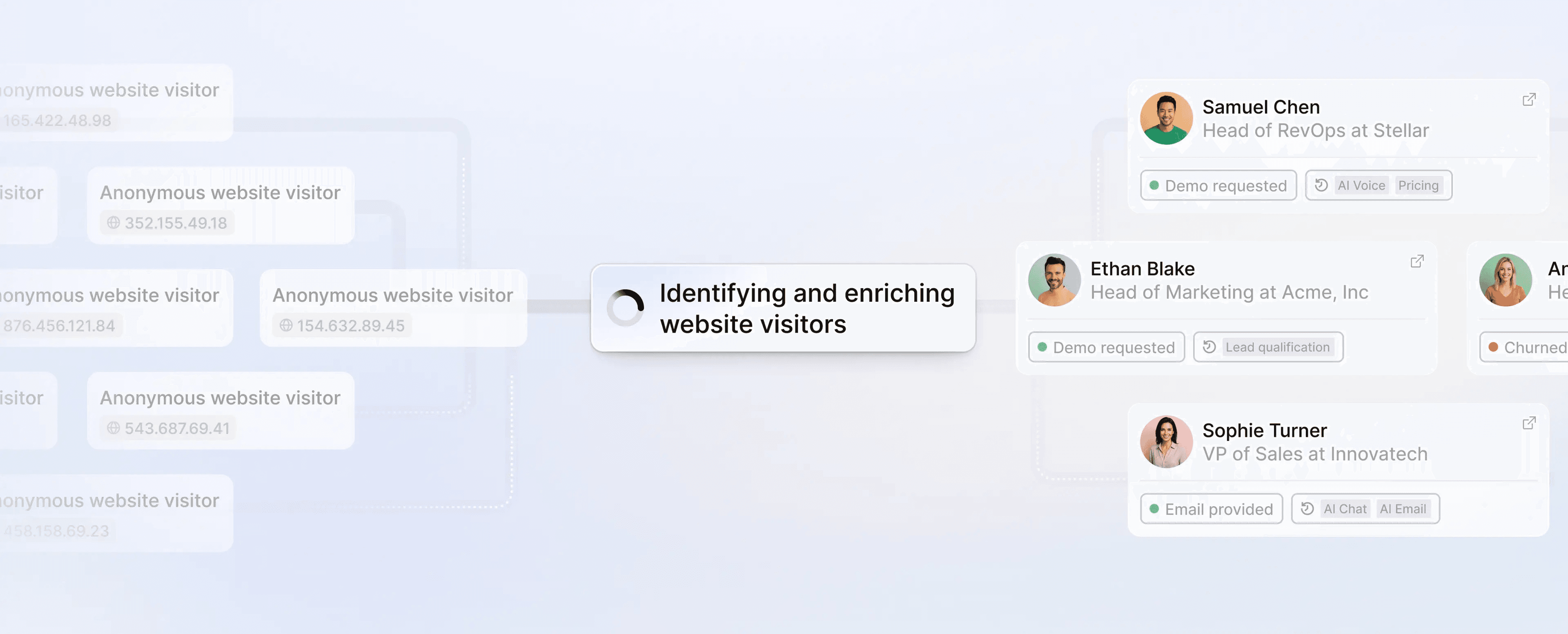
You get the most value when AI lead follow-up solves specific, visible problems in your current process.
The clearest trigger is consistent speed-to-lead failure. If you've defined a five-minute SLA for demo requests and you still see high-intent leads waiting an hour or more, no amount of coaching or dashboard reminders will fix that at scale. AI can reliably handle the first engagement, so your reps are not racing the clock on every form fill.
Other strong signals that you're ready for AI lead follow-up include:
Rising inbound volume across multiple channels. You're capturing demand from web forms, chat, and inbound calls, paid campaigns, marketplaces, and events, but your team can't triage it consistently. AI can unify capture, run initial qualification, and apply routing rules in real time.
Inconsistent follow-up quality. Different reps send very different messages, ask different questions, or follow different cadences. AI lets you standardize the first few touches while still tailoring copy to the prospect's context.
Missed SLAs and unworked leads. You see aged leads in your CRM that were never contacted or only received a single email. AI ensures every inbound hand-raiser gets a timely, relevant response instead of disappearing into a queue.
SDR bandwidth constraints. Your team spends a large share of time on basic triage, scheduling, and data entry. AI can take on those repeatable tasks, so SDRs focus on real discovery and outbound.
More than simple speed problems, these are coordination problems. Integrating lead data, intent signals, qualification rules, and multi-channel outreach into a single, reliable system is hard. Pilots are easy, but system design is hard.
Before you turn on any AI lead follow-up tool, map the current workflow on paper. Define what a "good" response looks like for each entry point, who should own which types of leads, and how you'll measure success. If you can't describe that flow clearly, AI will only automate confusion.
Are your highest-intent leads getting the follow-up they deserve? Spara instantly engages, qualifies, and converts leads to revenue, so SDRs focus on real conversations. See how it works.
How do you set up an AI-driven lead follow-up workflow from capture to meeting booked?
To make AI lead follow-up work in practice, you need more than a smart email response. You're designing a system that captures demand, qualifies it, routes it, and lands a meeting, all with minimal manual effort.
A practical framework includes three stages.
1. Unify lead data, intent signals, and routing rules
Start by making your CRM the source of truth for every inbound touch. Web forms, chat transcripts, demo requests, and event registrations should all sync into one place with consistent field mapping. At a minimum, you'll want accurate lead source, campaign or channel, product or use-case interest, and company-level details so the AI has enough context to personalize outreach.
Next, codify ownership and routing logic. Decide who should own leads by territory, segment, industry, or account tier, and define clear fallbacks for out-of-office or overloaded reps. Those decisions need to live in routing rules, not just in undocumented assumptions.
Finally, define qualification criteria that the AI agent can act on by combining the following:
Firmographic data (company size, industry)
Explicit signals (form answers such as timeline or budget)
Behavioral signals (pages viewed, repeat visits)
Defining qualification criteria helps separate high-intent leads from early-stage interest. Mark which combinations should trigger immediate outreach, which should move to a nurture track, and which should be suppressed.
2. Launch personalized multi-channel engagement workflows
Once your data and routing are in good shape, design engagement workflows that reflect both how someone entered your funnel and what you want them to do next. A demo request deserves different handling than an ebook download, and someone submitting a form during business hours expects a different experience than a weekend visitor.
In many cases, the goal is to qualify the lead and book a meeting. But depending on your motion, it could also mean driving a product-led upsell, guiding a self-serve user to activation, or routing an existing customer toward expansion.
For each entry point, map the sequence of AI touches across email, SMS, or voice. The first message should reference the exact action the person took, acknowledge who they are or which company they work for when you know it, and propose a concrete next step that matches their intent.
As you build these workflows, include:
Contextual personalization. Reference the asset, page, or offer that triggered the lead, and connect it to a likely problem or goal rather than relying on generic thanks-for-your-interest copy.
Timing rules. Adjust cadence by intent. A high-intent form or chat can receive follow-up within a few minutes and a reminder later that day, while a lighter intent can move onto a slower, value-first sequence.
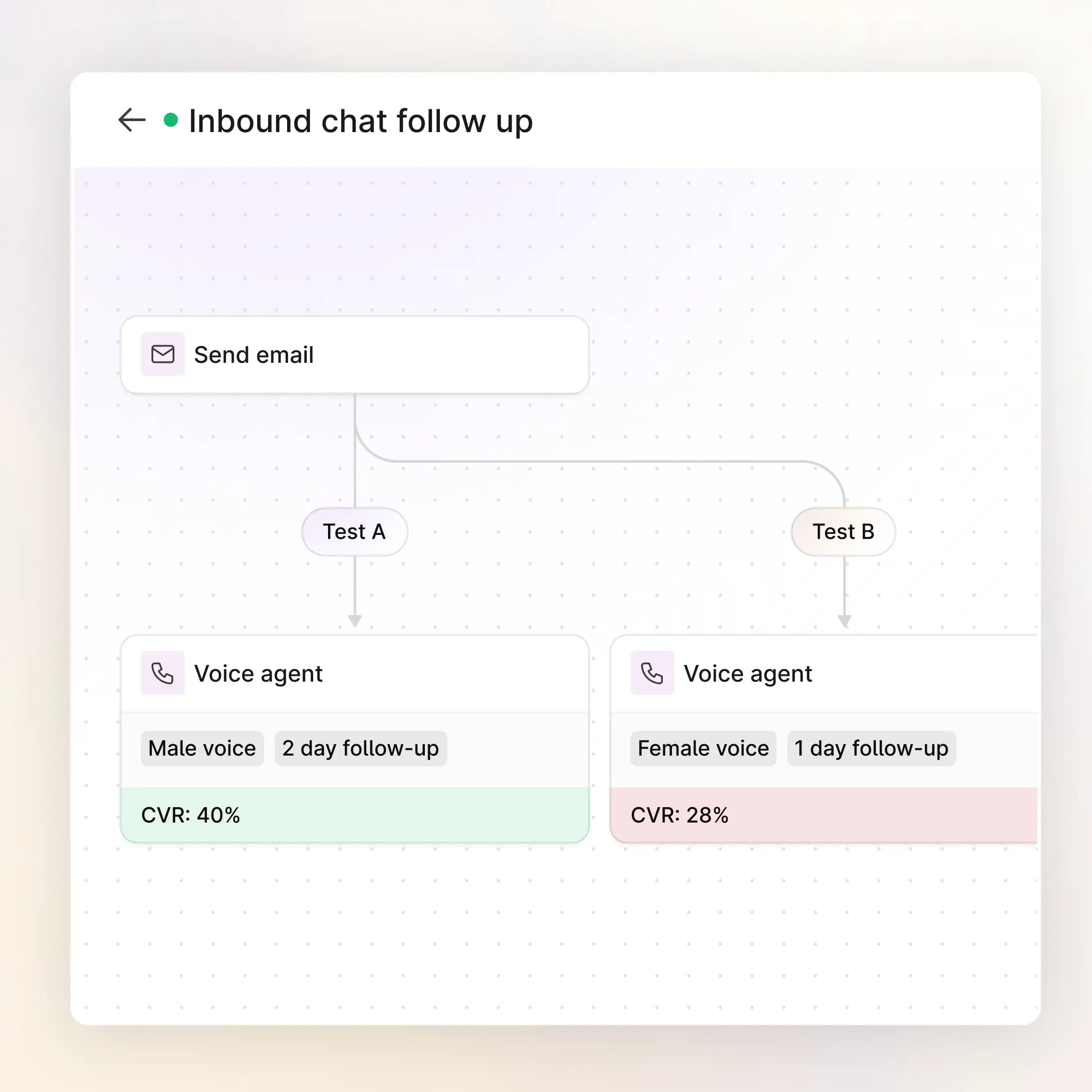
Channel coordination. Use secondary channels as back-up rather than hitting every channel at once. Send an email first, then follow with SMS only if there's no response and you have explicit consent. You should also continuously optimize and A/B test your sequences to improve response rates and conversion over time.
3. Score engagement and trigger human handoffs
Your AI follow-up system should capture behavioral data across channels, including email opens and clicks, chat replies and question depth, form answers, calendar interactions, and voice call outcomes. Use this to build simple engagement bands such as "cold," "engaged," and "hand-off ready" that map to your existing qualification stages.
When a lead reaches the handoff threshold, the system should:
Assign a sales rep in the CRM
Send alerts to the owner
Book a meeting on the rep's calendar
Log all interaction history
That way, sales reps enter conversations with full context.
To protect your SLAs on high-intent moments, add alerts for any handoff that sits untouched beyond your target window. If a prospect requests a call and no one responds in time, the system can escalate the alert or trigger an additional AI message to keep the conversation alive.
Platforms like Spara automate this entire process by instantly engaging visitors, qualifying intent, and routing opportunities, helping teams convert inbound demand without manual delays.
What should AI lead follow-up messages include?
The quality of your AI lead follow-up messages is just as important as response time. Instead of writing every message manually, define clear instructions your AI can follow. Effective prompts usually include a few key elements:
Specific personalization. Instruct the AI to go beyond first name and company. It should reference the guide they downloaded, the feature they asked about, or the problem they mentioned in a free-text field. For example, referencing a request for a security overview signals real attention.
A clear value proposition. Guide the AI to explain why it's reaching out and what's in it for the buyer. If they requested a demo, it should outline what they'll see. If they downloaded a resource, it should offer a quick takeaway rather than repeating what they already have.
A low-friction next step. Instruct the AI to ask for one simple action, such as booking time, replying with a priority, or confirming ownership. Avoid prompting it to ask multiple questions in the first interaction.
A human tone. Define tone guidelines so responses feel natural and concise. Messages should read like they're coming from a strong SDR: clear, direct, and genuinely focused on the buyer's needs.
For example, an AI email after a demo request might say:
"You requested a demo of our platform to help with faster lead routing. I can walk you through how teams like yours qualify inbound leads in under five minutes. Does Tuesday at 10:00 or 2:30 work, or is there a better time?"
That note is personalized, clear, and easy to respond to, even if you generated it automatically.
The advantage of AI is that you can continuously test these elements at scale, experimenting with different value props, subject lines, and CTAs across segments, then double down on what drives replies and booked meetings.
Choosing the right system for AI lead follow-up
AI lead follow-up is less about sending faster emails and more about connecting capture, qualification, routing, and meeting booking into a single motion. The system you choose should support that end-to-end flow, not just one isolated touchpoint.
Most teams already own pieces of this stack. Here's how:
CRM workflows handle structured, rules-based actions like assigning owners and updating fields.
Sales engagement tools excel at outbound sequences and task queues.
Marketing automation platforms are built for longer nurture journeys.
Conversational GTM AI platforms sit alongside these tools to handle real-time inbound engagement and run the dynamic logic needed for live qualification.
In practice, AI lead follow-up typically shows up as instant AI email or text responses to form submissions, chat-based qualification before routing to a rep, AI voice calls for high-intent demo requests, automated follow-up after no-shows, and qualification data written back into your CRM.
The question is how easily your current stack supports these motions without stitching together multiple tools and manual handoffs.
If your biggest bottlenecks include the following issues, AI-native conversational platforms are usually the best fit:
Slow speed-to-lead
Inconsistent follow-up
Multi-channel coordination
Scaling inbound demand
GTM AI platforms are designed to engage inbound leads in real time, ask the right questions for your business, and pass only qualified opportunities with full context to your team.
Spara is built specifically for this inbound use case. It uses AI-native agents to handle lead follow-up from first touch through qualification and conversion, connects directly to your CRM and calendar, and applies your routing and qualification rules so RevOps keeps control, with workflows that continue engaging and converting leads across chat, email, voice, and text throughout the inbound journey.
Speed-to-lead determines whether interest turns into pipeline. See how Spara's AI agents engage, qualify, and follow up across chat, email, voice, and text, so no high-intent lead goes cold. Book a demo.

Lauren ThompsonHead of Marketing, Spara
FAQ
Related posts
View all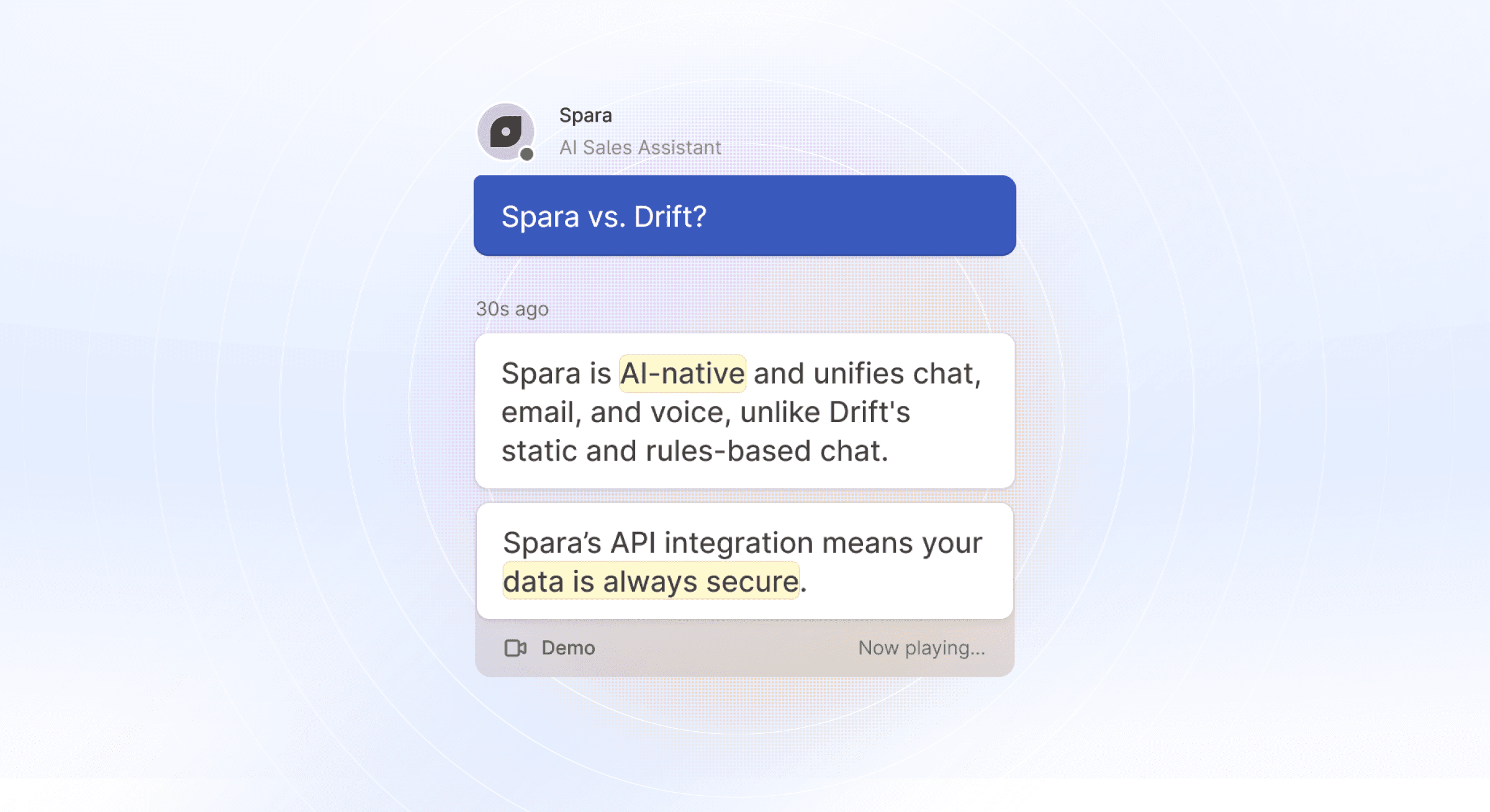
GTM
Top 5 Drift alternatives for better lead conversion
Drift alternatives drive more conversations, leads, and revenue growth. From AI chat to product demos, they personalize every stage of the customer journey.
Sep 14, 2026
•
10 min read

GTM
Databricks' Barry Dauber on why every project should start with impact, not AI
Barry Dauber runs Gen AI go-to-market at Databricks, talking companies down from AI hype every day. Here's his framework for scoping an AI project: name the metric, classify the initiative, and reserve the model for what actually needs one.
Sep 2, 2026
•
4 min read
GTM
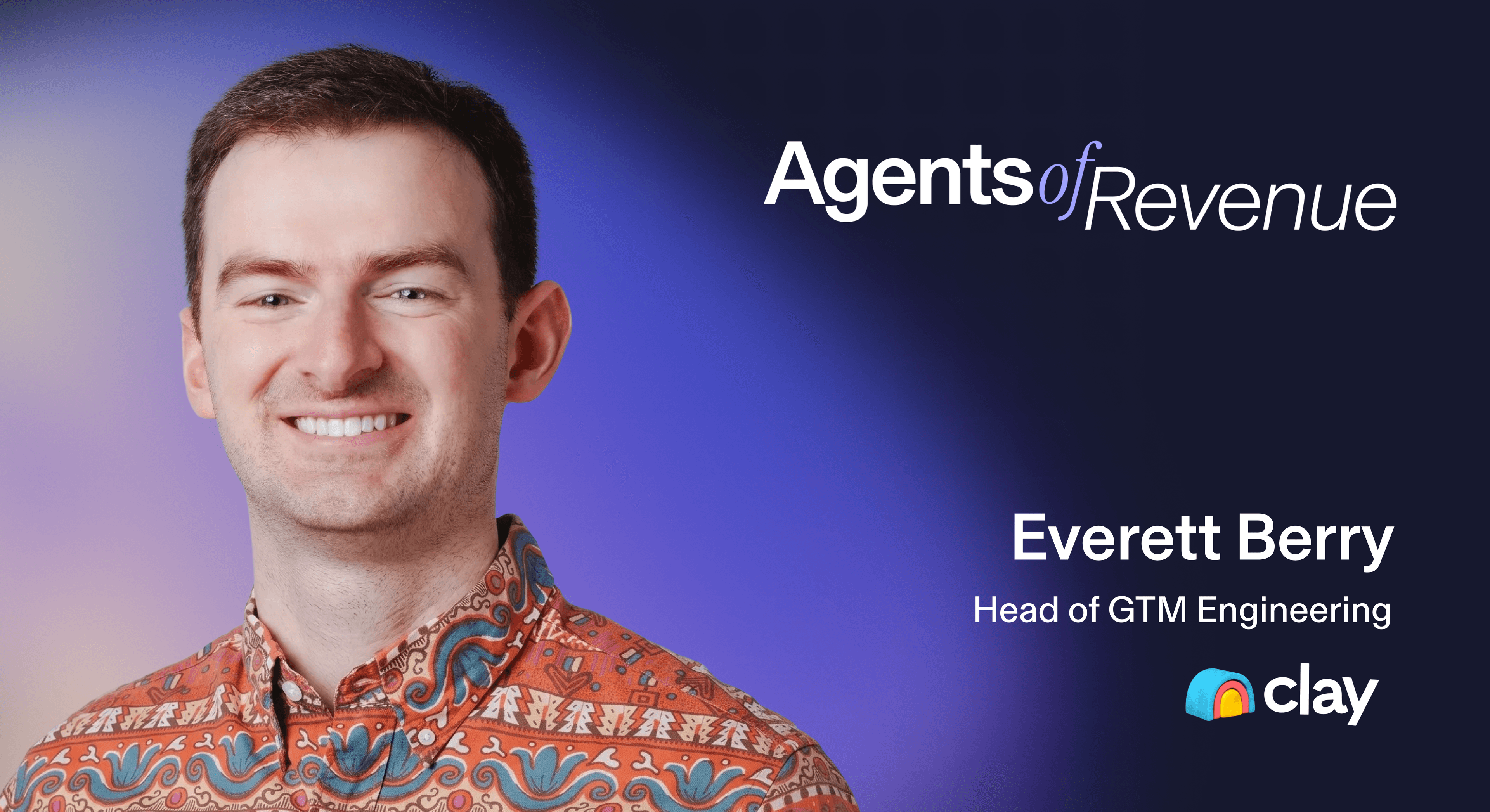
How Clay's Head of GTM Engineering Took Event ROI From 2x to 10x
Everett Berry treats every dinner like a funnel. Here's the six-stage system — golden lists, leader-to-leader invites, engineered seating, automated follow-up — that took Clay's event ROI from 2x to 10x.
Aug 26, 2026
•
5 min read
Sign up for the latest from Spara
Subscribe to get more GTM insights straight to your inbox.