
What it is, what it isn't, when to deploy it, and why the companies that wait will spend years catching up.
Executive summary
Every time the economics of selling software change, a new growth motion appears. Field sales became inside sales when calls got cheaper than flights. Sales-led growth got a sibling when digital products were able to onboard their own users, and we called it product-led growth. Both motions still work.
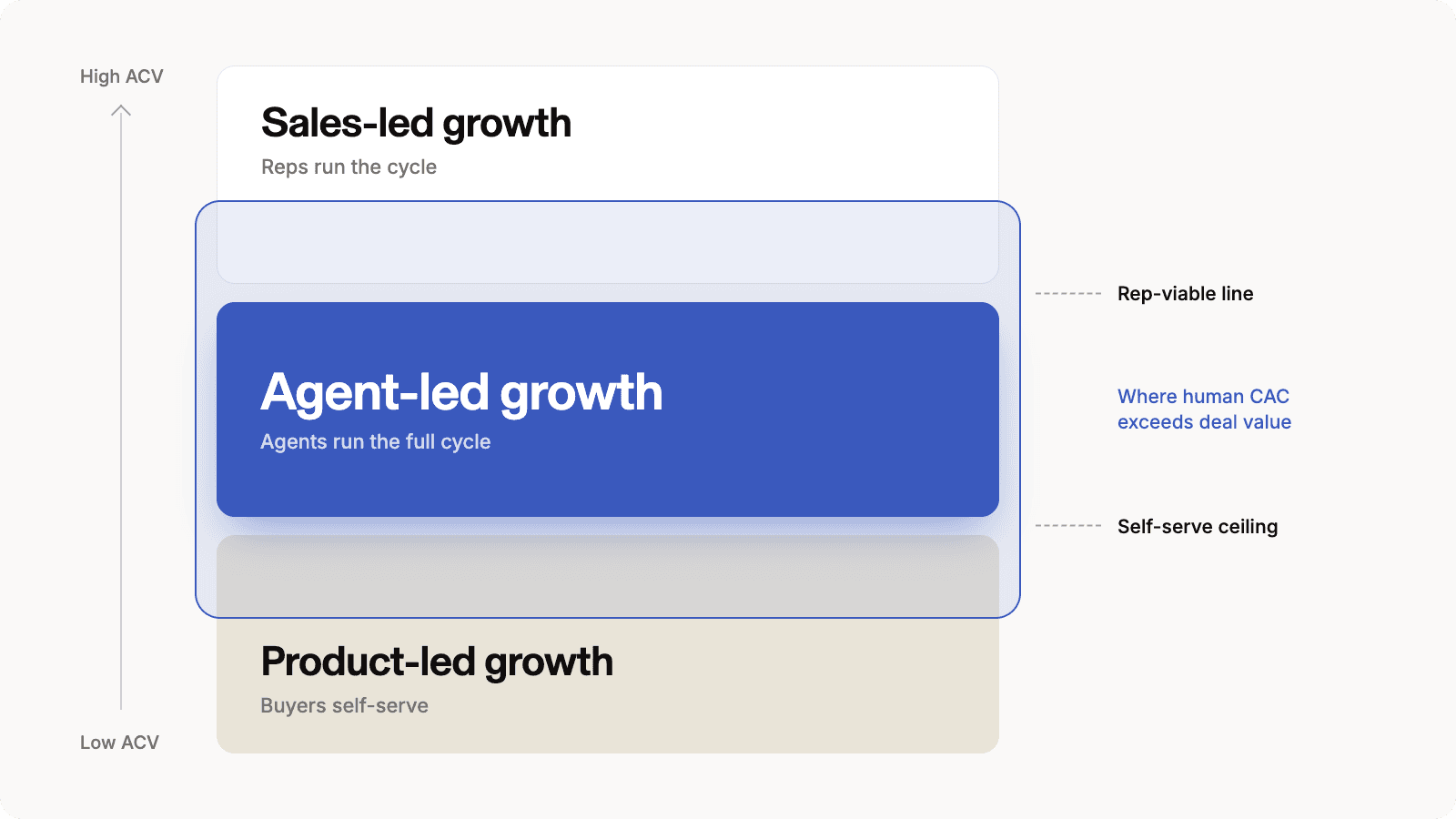
Agent-Led Growth (ALG) is the third motion: AI agents own sales conversations end to end, and humans enter where they actually add value.
This paper makes five arguments:
The human sales motion has a coverage problem that no amount of hiring can fix.
The economics only change when an agent owns the sale end to end. If a human still has to finish the deal, that's agent-assisted selling, and it improves the old motion instead of creating a new one.
The differentiating capability is not speed. It is speed-to-context: an instant response that already knows who the buyer is, what they run, and why they're buying.
ALG fits specific segments. This paper maps where it works and where it doesn't.
Agents improve with every conversation. Organizations can’t enact change that quickly.
Why the current sales model is breaking
Sales and marketing is typically the largest controllable investment on a SaaS company's P&L, and the operating model behind it has barely changed in twenty years: to grow revenue, add people. Pipeline targets go up, headcount must go up. Three cracks in that model have been widening for a decade:
The coverage problem
Write down the motion you actually want your team to run: respond to every qualified visitor instantly, research every account before the first touch, multithread every deal, follow up until there is a real answer, work the mid-market and the long tail with the same care as the top 50.
Now put it against the hours available. It does not fit in anyone's 40-hour week, so teams triage. Top accounts get worked. Everything else gets a nurture email and a prayer. Entire segments sit below coverage economics: each account too small to justify a rep, the segment in aggregate too large to keep ignoring. That revenue currently rounds to zero, not because the demand is missing but because the coverage is.
The buyer moved
Your buyer researches before they ever talk to sales, shows up with specific questions, and expects substantive answers in the moment. What they get instead is a form, a routing rule, and a calendar link for a meeting three days out. Most of them do not wait. The ones who do have usually already talked to someone who answered faster.
The speed-to-lead plateau
The industry's answer for the last decade was speed-to-lead: respond in five minutes, not five hours. It worked. Then everyone did it, and now it differentiates nothing. Fast and generic is still generic. A buyer who gets an instant "Thanks! Someone from our team will reach out" has learned exactly one thing: this company has automation and no one behind the screen.
Two motions and one major gap
The two established motions each solve a real problem. Each has constraints that only a new motion can address: Agent-Led Growth.
Product-led (PLG) | Sales-led (SLG) | Agent-led (ALG) | |
Who sells | The product | Humans | AI agents |
Buyer's first experience | Self-serve trial | Fill out a form, wait for a meeting | A real conversation at any hour |
Capacity constraint | Traffic | Rep hours | None |
Economics | Cheap per user, needs inbound volume | Expensive per conversation, cannot scale down | Sales-quality conversation at software cost |
Where it breaks | Products that need explaining | Segments below coverage economics | Relationship-defined deals |
Works best when | Simple product, end-user buyer | Few, large, complex deals | Complex product, more buyers than reps can cover |
Those two motions leave a gap: products too complex for self-serve, with more interested buyers than sales teams alone can cover. For most B2B software companies past the startup stage, that gap is the majority of their addressable funnel. This is where ALG operates.
What agent-led growth is (and isn't)
Agent-Led Growth is a go-to-market motion in which AI agents own sales conversations end to end: discovery, product questions, objections, qualification, scheduling, demos, follow-through, and in the right segments, the close. Humans join where humans add value: relationships, complex commercial negotiation, navigating a buying committee.
If a human still has to finish the sale, it isn't agent-led. It's agent-assisted. Agent-assisted tools make reps faster. Agent-led motions make whole segments of revenue economical for the first time.
Speed-to-context: the bar that replaced speed-to-lead
What makes agent ownership viable now is not that agents got fast. Automation was always fast. What's new is that an agent can be fast and informed at the same time, which no human has ever managed.
A human rep faces the same tradeoff on every inbound conversation: respond immediately with something generic, or spend an hour assembling context and respond well, late. By the time the good answer is ready, the buyer has moved on.
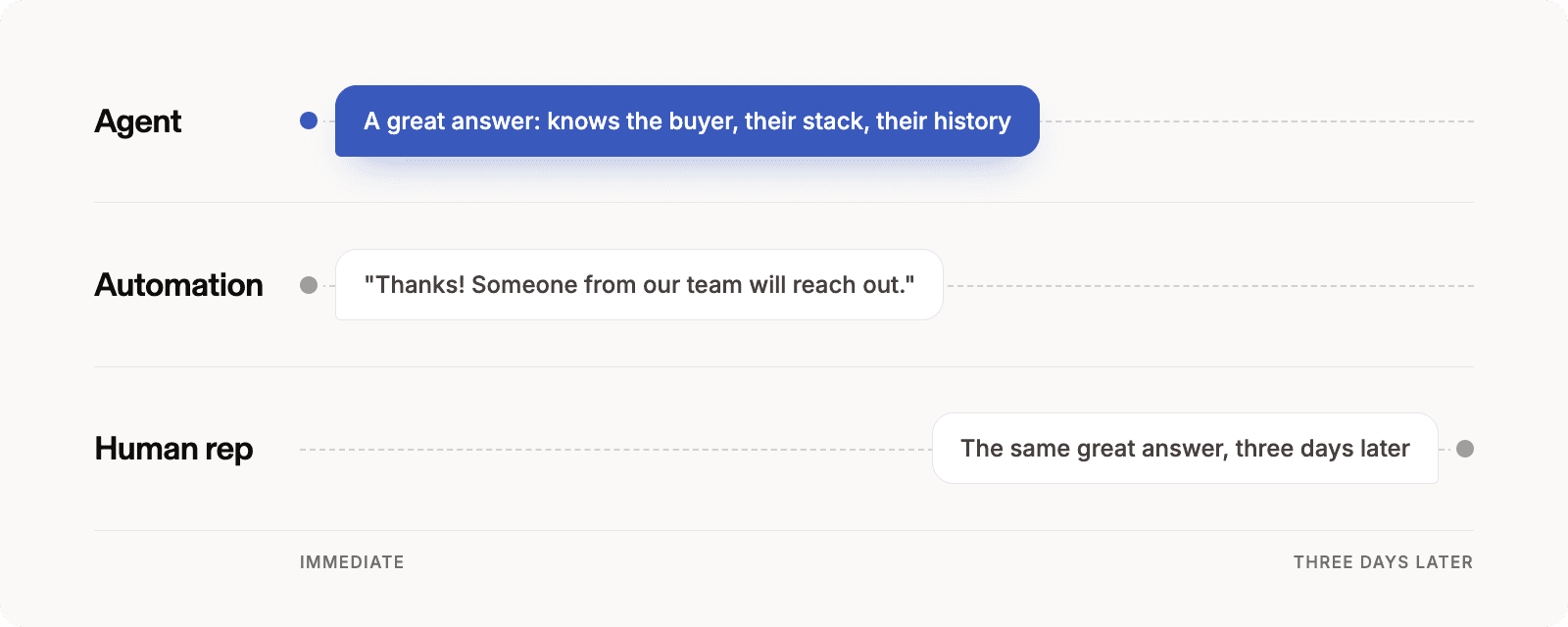
Immediate context means the agent already knows:
Who is here: the individual buyer and their role in the organization
The company: the account, deal stage in the CRM, past conversation history
What they run: the stack, so integration questions get answered
What they have touched: pages, docs, past threads
Where they are in the decision: a first-time researcher and a returning buyer with a security questionnaire deserve different conversations
Speed-to-lead asked "how fast did we respond?" Speed-to-context asks the question buyers actually grade you on: how fast did we say something of value?
Why agents improve faster than organizations
There is a second asymmetry, and it is the strategic one.
Consider how a finding travels through a human sales motion: a rep notices an objection pattern, it surfaces in a QBR, enablement builds a deck, the team half-adopts it, and two quarters later the motion has maybe improved. Now the same finding in an agent-led motion: the pattern shows up in transcripts immediately, the agent adapts, and every conversation from that moment forward runs the improved motion.
That difference compounds. A team that starts a year late isn't a feature behind. It's thousands of conversations behind, and there is no way to buy those back.
The deployment map, including where ALG loses
Where to start: the segment you already gave up on
The best first deployment is not your top of market. It is the segment you have already decided is too expensive for a human seller to cover: the long tail, the down-market inbound, the off-hours and international traffic, the "no rep assigned" queue, and the lists nobody works: dormant leads, closed-lost accounts, event follow-up. That revenue is currently zero. The agent does not have to beat your best rep. It has nobody to beat, which is the easiest bar in sales. Win there, then expand upmarket as trust builds.
Where ALG does not work
Nothing to work with. Agents need someone to talk to: site traffic, a lead database, dormant opportunities. Teams with no audience and no list should fix demand first.
Relationship-defined deals. The eight-figure enterprise motion runs on champions, committees, and trust built across quarters. Humans own those deals. Agents assist them, and pretending otherwise burns credibility.
Thin knowledge, disconnected systems. An agent's context is only as good as what feeds it: your pricing, positioning, and access to the systems that hold buyer context, starting with the CRM. An agent that can't see the stack can't know the buyer.
Organizations that will not grant ownership to agents. If your organization requires a human to approve every reply, you have built expensive agent-assistance and will conclude, correctly, that it did not change your economics. Ownership within guardrails is the only thing that allows the motion to work.
No appetite for governance. Agents will occasionally say the wrong thing. Controls determine how much damage a mistake can do: what the agent may discuss, commit to, and escalate. Teams unwilling to run those controls should wait.
We publish this list deliberately. The vendors who claim their agent belongs everywhere are the reason buyers trust none of us.
What it actually takes to run ALG
ALG has requirements, and they are properties of a platform, not features of a tool. This is where most attempts fail. Teams stand up agents inside their existing systems: a chat agent on the website, an outbound AI SDR, a rep's own Claude skill. Each agent has its own memory, its own partial view of the buyer, and no way to learn from the others.
To run ALG, the motion needs one layer underneath every conversation. Here’s how you should evaluate vendors:
One agent across every channel a buyer uses. A buyer is one person no matter where they show up, so an agent with shared memory should handle every conversation.
Ask: if a buyer chats today and calls tomorrow, does the agent remember them?
Identity resolution wired to live engagement. Knowing which account is on your site is only valuable if the agent can act on it while they are still there.
Ask: does visitor identification change the conversation in-session, or show up in a report?
Full context at first touch. The agent should already know everything your company knows about a buyer before it says a word.
Ask: show me a first response to a returning visitor from a known account.
Real ownership mechanics. The agent should finish the work itself instead of queuing it for a human.
Ask: what does the agent complete without a human in the loop, exactly?
Handoffs designed around human value. When a deal needs a person, the rep should arrive knowing everything the agent knows so the buyer never repeats themselves.
Ask: what does the rep see at the moment of handoff?
Governance as a first-class system. You should be able to control exactly what the agent is allowed to say and commit to, and audit what it actually did.
Ask: show me a time your agent went off the rails and what changed because of it.
A learning loop with a short cycle. An improvement discovered this week should show up in every conversation next week.
Ask: what did the agent do differently this month than last month, and why?
Measuring the motion
A new motion needs a new scoreboard. These are the metrics that tell you whether agents are actually carrying deals:
Speed-to-context: how long it takes for an agent to provide a response that reflects who the buyer actually is.
Coverage rate: the share of qualified buyers that get a real conversation, regardless of hour or segment.
Agent-sourced qualified pipeline: pipeline from conversations an agent started, not a human.
Ownership rate: the share of conversations the agent completed to a real outcome (qualified, booked, closed, or correctly disqualified) without a human stepping in.
Agent-closed revenue: revenue from deals the agent carried from first touch to signature.
CAC: blended acquisition cost should fall meaningfully as agents take over segments that used to require rep hours, and keep falling as they take more of the cycle.
Response time, chat volume, and deflection rate are deliberately not on this list. They measure activity, not whether the agent is actually selling.
The first 90 days
Weeks 1–2: pick a starting segment. Choose a segment your reps don't cover today, like the long tail, off-hours traffic, or international leads. Record your current coverage and cost in that segment so you have a baseline to compare against later.
Weeks 2–4: write down what the agent needs to know. Document your pricing, positioning, integrations, security answers, and how you respond to common objections, and connect the agent to your systems. Most deployment problems trace back to skipping this step.
Weeks 3–4: set the ownership rules. Decide what the agent handles on its own, what it escalates, and what it is not allowed to say or commit to. Put these rules in writing before the first conversation.
Weeks 4–12: run it and review weekly. Read transcripts, fix problems as you find them, and give the agent more ownership as results support it.
Day 90: compare results to your baseline. If the numbers hold up, expand to the next segment.
The cost of waiting
Category shifts in go-to-market reward early evidence. The companies that ran the PLG playbook before it had a name spent years harvesting an advantage the followers never fully closed. ALG has the same shape, with a sharper edge: the advantage is accumulated conversation-level learning, and a late start cannot buy it back.
There is one more reason the window matters. The same economics pushing sellers toward agents are pushing buyers toward them too. Procurement teams are beginning to deploy agents that research vendors, compare pricing, and run evaluations. When your buyer's agent initiates the conversation, only an agent can meet it: instantly, in structured detail, at machine speed. ALG is the motion for selling to humans at scale. Agent-to-agent buying is what comes after it.
Companies that treat agentic selling as a set of bolted-on, disconnected features will get incremental gains at best. Companies that run it as a centralized motion, with a segment, a scoreboard, and a learning loop, are the ones who will be poised to win when buying itself goes agentic.
The third motion is here. The only question is how many quarters of learning you give away before you start.
About Spara
Spara is the platform for agent-led growth. GTM teams, from high-growth startups to the Fortune 500, win more revenue by putting AI agents to work across the full sales cycle, while their reps stay focused on the deals that need them.
Spara agents talk directly to buyers to move deals forward, across chat, voice, email, and SMS. They engage and qualify every website visitor, run interactive AI product demos, reactivate dormant leads, follow up after events, and handle customer onboarding.
We're backed by Radical Ventures and Inspired Capital, with participation from XYZ Ventures, FJ Labs, Remarkable Ventures, and strategic angels working at OpenAI, Anthropic, Google, Meta, Databricks, and G2.

David WalkerCo-founder and CEO, Spara
Related posts
View all
GTM
Chili Piper Pricing (2026): Plans, Seats, and Total Cost
Explore Chili Piper pricing, included seats, AI credits, and annual costs. See what affects your total spend and what to confirm before choosing a plan.
Nov 2, 2026
•
7 min read

GTM
Qualified Pricing (2026): Plans, Limits, and Budgeting
Understand Qualified pricing, plan features, and usage limits. Learn what to ask for in a quote and how to compare the full cost with your sales needs.
Nov 2, 2026
•
7 min read
GTM
Qualified Integrations: API, MCP, and Stack Fit
Explore Qualified integrations, API options, and MCP capabilities. See supported tools, access requirements, and how to assess fit for your GTM stack.
Nov 2, 2026
•
5 min read
Sign up for the latest from Spara
Subscribe to get more GTM insights straight to your inbox.