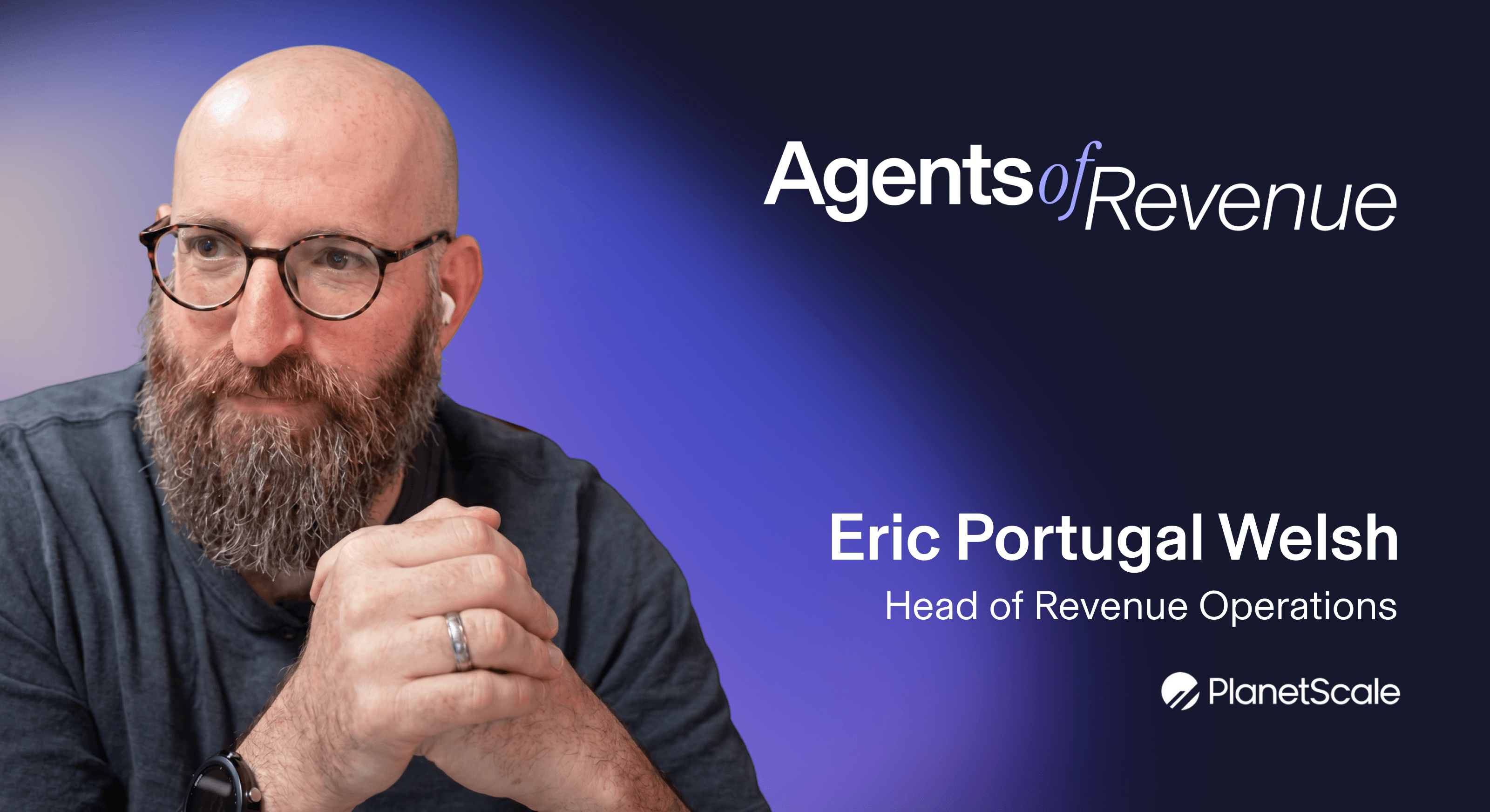

David Walker sits down with Eric Portugal Welsh, Head of Revenue Operations at PlanetScale, about what it means to be revenue obsessed
A lot of revenue teams are making the same mistake right now. They’re still thinking in 20% improvement increments when it comes to AI solutions. That used to work, but today it often just leads to AI-ifying an old process.
The teams getting real results from AI right now are the ones adopting the 5x rule. They’re setting the bar for new efforts at step-function improvement. They’re questioning how something should be done, not just how to add AI to how it’s always been done.
At Spara, that looks like: I don't just want a better AI chatbot, I want to move top-of-funnel conversion, and I want to move it big. Show me what you've got. We tell our customers to start with the impact and the problem. Then work back to the solution.
I recently sat down with Eric Portugal Welsh. He spent his career joining companies at inflection points and building the RevOps function before anyone else thinks to ask for it. Before PlanetScale he ran RevOps at Deputy, a global workforce management platform operating across 100 countries, where he scaled operations through a $100M ARR growth phase. He gravitates toward the hard problems most teams defer, which is exactly why I wanted to talk to him. We spoke about 5x thinking, the unsexy side of AI, and even a little about feeling old. Here's what Eric told me:
Fix The Foundation
Eric came into PlanetScale in December as a one-person RevOps team, with no Salesforce structure, no routing logic, and no visibility into how a lead moved from form fill to opportunity. Leads were triaged in Zendesk, and everything important lived in someone’s head.
His first move was to define the process rather than find a new tool. What should happen when a lead comes in? Where does it go? Who owns it? When does an opportunity get created? None of that had a clear answer, so he made it clear before he wrote a single line of automation. As he put it, he wanted to make sure the unsexy work of revenue got done and got done well, because things don’t become issues downstream when you get the foundation right.
“I want to make sure the unsexy work of revenue gets done and gets done well. Things don’t become issues downstream if you get the foundation right.”

Eric Portugal WelshHead of Revenue Operations, PlanetScale
Most teams skip this part, which is why so many AI rollouts disappoint. The foundation work isn’t glamorous, but it’s what determines whether the AI layer is worth anything.
The 5x Question
Eric’s filter for every new tool and process is a single question: will this 5x the person I’m trying to support? Not 20% better, not 50% better, but five times. If the answer isn’t clearly yes, he doesn’t build it.
He ran Salesforce through that filter and it failed. His take: Salesforce doesn’t multiply you by five, it divides you. The tool that actually hit the bar was Sweep, which let him iterate on Salesforce automation at a pace that would have been impossible natively. The process design took weeks of alignment, but the actual build took two days.
“In the current day of AI, it’s really easy to try to over-engineer everything. Thinking simple is best. Simple to execute, easy to track, auditable.”
The build took two days because the thinking took weeks. That's the order that matters, and it's the one most teams get backwards. Before you look to new technology, first audit your strategy and assumptions.
The Results
Four months in, PlanetScale went from roughly 70% confidence in lead visibility to 95%. Eric built a Claude artifact connected to Salesforce that pulls the current status of every lead and how long each one has been sitting there. What used to require a Salesforce admin and a full week of setup now takes an afternoon.
“If the CEO asks what happened to this lead, he’s not going to ask that again. Because it’s not going to get there. And if it does, I’ll know exactly what happened immediately.”
That last line is the whole point. The goal isn't a dashboard. It's never having to answer that question in the first place. AI is moving us toward a world where questions get answered before they're asked and outcomes happen without someone having to chase them down. The teams still running the same GTM playbook they were running three years ago aren't just falling behind, they're solving the wrong problem entirely.
One More Thing
At the end of our conversation, Eric and I ended up somewhere I didn't expect. We started talking about what all of this means for the next generation of revenue operators.
AI is now doing the entry-level work in RevOps, the manual data cleanup, the routing logic, the spreadsheets that never should have existed. That work was unglamorous, but it was also the training ground, and it's how people learned to actually think about revenue systems. Eric put it plainly:
"We're going to miss out on the journeyman component. When you start in RevOps, you start by doing everything manually. You learn the trade. We don't need anybody to do that anymore."
That one stuck with me. There's an entire generation of revenue operators who learned the function the hard way, cleaning data manually, building routing logic from scratch, running things out of spreadsheets that never should have existed. That pain was also the education. I'm not sure what today's version of that looks like, and I think about it more than I probably should.
But in the meantime, the 5x potential is real. The operators who do the foundational work first are the ones who will get there. The infrastructure creates the conditions for AI to actually multiply you.

David WalkerCo-founder and CEO, Spara
Related posts
View all
GTM
Drift sunset 2026: timeline, impact, and next steps
Salesloft retires Drift on January 31, 2027. See what stops working, when unexported data is deleted, and how to plan your move.
Oct 16, 2026
•
8 min read
GTM
Drift review 2026: what it did, where it fell short, and what to use instead
Drift is being retired on January 31, 2027. What it did well, what reviewers said, and what to look for in its replacement.
Oct 16, 2026
•
10 min read

GTM
Drift pricing in 2026: plans, costs, and what to budget now
Drift's last public price was $2,500 a month for Premium, billed annually. See what each plan included, what the sunset changes, and what to budget now.
Oct 16, 2026
•
6 min read
Sign up for the latest from Spara
Subscribe to get more GTM insights straight to your inbox.