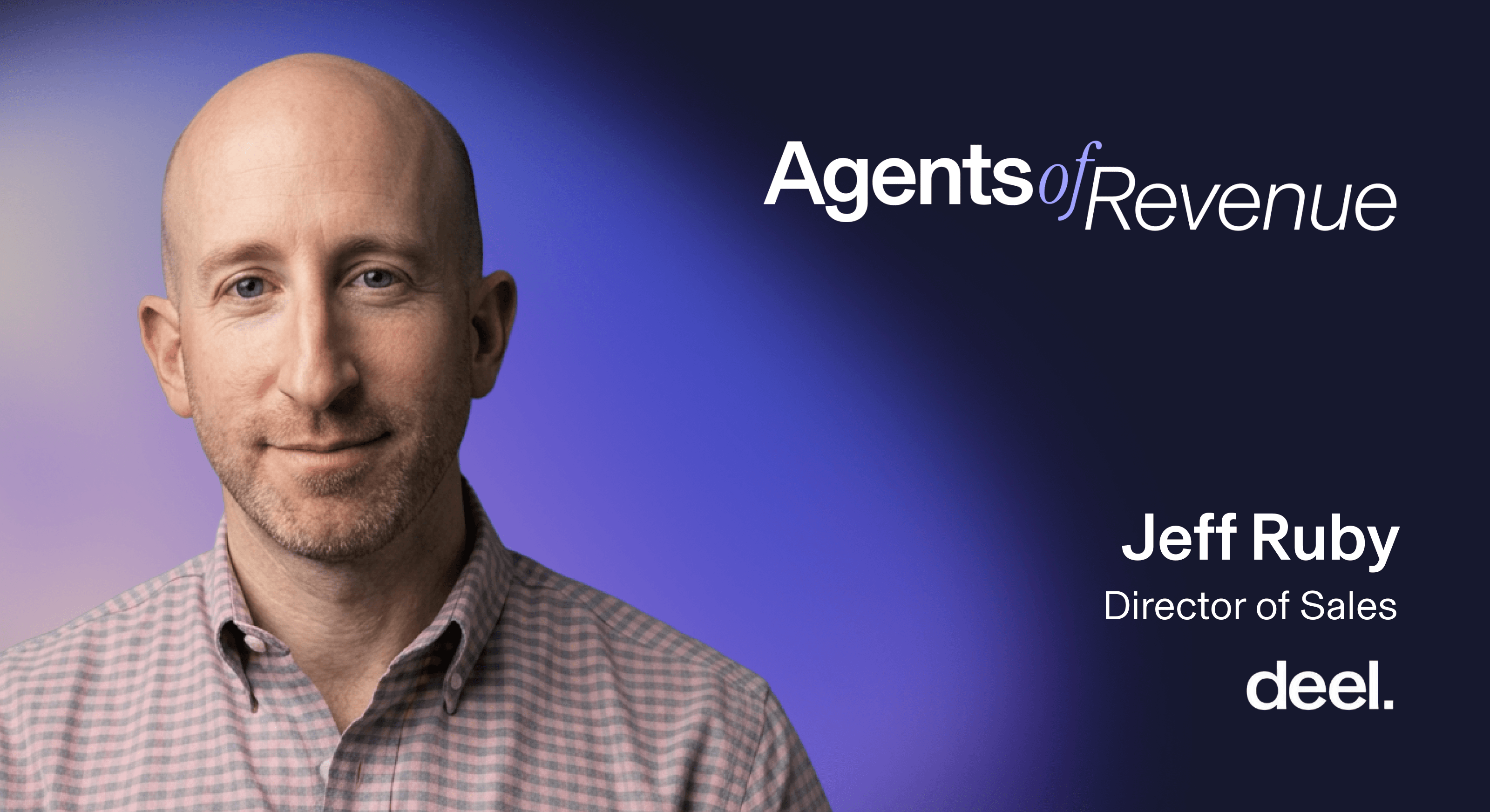

David Walker sits down with Jeff Ruby, Director of Sales at Deel, about what it means to be revenue obsessed
A lot of revenue leaders confuse the size of the goal with the size of the intervention. The number on the board is big, so most leaders assume that move has to be big, which usually means re-assigning territories, restructuring segments, or running a retro on why last quarter slipped. Most leadership cultures have an assumption baked in that the action has to feel proportional to the ambition, or it doesn't feel like leadership.
I recently sat down with Jeff Ruby, Director of Sales at Deel. He has spent more than 15 years in SaaS sales. He spent nearly a decade at LinkedIn rising from Account Executive to Regional Sales Leader, and a stint leading sales at Hopin through its acquisition by RingCentral. Jeff is genuinely revenue obsessed, and his read on this is different from most. We talked about how he doubled the pipeline without a reorg, how he broke an $8 million target down into ten activities a day, and what he thinks happens to the AE role next.
Small changes, big numbers
Jeff walked into Deel's mid-market segment as the first director of sales the org had ever had. The team was already performing, and he resisted the pull toward sweeping change. He sat with the data first.
When he looked at the pipeline numbers, the math was simpler than he expected. The team was generating roughly $93 million in outbound pipeline per year, and the activity volume behind that number was not extreme. They were not running at capacity. They were running at a pace that, with a small push, could produce a meaningfully different outcome. Jeff wasn't overly concerned with what those touches were. An email, a call, a LinkedIn message, whatever each rep was already good at. The volume was the point, not the channel.
If close rates held, those additional ten touches a day would lead to $8 million in additional ARR. He walked into the room with the big number, put it on the first slide, and let it land. Then he put up the next slide: ten activities a day. Your mouth starts to water at $8 million, he told me, and then you show them how small the ask actually is.
“I'm a big fan of small changes for big impact. If you make a big, drastic change, it can actually stall things.”

Jeff RubyDirector of Sales, Deel
That line takes more discipline to hold than it sounds. When the goal is audacious, the instinct is to match the size of the intervention to the size of the ambition. Jeff's read was that the team had a volume problem, and volume problems respond to small, consistent pressure applied over time. That takes patience most leaders do not have the stomach for.
Volume, then consistency, then refinement
"I've never seen a team or an individual fail if they have more pipeline."
Jeff was singularly focused on one thing: outbound pipeline, because it was the only bucket the team fully controlled. Marketing depends on campaign cycles, SDR pipeline depends on headcount ratios, and partnerships depend on relationships you cannot manufacture. Outbound was where he could actually move the number, so that is where he went to work.
He broke the build into three phases, in order.
Volume: Could the team hit the activity number at all? Ten extra activities per rep per day, if close rates held, was $8 million in additional ARR. The volume goal was not arbitrary or overly ambitious.
Consistency: Could they hit it every day, not just the weeks when energy was high? This is where most teams fall apart, and Jeff knew it, so he built a system around the behavior. Every day he posted who hit their number and who did not. Every week a digest went out with the highlights and the lowlights. Every Monday he dropped a prospecting starter so nobody could claim they did not know where to begin. He told the team upfront he was going to be annoying about it. This phase took almost a year.
Refinement: Jeff brought AI into the equation once the behavior was ingrained. Which activities were working for which rep? Which channels were converting? Where was time being wasted? The dashboard that had been a scoreboard became a diagnostic tool.
The results
2024 closed at $93 million in pipeline. 2025 came in just under $184 million, and they will cross $200 million this year.
Every rep now carries a quarterly pipeline target of roughly $1.5 million, and that KPI has not moved since Jeff put it in place. He tells his team the same thing over and over: every decision we make is to help the company make more revenue, and if the company is making more, you will too.
Jeff is grounded in his revenue obsession. What stays flexible is how each rep gets there. The dashboard he built to drive consistency became a tool for understanding each rep's patterns, which channels were converting, and which account tiers were producing meetings. The team now uses Claude to digest Gong calls into forecasts and run deal reviews, so the hours that used to go into manual review go back into selling.
One more thing
Jeff laid out a theory I think is mostly right. He figures the AE job is about to flip, with operating becoming the bigger part of the role and selling the smaller one. The operators end up being the reps who thrive.
I agree with him, but there's a bigger version of that idea underneath it, and it's the thing I'm most excited about.
For most of the last 15 years, the whole game was getting the buyer to fit our motion. They moved on our process, our timeline, and whatever the sales team could realistically handle. The great reps were the ones who could force a square peg into a round hole and make it look natural. That constraint is finally breaking, because for the first time, companies won't be limited by how many high-quality conversations they can have. We used to slow everyone down to the pace of our slowest buyer, and now we can let the ready ones move as fast as they want.
I notice this in my own behavior more than I'd like to admit. I shop for a lot of software, and if I can't get a real answer in that first interaction, I tend to cross them off the list. Buyers are moving faster than the motions most of us built for them.
Jeff's ten activities a day were a smart way to attack the volume problem. But whether any of it becomes revenue comes down to what happens the moment a buyer raises their hand, and how fast they get a real answer. That's the part most teams still leave to chance, and it's what we're building at Spara, because the buyers worth winning won't wait for the rest of us to catch up.

David WalkerCo-founder and CEO, Spara
Related posts
View all
GTM
Top 5 Drift alternatives for better lead conversion
Drift alternatives drive more conversations, leads, and revenue growth. From AI chat to product demos, they personalize every stage of the customer journey.
Sep 14, 2026
•
10 min read

GTM
Databricks' Barry Dauber on why every project should start with impact, not AI
Barry Dauber runs Gen AI go-to-market at Databricks, talking companies down from AI hype every day. Here's his framework for scoping an AI project: name the metric, classify the initiative, and reserve the model for what actually needs one.
Sep 2, 2026
•
4 min read
GTM
How Clay's Head of GTM Engineering Took Event ROI From 2x to 10x
Everett Berry treats every dinner like a funnel. Here's the six-stage system — golden lists, leader-to-leader invites, engineered seating, automated follow-up — that took Clay's event ROI from 2x to 10x.
Aug 26, 2026
•
5 min read
Sign up for the latest from Spara
Subscribe to get more GTM insights straight to your inbox.