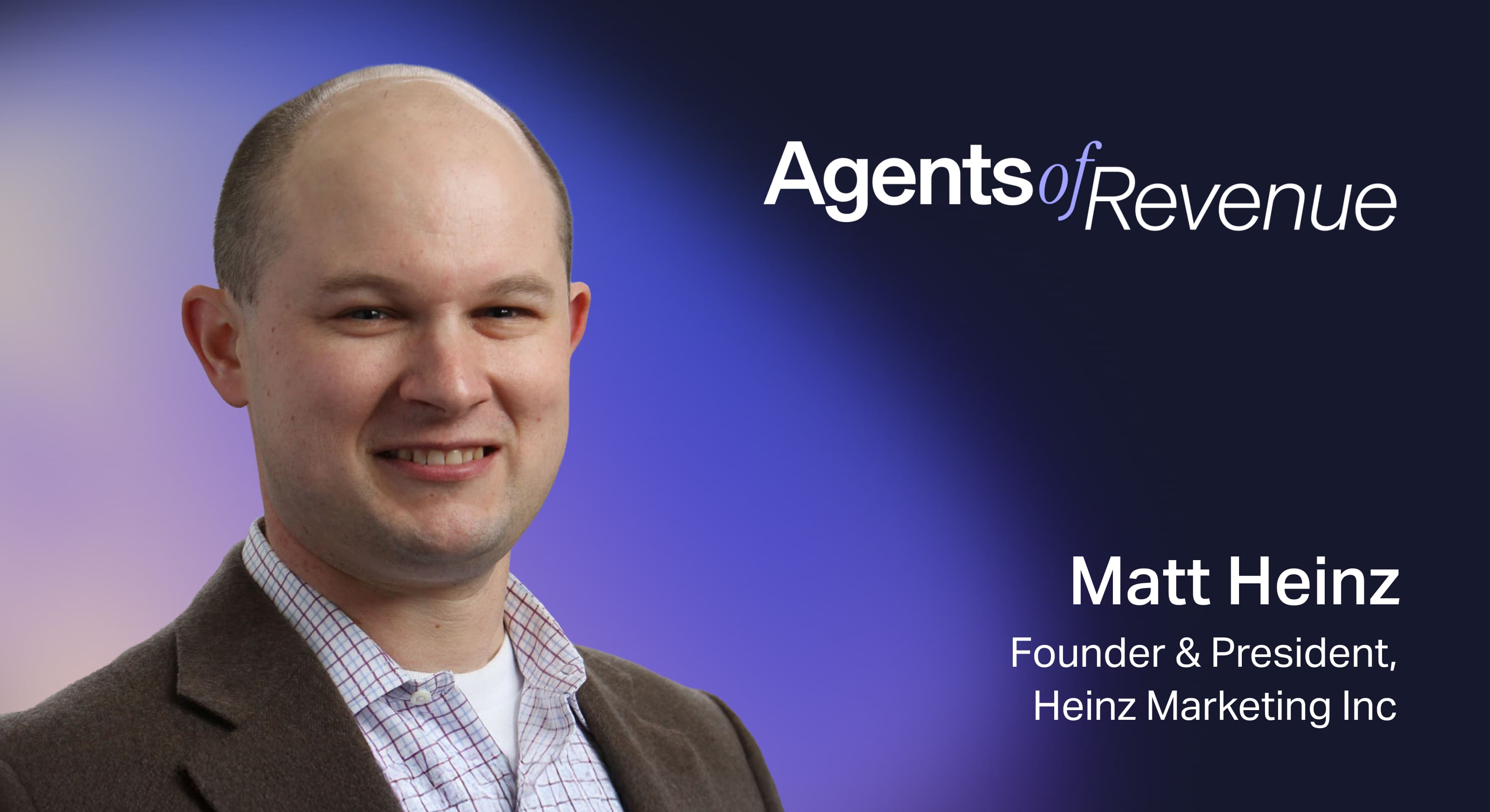

Sales and marketing alignment isn't a new problem. But the cost of getting it wrong keeps going up.
"We continue to see an increase in the complexity of the buying process, which brings an increase in complexity of the selling process," says Matt Heinz, founder and president of Heinz Marketing, who has spent nearly two decades helping B2B companies align their go-to-market teams around pipeline and revenue.
When sales cycles stretch months or quarters, with 10, 15, or 20 stakeholders on the buying side, sales and marketing can't afford to operate independently. But, many teams still do.
"Well-meaning people just cross swords way too often," Matt says, "and it becomes confusing to buyers. It creates an opportunity for a better coordinated competitor to come out and tell a more streamlined, more customer-centric story consistently and win the business."
Matt has been helping companies close this gap for years. Here's his playbook:
1. Build your target market from closed-won patterns, not assumptions
Before you can align sales and marketing, both teams need to agree on who they're selling to. Matt is specific about where that definition should come from.
"Your company already knows who your best customers are," he says. "Your company already knows the difference between the addressable market and the serviceable, obtainable market, which is a subset of the subset of the market you should be selling to."
The addressable market is everyone you could theoretically sell to. The serviceable, obtainable market is the subset where you actually win, and Matt's approach is to define it using data and institutional knowledge rather than assumptions.
"Do the regression analysis to figure out where you’re 3x more likely to close companies with these conditions in place," he says. "So now, how do we go find companies that have those conditions in place to improve the efficacy of our overall funnel?"
Matt tells teams to talk to customer success, talk to sales, and look at closed-won and closed-lost data, augmenting with industry information if needed. The goal is identifying the specific conditions that make a company most likely to have the problem you solve, because as Matt puts it, "most of what you need to build a workable, testable model is inside the organization."
When both teams operate from the same target market definition, everything downstream gets sharper. Campaigns reach the right accounts and reps pursue the right deals.
2. Put your personas in motion
Most teams build personas and leave them static. Matt says they need to be activated in two directions.
Horizontally, across the buying journey. Map where buyers are based on the problems they're experiencing, not just the actions they're taking on your website.
Vertically, across the buying committee. Identify everyone who influences a deal, not just the people who sign the check.
Matt shared an example from a wellness platform where the primary buyers were the head of HR, the benefits director, and the CFO. But the person who often accelerated deals had no purchasing power at all.
"Every company had that one fitness enthusiast who was organizing the 5K fun run," Matt says. "That person cares about the wellness of their colleagues. They don't write a check and they may not have authority to decide, but they’ve got influence."
The takeaway: ask your sales and customer success teams who accelerated past deals, because those patterns repeat. When you find those people and arm them with the right information, deals move faster.
3. Align teams around a shared metric
According to Matt, it’s essential for the full GTM team to be working toward the same success metrics, with a focus on pipeline. Matt's approach is to build a simple mathematical model that connects activity to outcomes.
"Be really clear about what number you're trying to hit and build a mathematical model to get there," Matt says. "This many qualified leads, this many opportunities, this many closed deals with some expected conversion rate and some expected sales cycle lengths."
Without this, marketing and sales end up measuring different things. In fact, Matt recently ran a LinkedIn poll asking marketers their primary success metric for virtual events. Only 33% said pipeline, with the majority saying leads or attendees.
"There is a massive credibility gap when sales feels like they're alone holding the number," Matt says. "And marketing just wants to get more people in the room, whether they're qualified or not."
Matt doesn't argue for ignoring leading indicators. Open rates and attendance still matter, but they matter in context. The metrics closest to revenue are always the ones that determine whether alignment is real.
When both teams operate from the same model, the conversation shifts from "did marketing generate enough leads" to "are we on track to hit the number."
4. Activate marketing across the full funnel
Matt believes that marketing's role shouldn’t stop when a lead is handed to sales.
"That's where I think a marketing organization has a responsibility," Matt says. "All the way to the bottom of the funnel."
He shared an example where a deal that would make or break the quarter was stalling. Five decision makers were involved, four said yes, and one was a soft no. So the marketing team built content targeted at that single person to address their hesitation.
"We were creating content for an audience of one," Matt says, "to help them be confident enough to say ‘yes.’"
When deals stall late in the funnel, marketing should have the tools and the context to help move them forward.
5. Organize the work before you add AI
Once teams are aligned, the question becomes how to execute on it faster. Matt gets a lot of requests from companies that want to implement AI across their go-to-market motion. His first move is always to step back from the technology.
"AI is the outcome. AI is what you leverage," Matt says. "But I still have to understand what problem we're solving."
His approach is to break every process down into jobs to be done, figure out what's inefficient or doesn't scale, and then decide where AI plugs in.
"Even before AI existed, a lot of companies really struggled with their output and their speed to market because they weren't very organized or efficient about how the work got done," he says.
Once the strategy and workflows are defined, AI has a clear role to play.
"It doesn't replace the humans entirely," Matt says. "What it does is free the humans up to do the part that they really want to do."
6. Treat alignment as a culture change, not just a process
Even with the right strategy, workflows, and tools in place, Matt says alignment fails when teams don't address the cultural side.
"You have to address this requires a culture change in your organization," Matt says. "The way go-to-market teams need to operate moving forward is not something a lot of leaders are used to."
Part of the challenge is that everyone on the team carries experience from past organizations where alignment didn't work. That history creates resistance, even when people are well-intentioned. Matt's advice is to get that on the table. Let teams surface what hasn't worked before, then commit to moving forward together.
"It's not just alignment with jazz hands at sales kickoff," Matt says. "It's alignment on a Tuesday morning."
He points to research from Demand Metric that found a direct correlation between sales and marketing alignment and the likelihood of hitting revenue targets. The most interesting part of the data: the scale went from "no alignment" to "ineffective alignment" to "minimal, moderate, and advanced," and results improved at every stage.
"If you try to better align your sales and marketing team and it isn't perfect off the bat, you are still improving your results," Matt says. "Lean into the suck."
What changes when alignment is in place
Matt has seen this playbook produce measurable results across clients, with teams becoming 30 to 40% more efficient without adding headcount.
But the outcome Matt finds most underrated is what happens to the people doing the work.
"When you put better processes in place, and some of that includes the resources like AI agents and tools that rely on AI to be successful, it allows the humans to be far more efficient and effective and satisfied with their job," Matt says.
One client saw their marketing team's employee satisfaction scores jump to the highest in the company after implementing these changes. Matt's explanation: people want to do their jobs well, and when the process actually supports that, they feel it.
Final takeaway
The buying process has gotten more complex, and the teams responsible for revenue need to operate as one unit to keep up, starting with shared definitions, shared metrics, and shared accountability across the funnel.
But foundation alone isn't enough. Once teams are aligned on who to target, how to engage, and what to measure, the next challenge is speed. Buyers don't wait, and the gap between the moment someone raises their hand and the first meaningful response often determines whether you win or a competitor does.
This is where Spara fits in. When sales and marketing have aligned on their ICP and how they qualify buyers, Spara makes that alignment operational, in real time. Our AI platform engages and qualifies inbound buyers against your shared criteria the moment they express interest, across chat, voice, and email, and routes them to sales with the context they need to have a meaningful first conversation, not a cold follow-up days later.
Related posts
View all
GTM
Drift sunset 2026: timeline, impact, and next steps
Salesloft retires Drift on January 31, 2027. See what stops working, when unexported data is deleted, and how to plan your move.
Oct 16, 2026
•
8 min read

GTM
Drift review 2026: what it did, where it fell short, and what to use instead
Drift is being retired on January 31, 2027. What it did well, what reviewers said, and what to look for in its replacement.
Oct 16, 2026
•
10 min read

GTM
Drift pricing in 2026: plans, costs, and what to budget now
Drift's last public price was $2,500 a month for Premium, billed annually. See what each plan included, what the sunset changes, and what to budget now.
Oct 16, 2026
•
6 min read
Sign up for the latest from Spara
Subscribe to get more GTM insights straight to your inbox.