
Five or ten years ago, sales reps spent more time preparing to sell than actually selling. Research was slow. Context lived across a mix of tools. Most first touches began with a rep who knew almost nothing about the account they were calling.
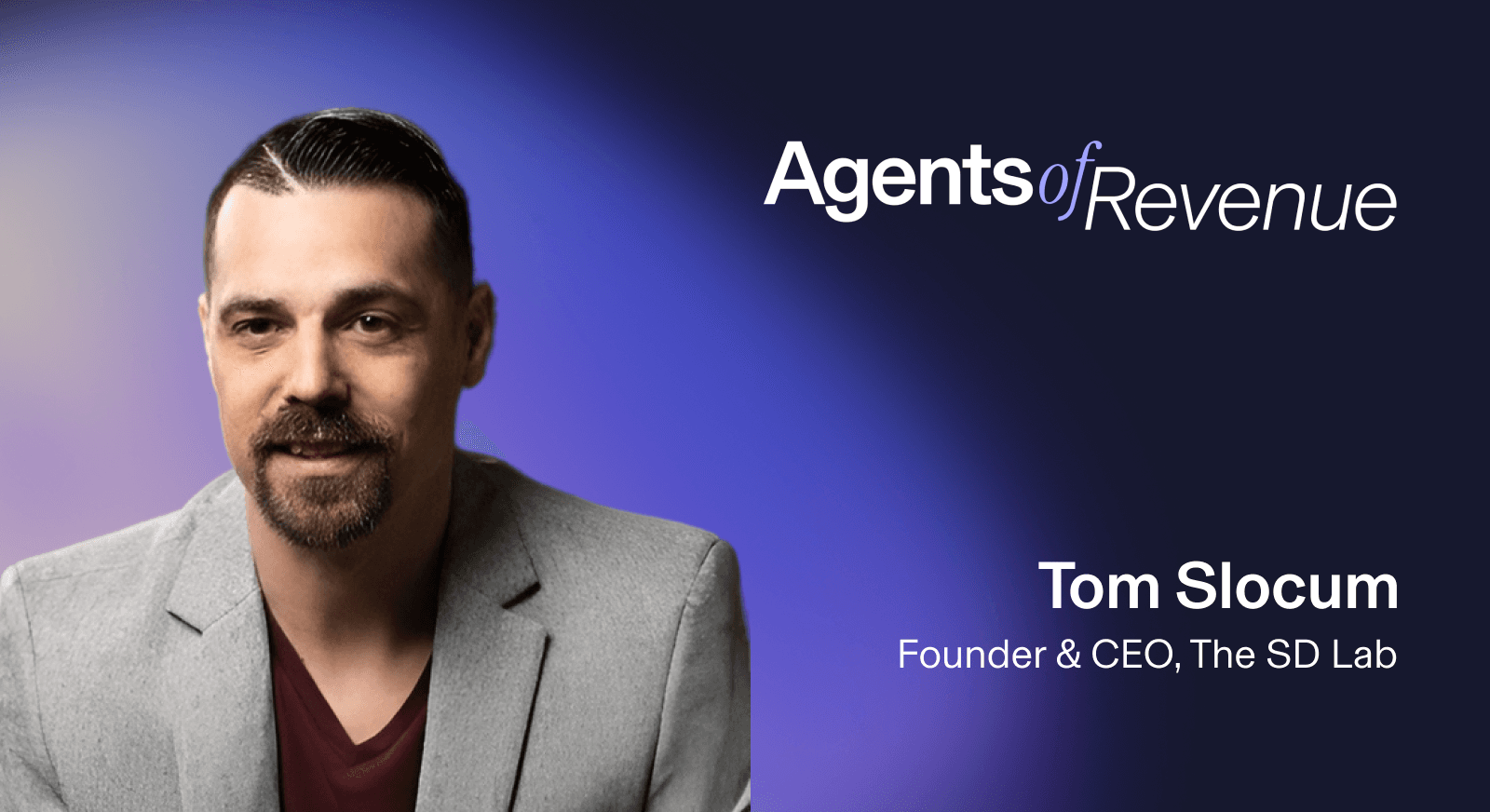
Tom Slocum remembers exactly what that world felt like.
“You didn’t really have much,” Tom says. “You had a name, a number, maybe a form fill. That was it. We were guessing. We didn’t have triggers. We didn’t have intent.”
To figure out something as basic as a company’s tech stack, he would “right-click a website, inspect the code, and hope you could find embedded tools.” Reps made assumptions because they had little choice. Discovery calls were bloated, first touches were generic, and teams missed good opportunities simply because they couldn’t see them.
Many teams still work like this, but today, it’s far from required. What’s changed isn’t just faster research. It’s faster prospect engagement, qualification, routing, and value to the customer.
“With AI, you’re not coming in blind anymore,” Tom says. “You can click a LinkedIn profile or run a prompt and get everything within five seconds. Industry pain, news, tech stack, buying committee, triggers. All of it.”
When context takes seconds instead of minutes, reps can respond while buyers are still in the moment. That combination of fast clarity and fast action is what Tom believes now defines modern revenue performance.
Key takeaways
What is a zero-leak inbound funnel? A zero-leak inbound funnel is a system that combines instant AI-driven context, automated lead scoring, and pre-built outreach narratives so every qualified inbound lead reaches a rep with full context and no delay.
The funnel runs in three acts: an automated investigation that builds context, a lead scoring matrix that filters what reaches reps, and a relevance engine that drafts the outreach.
After scoring was introduced, only 60% of inbound reached reps, and 40% of those became customers.
Who is Tom Slocum?
Tom Slocum is the founder of The SD Lab and has spent nineteen years coaching SDR teams through every major shift in outbound while also helping teams modernize their inbound motion. He specializes in human plus AI workflows that cut prep time and sharpen message quality. His views on context and speed come from building inbound systems for teams like the one described below.
What changed in B2B sales context?
Tom spent much of his early career teaching reps how to do just enough research to avoid sounding generic. The “three-by-three” method he taught was built for the old environment. Three minutes to find three meaningful insights so reps could stop getting lost in endless prep.
“I used to preach the three-by-three because people would over research,” Tom says. “Now you can run a quick prompt or use a GTM agent and your context is filled in seconds.”
Depth changed as much as speed. Reps now receive context that used to be impossible to gather fast enough to act on.
“We didn’t know the inner workings of an organization,” Tom says. “We had no idea about buying committees. Triggers didn’t exist. Unless it was on Google, you had nothing. And who had thirty minutes to read a 10-K?”
The context reps can receive near instantaneously today isn’t trivial. It includes:
Industry pain and market shifts
Recent news and hiring activity
Technical footprint
Buying committee roles
Behavioral signals
CRM history and past conversations
“The rep hasn’t even touched the lead yet,” Tom says, “and they already know exactly why they’re calling.”
The first touch improves, but the bigger gain is the research burden disappearing. That was the heaviest productivity tax in SDR work.
“When AI gives you the context upfront, productivity skyrockets,” Tom says. “Reps don’t get paralyzed anymore.”
Why does speed-to-lead define modern pipeline?
If instant context has changed how reps prepare, speed-to-lead has changed how buyers expect teams to respond.
“When I started, getting back to someone within twenty-four hours was considered fast,” Tom says. “Now, if you are not responding within fifteen minutes, you are losing deals you didn’t even know you were in.”
Teams can only meet that expected experience with the right tools and process to deliver it. But Tom still sees the same failure pattern in most organizations he works with.
“A lot of inbound flows are slow,” he says. “Leads get dumped into buckets. Reps don’t get notifications. Routing is manual. And if RevOps does not push something through, it just sits there.”
Every delay kills momentum. Buyers move on, competitors reach out faster, or the buyer simply loses interest.
Tom’s point is clear. When context is instant, slow response becomes a process issue, not a rep issue. And solving that process issue is the foundation of his Zero-Leak Inbound Funnel.
Inside the Zero-Leak Inbound Funnel
One of Tom’s recent engagements involved a 25-person SDR team with an inbound system that was slow, clunky, and heavily dependent on manual routing. Reps had almost no context before making a call. They didn’t know who the buyer was, what mattered, or even why the person reached out.
To fix that, Tom helped the team implement a set of AI-powered workflows that gather context, score leads, and prepare outreach automatically. The result was what he now calls the Zero-Leak Inbound Funnel.
The system is built around two simple principles: instant context and immediate action. And to operationalize those principles, Tom breaks the workflow into three acts, each one eliminating a major bottleneck in the traditional inbound process.
“Inbound should not leak,” Tom says. “Before a rep touches the lead, they should already have the deep dive. Before the lead hits the rep queue, it should be scored. And before outreach happens, the narrative should already be drafted. That’s how you move fast.”
Act 1: The great investigation
The first step is removing the research burden entirely. Historically, reps had to jump across LinkedIn, CRM, search engines, job pages, and even HTML inspection just to form a baseline view.
Tom now helps teams implement an AI-driven “great investigation,” an automated sweep that pulls the exact information a rep would normally spend several minutes hunting down.
“It generates a company deep dive,” Tom says. “Tech stack, job postings, news, buying committee, LinkedIn activity. All of it. And it happens in minutes.”
Tom describes it as a wide scan that happens the moment a lead enters the system. The AI agent collects:
Company-level insights
Decision makers and GTM leadership
Hiring signals
Notable events or triggers
Tech stack
Expansion plans
Recent LinkedIn activity
CRM touches
“For the rep, the context is just there,” Tom says. “Before they pick up the phone, they already know exactly why they are calling.”
Act 2: The lead scoring matrix
The second step is a lead scoring matrix. Tom sees most teams skip this entirely. Everything that comes in is handed directly to reps. The result is low win rates and wasted cycles.
“Everybody thinks an inbound lead must be valuable,” Tom says. “But I have seen teams pass 100% of inbound to reps and close only thirty percent.”
Tom helped the previously mentioned team build an AI scoring agent that weighs each piece of context from the investigation layer.
“This is where you need a shield,” Tom says. “The scoring agent weighs every signal and then ranks the accounts so reps focus where it matters.”
The scoring matrix looks at:
Fit: company size, industry, team, ICP alignment
Timing: recent triggers, hiring signals, news
Intent: website behavior, engagement strength
The result is a single, unified score that tells the team what deserves immediate action.
“When we implemented this, only 60% of inbound made it through,” Tom says. “But 40% of those became customers.”
The goal is simple. Make sure reps spend their time where they have the highest chance of winning.
Act 3: The relevance engine
The final step prepares reps for high-quality outreach as soon as the lead enters their queue.
“For each high-value contact, it analyzes their LinkedIn activity and combines it with the company signals,” Tom says. “Then it generates talking points, an opener, and a draft email.”
This is what Tom deployed inside the client’s 12-week program: a lightweight AI agent that turns the deep-dive context and the score into a ready-to-use narrative.
The relevance engine prepares:
Why now: context + triggers + what’s happening internally
How to start: opener + angles
What to send: draft email/talk track
Once the engine runs, everything the rep needs is centralized in one view. The rep simply picks up the phone, sends the email, or starts a sequence.
“It runs in minutes,” Tom says. “And it removes every point where things used to fall through the cracks.”
Final takeaway
Tom’s approach solves two long-standing issues in revenue teams. A lack of context and a lack of speed.
“Speed without relevance is noise,” Tom says. “Relevance without speed is wasted. You need both.”
The Zero-Leak Inbound Funnel brings the two together. Reps no longer begin blind. Leads no longer sit untouched. Buyers no longer go unanswered.
This is the modern GTM standard: instant context, fast and intelligent response, and reps who arrive prepared.
It is the operating model Tom teaches, and one that aligns with how Spara believes the next generation of revenue teams will work: fast, informed, and ready when the buyer is.
FAQs
Related posts
View all
GTM
Jon Harper on the four traps that stall complex deals before the proposal
Jon Harper's PEO reps closed 35 to 45% of the deals they proposed, but only 9% of first meetings ever got that far. The BizBenchmark founder breaks down the four traps that stall complex deals, and what to do instead.
Oct 9, 2026
•
4 min read

GTM
How Clay Built a Partner Motion That Drives 20% of Revenue
Nancy Mottice joined Clay as it moved from product-led growth into enterprise. Since then, partner-sourced revenue is up 16x and drives 20% of the business. Here are the six steps she took to get there.
Oct 9, 2026
•
7 min read
GTM
Pendo's Kobi Stok on turning product usage into upsell pipeline
Teams automated inbound years ago, but upsell still depends on a rep hearing a customer bring it up. Kobi Stok, SVP of Product at Pendo, walks through six moves to turn product usage into pipeline.
Oct 9, 2026
•
6 min read
Sign up for the latest from Spara
Subscribe to get more GTM insights straight to your inbox.